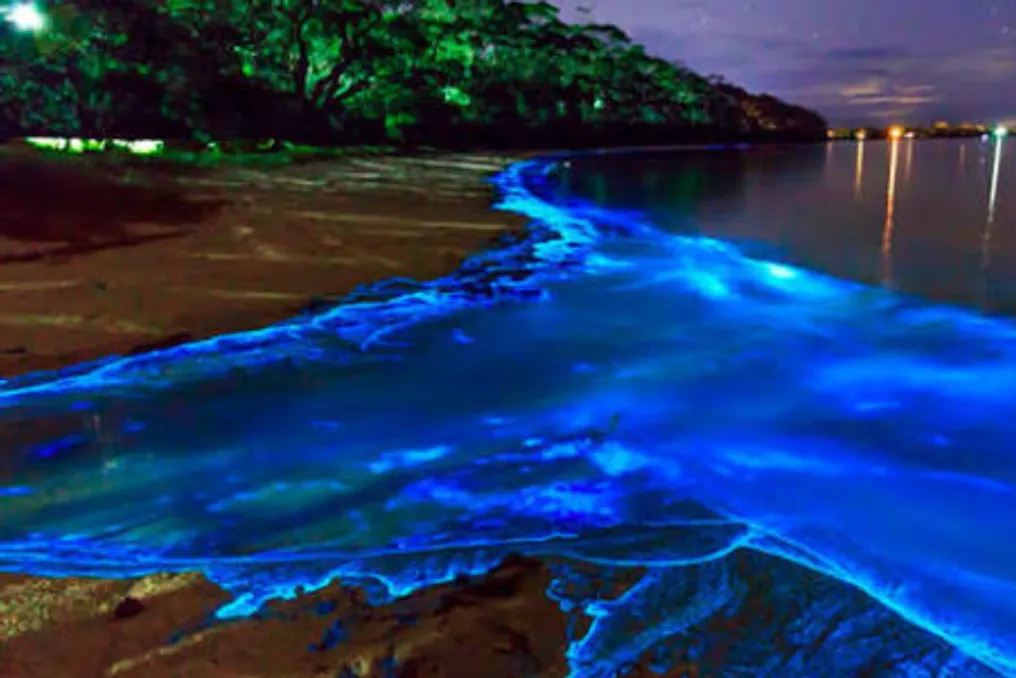
Most people are familiar with the illuminated beaches of India, but there are also forest areas that glow in the dark. These luminous landscapes resemble the fantastic scenery from the movie 'Avatar,' where the forest floor shimmers with an unearthly green light.
In the Western Ghats of India, hidden beneath the dense canopy of trees, decaying logs, trunks, and fallen branches can emit a soft emerald glow after sunset. This represents one of the least known natural phenomena in the country. Information about India's bioluminescent ecosystems covers scientific foundations and also indicates the places and times when this phenomenon can be observed.
Unlike the bioluminescent beaches of India, these glowing forests rarely feature in tourist routes. Their light is subtle, seasonal, and visible only under specific conditions.
Scientific Explanation of the Glow
This phenomenon is called bioluminescence—the ability of living organisms to generate light through a natural chemical reaction. In the Indian forests, this glow originates from bioluminescent fungi that colonize dead and decaying wood during the monsoon season. High humidity, constant rainfall, and damp forest floors create an ideal environment for these fungi to spread across fallen trunks, branches, and stumps.
The light is generated by a reaction involving the molecule luciferin, an enzyme known as luciferase, and oxygen. Instead of releasing energy as heat, this reaction produces visible green light. Natural researchers sometimes refer to this phenomenon as 'foxfire' or 'fairy fire.' Unlike fluorescent materials that require an external light source, these fungi continuously produce their own light through a biochemical process. Scientists have identified several species of bioluminescent fungi, many belonging to the genus Mycena. It is believed that numerous such glowing fungal species inhabit India, although researchers continue to document and identify them.
7 Places in India Where Nature Glows After Dark
1. Bhimashankar Sanctuary, Maharashtra
If there is one place most closely associated with the glowing forests of India, it is Bhimashankar. Located in the northern part of the Western Ghats, the sanctuary receives abundant monsoon rains, creating ideal conditions for bioluminescent fungi. On moonless nights from July to September, patches of decaying wood can emit a faint green glow under the evergreen canopy. Wildlife photographers often advise waiting quietly in complete darkness for several minutes before the glow becomes visible.
Best Time: July – September
2. Chorla Ghat (Goa – Karnataka – Maharashtra border)
Chorla Ghat, one of the wettest regions of the Western Ghats, is known for its misty forests and exceptional biodiversity. During the monsoons, moist fallen logs scattered across the forest floor serve as an ideal habitat for glowing fungi. Although seeing them cannot be guaranteed, this region has become a favorite spot for naturalists hoping to see an Indian analogue to the Avatar forest.
Best Time: July – September
3. Agumbe, Karnataka
Agumbe, also known as the 'Cherrapunji of South India,' is famous for its tropical forests, royal cobras, and impressive biodiversity. The same heavy rains that sustain these ecosystems also create favorable conditions for light-emitting fungi.
Best Time: June – September
4. Silent Valley National Park, Kerala
Silent Valley is one of the last untouched tracts of tropical forest in India and provides the cool, humid conditions necessary for glowing fungi. Although this phenomenon is not advertised as a tourist attraction, researchers have documented light-emitting fungal species in the Western Ghats ecosystem, including forests like Silent Valley, which have much decaying wood.
Best Time: Monsoon Season
5. Bangaram Island, Lakshadweep
India's most famous glowing beach owes its brilliance to microscopic marine plankton known as dinoflagellates. When waves disturb the water, the organisms produce bright blue flashes, making the sea appear internally lit. Best time: October – March, depending on plankton blooms.
6. Mattu Beach, Karnataka
Near Udupi, Mattu Beach occasionally displays an impressive bloom of bioluminescent plankton after the monsoon. Under favorable sea conditions, gentle waves paint the coastline with streaks of electric blue. Best time: September – December.
7. Bioluminescent Beaches of Goa
Goa is famous for its sunsets, but on certain nights, beaches such as Betalbatim, Colva, and some quieter stretches reveal another spectacle. Seasonal blooms of marine plankton can cause waves to glow blue after dark, although this phenomenon remains unpredictable. Best time: Post-monsoon, usually September – December.
Forest Glow Versus Beach Glow
Although both phenomena are examples of bioluminescence, they are caused by entirely different organisms. In the forests, fungi growing on deadwood produce a constant green glow that remains visible in complete darkness. Along the coast, microscopic plankton called dinoflagellates emit flashes of bright blue light only when disturbed by waves, currents, fish, or people moving on the water. One illuminates fallen trees, while the other illuminates the sea.
Why These Glowing Ecosystems Are Important
While the glow attracts attention, the organisms behind it play a vital role in maintaining ecosystem health. Bioluminescent fungi are among the most efficient recyclers in the forest. They decompose fallen trees, branches, and rotting wood, returning nutrients to the soil that plants can reuse. Without fungi, forests would gradually accumulate dead organic matter, disrupting the nutrient cycle and affecting countless other species. Marine plankton is no less important. It forms the base of coastal food chains, supporting fish, crustaceans, and larger marine animals, while contributing to the health of oceanic ecosystems.
Protecting India's Natural Light Shows
These ecosystems survive only under specific ecological conditions. Glowing fungi depend on cool, humid forests with an abundance of deadwood. Changes in precipitation, habitat fragmentation, and the removal of fallen logs can reduce the conditions necessary for them to thrive. Similarly, coastal bioluminescence depends on water quality, seasonal plankton blooms, and healthy marine ecosystems.
What to Keep in Mind Before Traveling
If you plan to observe the glowing forests of India or the bioluminescent beaches, a few simple rules can help protect these fragile ecosystems: stay on marked trails and avoid entering sensitive forest areas. Do not collect glowing fungi, wood, or other natural specimens as souvenirs. Minimize the use of flashlights and camera flashes, as bright light can hinder the observation of the glow and disturb wildlife. Avoid disturbing marine life or entering protected coastal areas without permission. Whenever possible, travel with experienced local naturalists or authorized forest guides.