The Linux operating system reached 10.61% market share in North American desktops in June 2024, according to information provided by StatCounter. This sudden increase surprised the tech community but does not represent a massive shift in users.
The Linux operating system reached 10.61% market share in North American desktops in June 2024, according to information provided by StatCounter. This sudden increase surprised the tech community but does not represent a massive shift in users.
The rise was attributed to an intense flow of bots and artificial intelligence agents utilizing the open-source platform. A subsequent analysis conducted by Cloudflare Radar showed that when applying a filter for visitors considered 'Probably Human,' actual Linux usage dropped to 4.7%, while Windows maintained a share of about 65%.
StatCounter data indicates that Linux rose from 3.56% in May to 10.61% in June. During the same period, Windows saw a drop from 64.66% to 57.63%, while Apple's macOS remained relatively stable.
Compared to the global scenario, StatCounter points out that Linux holds approximately 3.7% of the worldwide market. In Latin America, including Brazil, historical records show that the operating system fluctuates between 2% and 4% usage. However, growth in South America is driven mainly by developers and corporate sectors, without showing the peaks seen in the United States and Canada, which host most of the AI processing data centers.
The cause of this anomaly lies in the methodology employed by StatCounter, as the platform does not monitor physical computers. Its statistics are based on over three billion monthly page views collected through more than one million partner sites that incorporate its tracking code.
In practice, StatCounter measures internet browsing activity. Consequently, when a large volume of automated agents, content crawlers, and AI bots (which operate on Linux servers) continuously access these sites, the volume of pages viewed with the system's 'signature' increases drastically. Since the final calculation distributes the market in a 100% proportion, this artificial insertion of requests decreases the portion of traffic credited to Windows, generating the false impression that millions of people abruptly switched away from Microsoft.
To validate this hypothesis, network infrastructure specialists turned to Cloudflare Radar. Initially, the tool corroborated StatCounter's data and also detected an unusual spike in Linux usage in North America.
Cloudflare's technical advantage, however, lies in its inherent ability to distinguish connections originating from humans from traffic generated by automated systems. By activating the 'Probably Human' visitor filter, the apparent growth of Linux in North America ceased, falling to a more accurate average of 4.7%, while Windows reached approximately 65%, followed by macOS at about 28%. It is important to note that StatCounter has a history of reporting distortions, such as the unrealistic gains of former Windows 7 users.
Alibaba has announced the flagship Qwen3.8 model with a total of 2.4 trillion parameters and 95 billion activation parameters, as well as the Qianwen Office agent designed for corporate artificial intelligence workflows. The strategy, based on combining a foundational model with office tools, leverages the advantage of the DingTalk ecosystem over competitors such as Tencent WorkBuddy and ByteDance Doubao.
On August 3rd, Alibaba released the new generation of the foundational model, Qwen3.8. The flagship version, Qwen3.8-Max, boasts 2.4 trillion total parameters, 95 billion activation parameters, a 1 million token context window, and native visual understanding capabilities. The model's architecture integrates a sparse Mixture-of-Experts structure with mixed attention optimization, ensuring higher inference speed and efficiency.
Concurrently, the public beta version of Qianwen Office was launched, where Qwen3.8 serves as the standard inference engine. This closes the loop between the foundational model, access via DingTalk, and real-world work tasks. The release of Qwen3.8 marks a shift in focus from chat intelligence to intelligent delivery.
The model demonstrated a breakthrough in autonomous programming, independently operating for about 16 days in an empty folder to create a self-evolving agent framework named oh-my-cli, which was fully open-sourced on GitHub. In performing professional office tasks, Qwen3.8 completed the annotation of legal clauses in one hour, a task that would take a team of lawyers a week. Furthermore, the model analyzed over 160 hours of basketball game footage, containing more than 8400 offensive and defensive episodes, and prepared player tactical profiles and reports for coaches in just a few minutes. The ability to handle long context allows the model to read 200-page financial PDFs and process over 100 hours of video for subsequent use in workflows.
On the external Arena ranking, Qwen models rank just behind Anthropic Claude overall and hold fourth place in the global CodeArena programming ranking. The pricing policy is aggressive: domestically, the cost is 12 yuan per million input tokens and 36 yuan per million output tokens, with internal cache hits valued at 1.5 yuan. International rates are $2 USD and $6 USD per million tokens, corresponding to 40% and 24% of the Opus price.
The company's strategy is based on a principle of pricing in exchange for scale, locking developers and corporate clients into the Qianwen ecosystem through the high economic efficiency of the flagship model. Qianwen Office is the first platform to realize the capabilities of Qwen3.8. Although closely tied to Qwen3.8, it is open to using any model better suited for a specific task, including models not developed by Alibaba. This creates internal pressure on the Qwen team to maintain leadership in office applications.
Qianwen Office is the result of several months of internal integration and reorganization, during which QoderWork, Wukong, and MuleRun were merged under the leadership of DingTalk CEO Chen Yusen. Alibaba utilizes its existing base of DingTalk enterprises and Alibaba Cloud instead of directly competing with Tencent in consumer AI tools. The competitive landscape now includes ByteDance's integration of Feishu and Doubao into Doubao Enterprise, Tencent's promotion of WorkBuddy, and Alibaba's positioning of Qianwen Office. Alibaba's bet is that when the foundational model, DingTalk access, and corporate workflows are integrated using Qwen3.8 and Qianwen Office, they can overcome the final stage of transition from parameter competition to direct implementation in the workplace. The launch of Qwen3.8 itself signals a paradigm shift in the industry—from demonstrating conversational capabilities to ensuring productive intelligent delivery.
Intel and Lens Technology have signed an agreement on a strategic partnership aimed at accelerating the development of solutions for glass substrates. This step was taken on July 25th, three years after Intel first identified the glass substrate as a promising path for advanced packaging.
As part of this collaboration, companies Triassic (Guangdong) Technology and Tongge Micro independently overcame the fundamental problem of brittleness by employing material selection methods, process optimization, structural reinforcement, and control over the entire production cycle.
Yui Zongguang, a leading scientist at the Research Institute No. 58 of China Electronics Corporation and the rotating chairman of the Packaging and Testing Branch of the China Semiconductor Industry Association, informed China Electronics News that cracks caused by brittleness are no longer the main obstacle. He confirmed that products on glass substrates for mass production and samples for customers have successfully passed rigorous reliability tests, including thermal cycling, mechanical shock, and bending compliance.
Thus, the key competitive hurdle in the industry has shifted from solving basic brittleness issues to tackling more complex challenges related to high-precision Through Glass Via (TGV) performance, multilayer interconnects, and cost control during scaling.
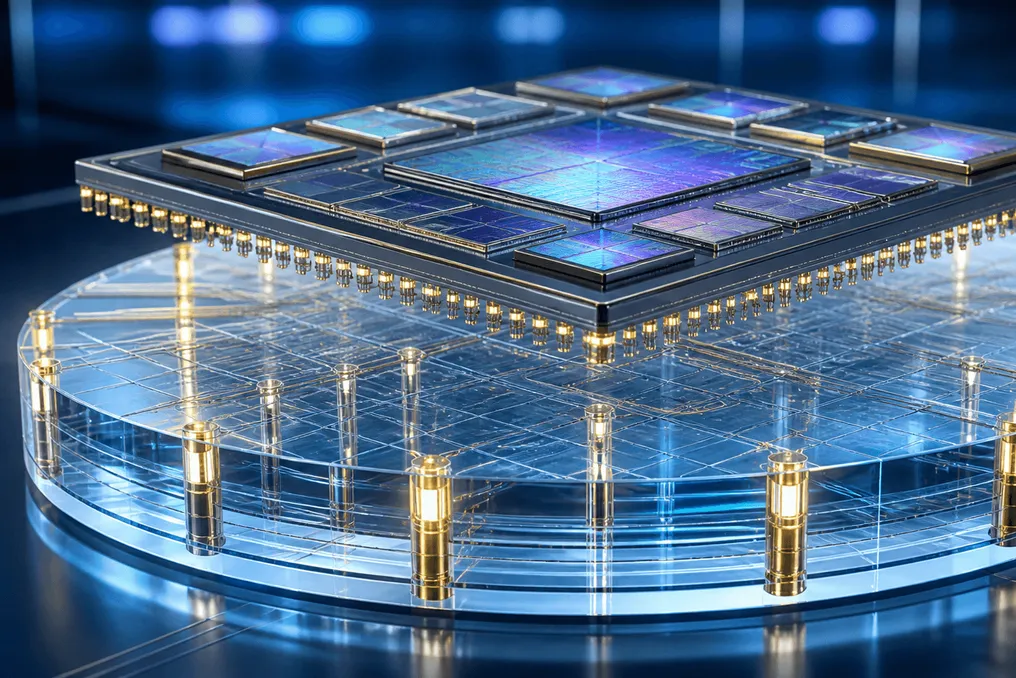
Glass substrates can be applied in three chip packaging scenarios. Firstly, they serve as temporary glass carriers for already mature or near-mass-production 2D or 2.5D packages. Secondly, they can replace silicon interposers to reduce costs. Thirdly, they act as a glass substrate, replacing printed circuit boards (PCBs) or other organic substrates. In terms of TSMC's CoWoS, the second and third applications correspond to replacing the W (Wafer) layer or S (Substrate), respectively.
It is important to note that the glass substrate is intended not for the green printed circuit board in computers, but for the critical packaging layer between the chip and the printed circuit board, which determines packaging efficiency and signal integrity.
The performance of the TGV (Through Glass Via) process directly affects the overall performance of the entire board, making it the primary bottleneck. TGV accounts for over 40 percent of the processing cost of the glass substrate, with the most expensive segments being the vias themselves and metallization. The technology requires breakthroughs in three areas: forming high-precision holes using laser deep etching as the optimal path for high-density, large-size TGVs; ensuring high reliability of via metallization for uniform, dense metal deposition; and multilayer RDL interconnects and soldering, where issues such as composite substrate warping and even rupture due to the low mechanical strength of glass and thermal mismatch with multilayer wiring dielectrics dominate.
The glass substrate ecosystem in China includes substrate suppliers like Triassic and Tongge Micro, equipment manufacturers capable of local customization, and end integrators, including the Lens-Intel alliance. China Electronics Technology Corporation continues to promote standardization through its research institutes. Since the brittleness issue has been resolved, the transition to mass production now depends on improving TGV performance, the reliability of multilayer RDL, and cost curves during scaling. The strategic alliance between Intel and Lens Technology signals global endorsement of the supply chain developed in China, positioning the country for a leading role in the post-silicon substrate era.
SpaceX has scheduled the fourteenth test flight of Starship to occur before the end of August, introducing a new feature: the attempt to capture the rocket's upper stage, called Ship, using the launch tower's arms. Elon Musk communicated this detail during the company's first quarterly results meeting since its historic IPO this Tuesday (4).
Musk stated that, depending on regulatory approval, the team will attempt to capture the Ship with the tower on the next flight, which is temporarily scheduled for the end of the month. The realization of this flight is subject to obtaining the necessary authorization from regulatory bodies.
The Ship constitutes the upper stage of Starship and is 52 meters high. The complete system also includes a first stage known as Super Heavy. Although SpaceX has already managed to capture the Super Heavy with the tower in three previous tests, this would be the first time such a procedure is attempted with the Ship.
In addition to the capture maneuver, Flight 14 is expected to be the pioneer in placing payloads into operational orbit, something unprecedented for Starship. In the previous flight, the 13th, conducted on July 24, it transported 20 Starlink V3 satellites, but these were placed in suborbital trajectory. If all goes as planned, according to Musk, in Flight 14 these satellites will be inserted into operational orbit.
Confidence in planning the capture was reinforced by the performance of the Ship in Flight 13. Its thermal shield withstood reentry into the Earth's atmosphere well, and the Ship landed smoothly in the Indian Ocean, near the west coast of Australia, remaining intact so far. Musk commented: 'I don't want to jinx it, but I think I would consider the thermal shield issue resolved at this point.'
Months before the earnings call, SpaceX revealed its ambition to reach the 'total addressable market' of US$ 28.5 trillion (equivalent to R$ 146.6 trillion) annually in the long term, with almost US$ 23 trillion (R$ 118.3 trillion) belonging to the 'enterprise AI applications' segment. For comparison, the Gross Domestic Product (GDP) of the United States in 2025 was slightly less than US$ 31 trillion (R$ 159.5 trillion).
A central element of this strategy is the Starmind constellation, composed of one million artificial intelligence data centers in orbit. Musk informed during the meeting that SpaceX expects to begin launching the first operational spacecraft of Starmind in 2027. To maintain this launch pace, he projected that 'we expect the flight cadence to increase rapidly and, probably, within a year, we will be doing at least one flight per day, possibly more.'