The common belief that old cars are 'built like tanks' does not always correlate with their actual safety compared to modern vehicles. Although it is often said that 'they are no longer made like before,' this statement does not apply to the field of car safety.
Despite some drivers believing that their old car maintains integrity in an accident due to its sturdy construction, experts point out that what is critically important is not just a strong body, but how the vehicle deforms around the passengers.
According to Eugene Herbert, CEO of MasterDrive, a car that deforms properly in the right places fulfills its structural function. Modern cars are equipped with special deformation zones designed to absorb kinetic energy during a collision, thereby slowing down the sudden deceleration experienced by passengers.
The passenger compartment, conversely, is designed to remain rigid and resist impact. Thus, even if the damage looks dramatic after an accident, it may indicate that the passengers sustained only minor injuries.
Consumers should exercise caution and not jump to conclusions about a car's safety level based solely on how much it deforms in test videos.
Eugene Herbert added that organizations such as Global NCAP and ANCAP consider far more factors than what is visible on camera. Their ratings include data from sensors measuring the forces acting on the head, chest, hips, and legs of mannequins, as well as an assessment of child seat compatibility, rollover protection, and the presence of active safety systems like Electronic Stability Control (ESC).
Old cars do not crash like tanks
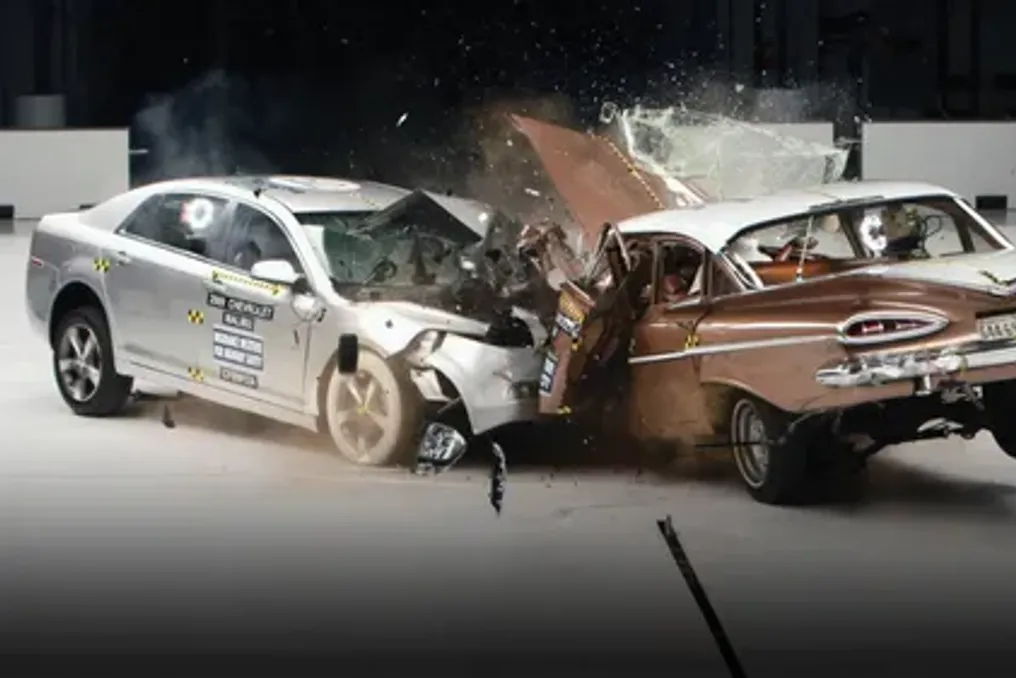
There are many well-known crash tests where modern cars have been compared to their 'classic' predecessors with catastrophic results. One of the most famous was the Insurance Institute for Highway Safety (IIHS) test between a 1959 Chevrolet Bel Air and a 2009 Chevrolet Malibu. The latter was also tested against an older 2004 model, which also suffered severe deformation.
Another illustrative test pitted a 2010s Nissan Versa (Almera in South Africa) against a 1990s Nissan Tsuru sedan, which was produced for many years in markets such as Mexico.
Airbags are incredibly important
Another common misconception is the assertion: 'My car doesn't need airbags; it's strong.' However, an airbag is often referred to as a Supplemental Restraint System (SRS), and its effectiveness is virtually zero without using the Primary restraint system—the seatbelt.
Nevertheless, the combined use of these two systems significantly increases the chances of survival in the event of an accident. The independent crash testing body Latin NCAP conducted a test on a previous generation Mitsubishi Triton several years ago and failed to score any points. Yet, the same vehicle, presumably with an identical structure, received five stars in the Australian ANCAP test.
The reason for the discrepancy was that the Latin American versions of the Triton were not equipped with airbags. Furthermore, the seller informed the buyer who acquired the car for the test that 'airbags are unnecessary because the construction is reliable.'
Not all modern cars are as safe as they seem
While modern vehicles are generally much safer than their predecessors, this does not mean that every new model is automatically safer. Some budget models have shown poor results in crash tests in certain markets, such as the Datsun Go and Hyundai Grand i10. Moreover, some versions of these and many other cars lack important safety features in base trims.
The situation is complicated by the fact that the same model can be sold in different markets with different safety specifications. Therefore, when viewing crash test results, buyers should remember that not all Global NCAP results apply to the equivalent vehicle sold locally.
Herbert warns that there are sometimes lower-spec versions of models available elsewhere that lack features such as side or curtain airbags, as well as Electronic Stability Control (ESC).
He notes that cars with familiar names may receive low scores even if similar versions perform well abroad, because local laws require certain safety features. When examining a new car, one must check not only for a Global NCAP or ANCAP rating but also whether that rating applies to the specific specification being sold in South Africa.
Dangerous game for compact car buyers
Bobby Ramagvede, CEO of the Automobile Association of South Africa (AA), called the market for cars under 400,000 Rand a 'dangerous game' currently, especially regarding entry-level models. He warned that in a side impact, curtain airbags are often the deciding factor between life and death.
Ramagvede stated that without an additional barrier, a person risks serious injuries such as decapitation, deep neck cuts, or a broken neck.
He expressed regret over the minimal vehicle safety requirements in South Africa, calling them 'trolley standards.' Ramagvede accused many manufacturers of complicity because they do not raise the safety standards of their cars. He emphasized that there are cases where the same car is modified for the African market. He believes that removing safety features when bringing a car to market is an indirect attempt to kill people.
He strongly urged car buyers in South Africa to exercise extreme caution when purchasing new or used entry-level vehicles, as recent crash tests have revealed an alarming trend toward inadequate protection in budget models. Ramagvede concluded that it is even more worrying that very few tested cars have safety ratings similar to the same models sold abroad.