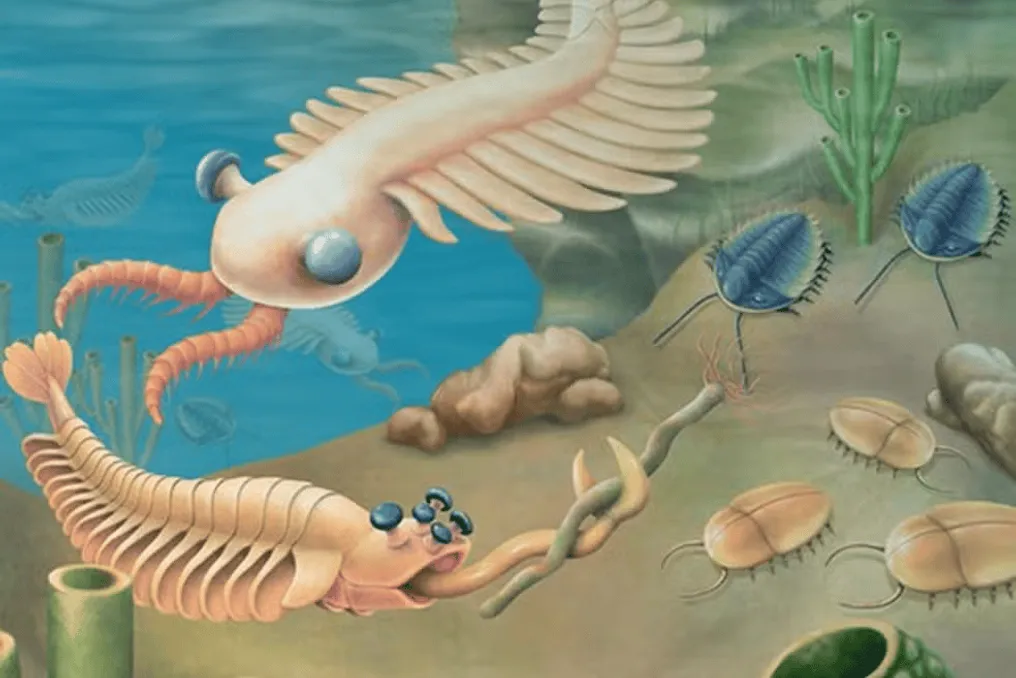
A change in how early living beings consumed and digested food may have been crucial in the transformation of Earth's oceans approximately 540 million years ago. A new scientific analysis points out that the increase in both the quantity and variety of excrement generated during the Cambrian Period contributed to the distribution of nutrients in deep marine waters, which in turn stimulated the emergence of progressively more complex ecosystems.
Scientists have named this event the 'Cambrian fecal revolution.' This theory adds a new element to the understanding of the so-called Cambrian explosion, a period marked by the rapid diversification of marine life and the appearance of many of the main animal groups existing today.
How excrement modified the oceans
As animals evolved more elaborate digestive systems and began seeking diverse food sources, they started generating larger and more heterogeneous waste. These waste products acted as small packages of organic material that gradually sank through the water column, transporting nutrients and food from the surface to deeper areas of the ocean. This mechanism amplified the availability of resources for organisms located far from sunlight, promoting the development of new habitats.
Russell Bicknell, a researcher at Flinders University (Australia) and co-author of the study, clarified that 'this increased the amount of accessible food and also helped supply vital nutrients to the deeper regions of the ocean, creating new niches for life.'
Fossils indicate a more complex diet
The scientific review analyzed data collected from over 35 paleontological sites scattered globally. Among the discoveries were coprolites—fossilized feces—that showed varied sizes, from tiny particles to specimens measuring several centimeters. Some of these fossils contained shells and fragments of other animals, suggesting that feeding interactions were already quite diverse during the Cambrian. Scientists also detected signs of predation and preserved prey remains within the digestive tracts of other fossils.
According to Bicknell, this type of evidence constitutes one of the most robust demonstrations that animal digestion and feeding became more refined during that period. Additionally, the fossils show that certain primitive arthropods developed specialized digestive structures capable of processing a wider range of food types.
Carbon and nutrient transport
With the presence of larger waste, an increasing amount of organic matter was able to reach the ocean floor, accelerating the movement of carbon and nutrients between the surface, deep waters, and the seabed. However, researchers emphasize that this process alone does not explain the Cambrian explosion. Additional factors, such as increased oxygen levels, environmental changes, and intensified predation, also played significant roles in the rapid diversification of life.
Nevertheless, the study proposes that nutrient transport via feces was a relevant component in this process. Bicknell stated: 'This offers us another point of view to consider. We can interpret the acceleration of this matter transport via excrement as an important driving force.'
The authors concluded that this mechanism persists to this day, contributing to the maintenance of contemporary marine ecosystems, where feces, organic debris, and other particles continue to distribute food and nutrients throughout the ocean. The researcher concluded by stating that 'it was the beginning of modern marine ecosystems.' The study was published in the scientific journal Trends in Ecology & Evolution.