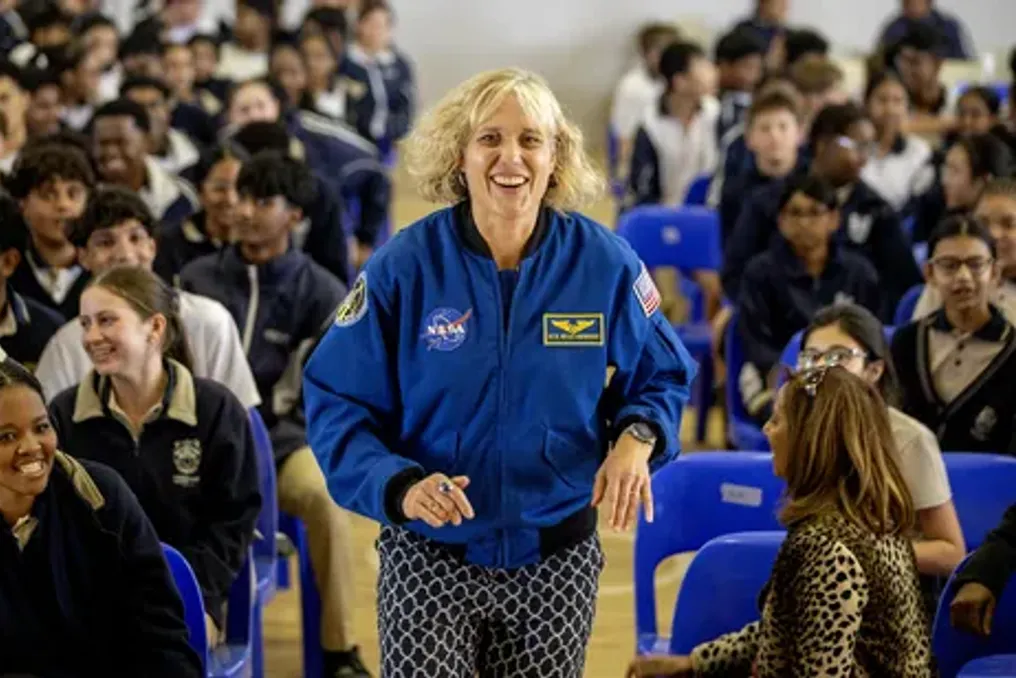
Former NASA astronaut Dotty Metcalf-Lindenburg shared with students in Durban the idea that curiosity and perseverance can turn childhood dreams into reality, and that STEM programs open paths to the developing space economy.
Dotty Metcalf-Lindenburg spent decades realizing her long-held dream of becoming an astronaut. In the end, it took her only eight and a half minutes to travel from Earth into space.
However, before boarding the Space Shuttle Discovery, Dotty was aware of the associated risks. At the time, her daughter was only four months old, and there was a possibility she might not return to see her child grow up.
The memory of the Columbia Space Shuttle disaster is still alive. Dotty's class was training during a period when NASA had suspended flights after the spacecraft disintegrated upon re-entry into the atmosphere. The entire team of seven people perished.
She recalls: 'When our class arrived, it was during a flight ban because... they were trying to understand this accident, and then improve the craft before flying into space.'
During her visit to various schools in Durban this week, she told the Independent on Saturday that despite all the dangers and uncertainty about whether she would see her child grow up, she continued to move toward the dream she had held since childhood.
Before leaving Earth, she wrote letters to her daughter and family, wishing her little girl to know how much she was loved and encouraging her to follow her own big dreams.
She added: 'I mean, it's hard to say, hey, I might not come back, but if I don't come back, here's what I would want for our daughter, and I would want her to know what I did. I don't remember exactly, but I think I would probably tell her that I love her very much, and that I want her to achieve great things in the future. That's what I tell her now too.'
Dotty, as she prefers to be called, said she first dreamed of flying into space in third grade in 1983 when Sally Ride became the first American woman to fly in space. Even at such a young age, she began working to make this dream come true. She also visited a Space Camp where she bought and later assembled a model of the Space Shuttle Discovery, unaware that it would be the exact spacecraft she would one day ride in.
The childhood dream never faded, and years later, as a high school science teacher, Dotty found herself on the NASA website looking for answers for one of her students who wanted to know: 'How do astronauts use the toilet in space?'
She came across a call from NASA for those interested in spaceflight. She applied, and exactly 20 years after assembling the Discovery shuttle model, Dotty flew on the real Discovery shuttle to the International Space Station.
Before leaving NASA, she was asked if she still wanted to travel in space given the Columbia tragedy. She replied: 'I said yes because I truly believe that the risks we take are worth what we do here on Earth. All the scientific and engineering development is truly significant.'
Finally, the day came when she and her crew were suited up and entered the massive spacecraft. She described: 'Then you wait two and a half hours on your back, waiting for clearance to launch. And as soon as we get that clearance, there are several items on the checklist that have to happen, but pretty soon it feels like, oh man, we are really taking off. And the main engines light up. When they light up, the craft shakes a little. It moves side to side, and then, if they reach full thrust at 100%, the solid rocket boosters light up, and then we are on our way.'
All these years of dreaming and preparation led to a quick trip. 'The flight and reaching a safe orbit is an eight and a half minute journey.'
When Dotty finally reached space, the view was everything she imagined and more. She recalled: 'I just saw beautiful Earth as we orbited it every 90 minutes. And I saw sunrises and sunsets. A beautiful Milky Way.'
But they also had work to do. They needed to perform tasks on the ISS. Dotty was part of the flight crew participating in the ascent and reentry of the spacecraft, and she also operated the robotic arm. Although she did not perform an EVA herself, she was part of the team handling EVAs and, like the entire crew, helped move equipment to the International Space Station.
'We moved six tons of equipment to the space station, and then we collected the trash and returned it to our craft,' she reported.
From space, she saw Earth in a way few people ever have. Her message to children in South Africa was this: 'Through their curiosity and willingness to tackle academic difficulties and the courage to aim high, they can make their dreams come true. I shared with the students that not everything went as I planned, but I didn't give up on my dream.'
And although she did not find extraterrestrial life in space, she is sure that something is out there. 'We are returning quite convincing evidence that there was a biosignature on Mars in the past, likely microbial in size. And I believe there is a probability that one of these moons around Jupiter, especially Europa, has life in its ocean waters. So yes, we are probably not alone.'