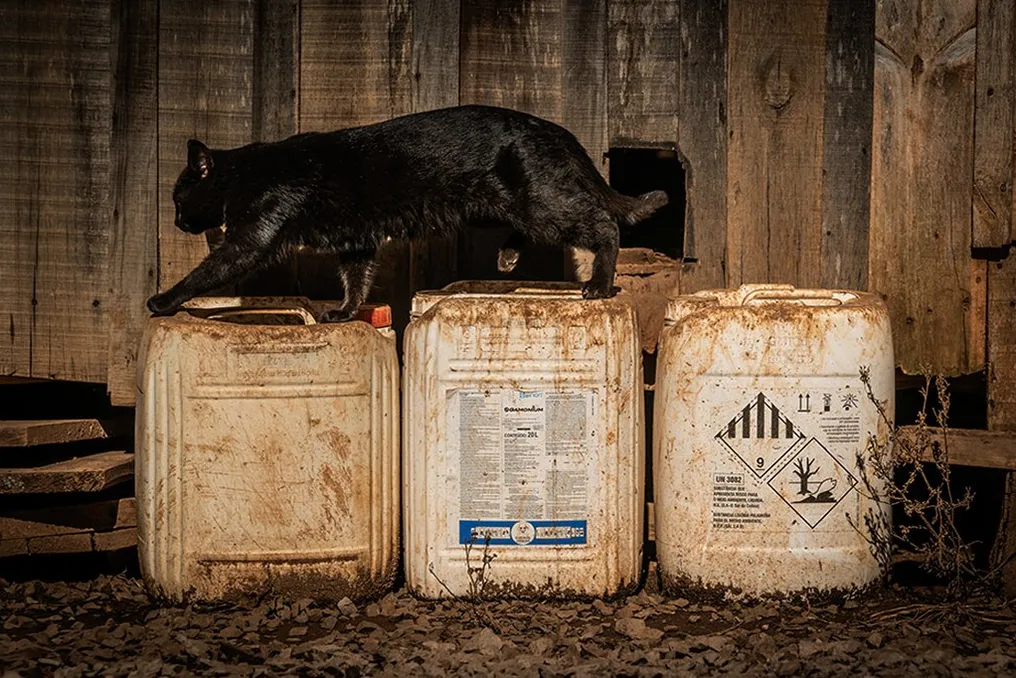
A pesticide banned in Europe is increasing its presence in the Brazilian market. This occurs after national authorities prohibited another pesticide from the same chemical family eight years ago due to risks linked to genetic mutations and Parkinson's disease.
The increase in the use of this alternative substance is directly associated with the multiplication of poisoning cases. Between 2018 and 2025, 250 cases were registered in the country, resulting in at least 40 deaths, six due to accidents and 34 due to suicide after ingesting the pesticide.
This data was revealed by a joint investigation by Repórter Brasil and the Swiss organization Public Eye, using official information from the Unified Health System (SUS).
Use and Prohibition of Pesticides
Paraquat, a herbicide widely used in controlling weeds in crops, was banned in Brazil in 2017 due to its potential impacts on human health. Subsequently, its chemical relative, diquat, saw its use increase tenfold until 2024, according to monitoring by the Brazilian Institute of Environment and Renewable Natural Resources (Ibama).
Currently, only one-third of the ten thousand tons consumed in Brazil is produced domestically; most is imported, including Reglone. The latter, manufactured by the multinational Syngenta, is the best-known brand and is responsible for at least 65% of poisonings. Public Eye discovered that in 2023, Syngenta exported more than half of the Reglone production made in England to Brazil.
Diquat has been banned in England and Switzerland, Syngenta's headquarters, since a reassessment conducted in the European Union in 2018, which identified 'a high risk to workers, passersby, and residents' of areas near farms. Syngenta imports diquat for the manufacture of Reglone in Brazil from both England and China.
In Brazil, where diquat use is permitted, poisoning cases have raised concerns among authorities. There were six cases in 2018, but in the previous year (to the publication), the number jumped to 71, representing a 1,100% growth.
This increase, although it may seem small compared to the more than 11,000 episodes of pesticide contamination reported in Brazil in 2025, signals an alert due to the rapid multiplication of records.
Poisoning Cases and Symptoms
Toxicologist Dr. Bruna Telles Scola, who works at the Toxicological Information Center of Rio Grande do Sul (CIT-RS), illustrates the seriousness of the situation: 'In 2025, we attended 17 cases related to diquat in Rio Grande do Sul, but in these first months of 2026 alone, we already have 15 registered cases.'
In response to Repórter Brasil, Syngenta stated that diquat 'is a registered herbicide in Brazil' and guaranteed that 'its use is safe under conditions approved by regulatory authorities, provided the instructions in the leaflet and agronomic prescription are followed.'
Rio Grande do Sul Led Diquat Poisoning Ranking Last Year
Rio Grande do Sul was the state that recorded the highest volume of diquat sold in 2024 and was also the leader in poisoning incidents in 2025, two of which resulted in death.
Nelson Castoldi, an 80-year-old farmer, was one of these victims. He came into contact with Reglone on his family's soybean farm in Guaporé, in the Serra Gaúcha municipality. His son, Ivan André Castoldi, reported that to avoid carrying the entire container, his father separated what was necessary and put it in a Coca-Cola PET bottle.
Due to the intense heat in October, the farmer made a mistake and ingested the liquid, thinking it was soda, because he was thirsty. After tasting it, he vomited. Two days later, Nelson died in the hospital. The medical examiner's report confirmed that 'the clinical evolution is compatible with the conditions caused by intoxication by this herbicide [diquat]' and attributed the death from respiratory failure to pesticide poisoning.
Diquat is a herbicide of the same family and type as paraquat, popularly known as 'weed killer,' used against weeds in crops such as soy, corn, cotton, potatoes, and beans. Although not recommended for tobacco, there are also reports of poisonings in this crop.
Ivan André Castoldi argued that 'Reglone should be banned, not because of what happened to us, but because of its toxicity,' concluding that if it is banned in other countries, it should also be banned in Brazil. Toxicologist Dr. Bruna Telles Scola agreed, stating that 'if it was banned where it is manufactured, it means they know about the potential toxicity of this product.'
In its note to Repórter Brasil, Syngenta clarified that 'the fact that a certain active ingredient has not been registered or approved in a country does not mean that it underwent an evaluation that banned it for presenting health or environmental risks. Differences in registration between countries do not, by themselves, mean that a product has been considered unsafe in another jurisdiction.'
Products Trigger Similar Symptoms
Nelson Castoldi suffered a very severe poisoning episode. His daughter-in-law, Cristiane Redante, reported that 'the first thing the poison attacked were the kidneys, which paralyzed. So, they took him for hemodialysis.' Subsequently, the herbicide affected the lungs, which 'necrotized,' according to Ivan Castoldi.
Paraquat, which was also known to affect the respiratory system, causes problems in the alveoli, preventing gas exchange, detailed the sanitary biologist Vanda Garibotti, from the State Center for Health Surveillance (Cevs) of Rio Grande do Sul.
There are other similarities in the effects of the two pesticides on the human body. An Anvisa diagnosis in 2017 pointed out that 'cases of severe acute poisoning by accidental ingestion of paraquat or suicide attempts are worrying' and was a reason for the pesticide's ban.
Of the 250 diquat poisoning cases registered in Brazil between 2018 and 2025, 34 were related to suicides and 77 to suicide attempts.
Although the industry denies the link, various scientific studies warn of a possible impact of chronic exposure to pesticides on mental health, suggesting that suicide rates may be higher in regions with heavy pesticide use, especially in developing countries.
SUS data also accounts for six accidental deaths in Brazil, all occurring after 2023, where the victims did not attempt to take their own lives.
Bruna Telles Scola compared: 'We notice that the symptoms they cause are very similar, as is the clinical outcome of severe cases. If diquat is ingested, in most cases it is fatal.'
However, health professionals believe there is a greater chance of recovery for patients poisoned with diquat than with its predecessor, as diquat takes longer to reach the lungs.
Despite this, Anvisa evidence indicates that paraquat could cause Parkinson's disease. Diquat, however, 'deposits in the central nervous system, bringing signs of parkinsonism, with symptoms such as tremors, vision changes, irritability, aggression, and mental confusion,' observed Scola.
Paulo Rozelmo Krug, poisoned after using Reglone to clean his tobacco field in Tunas, in the center of Rio Grande do Sul, became 'possessed,' according to his wife, Daniela Oliveira dos Santos, who reported: 'He wouldn't listen to me, no one could hold him.'
The family of Paulo Roberto Schimunek, from Venâncio Aires, in Rio Grande do Sul, initially thought he was having a stroke after applying Reglone in the garden. He began to stutter, twist his tongue, and show mental confusion. The victim recalled: 'When the doctor came to check, he said this is the most dangerous poison there is.'
Valdemar Postanovicz, a tobacco grower in Ipiranga, Paraná, also felt as if he had suffered a stroke, but these were symptoms of acute diquat poisoning. He described: 'My entire right side became paralyzed. My mouth twisted to the right. On the way to the hospital, I started seeing everything dark.'
Paraná is the Brazilian state with the highest total number of diquat poisonings registered in the SUS since 2018. Postanovicz justified the use of Reglone because Gramoxil (a paraquat-based product) had stopped being produced, leading everyone to use Reglone, but added that he would never buy the product again because it was 'very frightening.'
PPE Does Not Guarantee Protection
Among the 250 cases reported to SUS between 2018 and 2025, 109 were classified as work-related diseases, including five of the six non-suicide-related deaths.
The vast majority of the poisoned individuals are farmers. In interviews conducted by the Repórter Brasil and Public Eye teams, two individuals defended the use of the substance despite having suffered contamination, assessing that it is possible to control health risks.
Pesticide manufacturers, such as Syngenta, recommend the full use of Personal Protective Equipment (PPE), which includes sleeved overalls, long pants, rubber boots, waterproof apron, PFF2 mask, goggles, Arab head covering, and gloves.
Furthermore, rural unions offer training on the 'safe use' of pesticides in partnership with the National Rural Learning Service (Senar). Another common practice is the 'field day,' where the industry presents new technologies for seeds, pesticides, and crop management to farmers.
Syngenta informed Repórter Brasil that 'in 2025, it trained a total of 81,893 people for the safe use of products in Brazil, representing a 35% jump compared to the consolidated figure of 2024.'
Ivan Castoldi commented that 'in the lectures, companies talk about the dangers of pesticides,' but added: 'deep down, they want you to buy the product.' He summarized that companies raise awareness about risks but also make the farmer believe that he can apply the poison without problems using PPE.
In the specific case of diquat, the effectiveness of personal protective equipment was tested in a risk assessment conducted in the European Union in 2018. The assessment committee concluded that 'workers' exposure to diquat was clearly above the acceptable level,' even with the use of PPE.
According to the calculations of the study that underpinned this conclusion, spraying diquat with a tractor exposed the farmer to a risk 40 times higher than acceptable, even when using PPE. With manual sprayers, the exposure was 450 times higher than the limit. This is similar to what happened with paraquat, as Anvisa, when suspending its use in Brazil, considered that PPE did not guarantee 'total protection against poisoning' and that the actual level of worker exposure was 'exceeding the acceptable.'