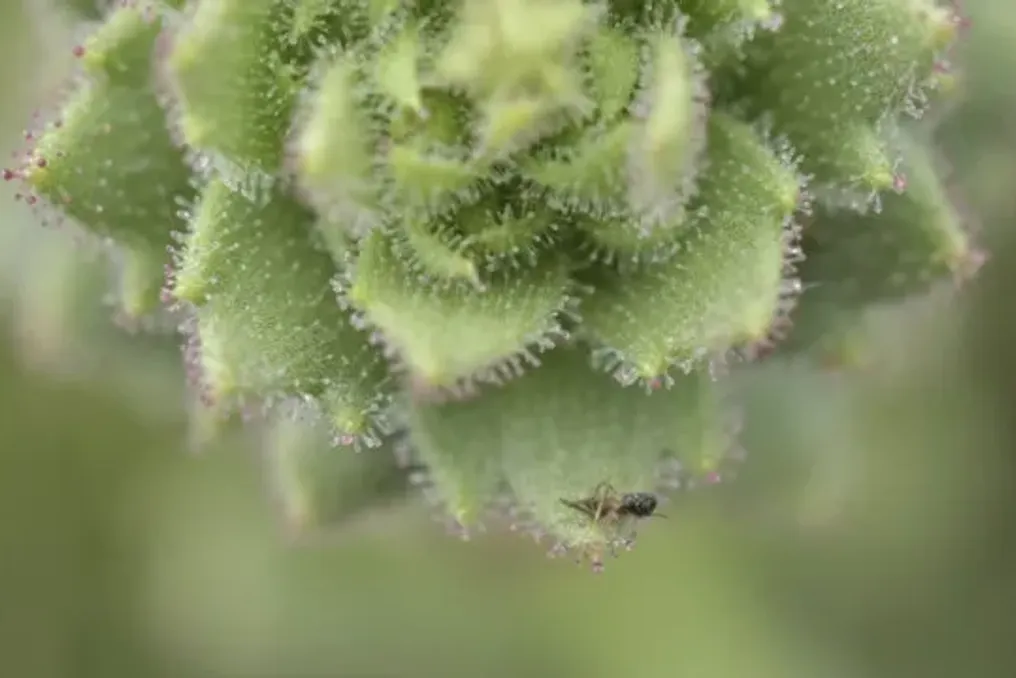
According to a study published in the scientific journal Nature Communications, the plant 'Saxifraga candelabrum' has the ability to attract, catch, and digest insects, as well as absorb nitrogen from them.
In 1875, Charles Darwin proposed that some species of the genus 'Saxifraga', which are flowering plants characteristic of mountainous conditions, might be carnivorous. This assumption was based on the presence of sticky glandular hairs on these plants capable of trapping insects.
Based on field observations, examination of plant samples, and genetic analysis, scientists concluded that 'Saxifraga candelabrum' confirms the hypothesis of the British naturalist.
In China, this plant grows on the Tibet-Qinghai high plateau, considered the highest and largest plateau in the world, as well as in the Hengduan Mountains.
The team of Chinese botanist Hang Sun began its work by testing 43 out of 45 examined samples, discovering that they had captured insects on their glandular hairs.
Furthermore, using fluorescent labeling, phosphatase activity—a digestive enzyme commonly found in carnivorous plants—was identified, indicating the probable ability of 'Saxifraga candelabrum' to digest prey.
Subsequently, Hang Sun and his colleagues fed the plant flies of the genus 'Drosophila' labeled with a stable form of nitrogen to test whether 'Saxifraga candelabrum' could absorb nutrients from its prey.
The scientists recorded a significant increase in the level of labeled nitrogen in 'Saxifraga candelabrum' compared to other carnivorous plant species, as well as compared to non-carnivorous species.
Finally, according to the publication in Nature Communications, researchers discovered genomic similarities between 'Saxifraga candelabrum' and other carnivorous plants that evolved independently, including genes related to prey attraction, digestion, and nutrient absorption.