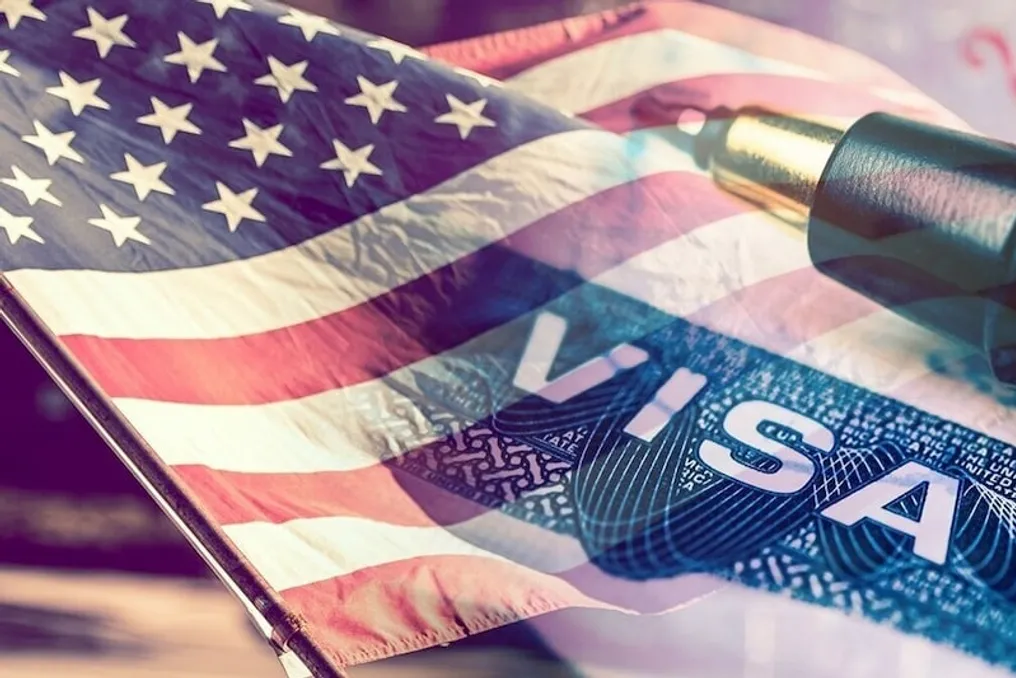
The financial burden for hundreds of thousands of foreign workers employed in America on H-1B and L-1 visas may increase. The Trump administration has prepared a proposal that would require an additional payment even when renewing a visa.
Previously, this fee was only charged upon obtaining new H-1B or L-1 visas, or when changing jobs.
The U.S. Department of Homeland Security (DHS) intends to amend the existing rule regarding the additional charge associated with H-1B and L-1 visas. Currently, the '9/11 Response and Biometric Entry-Exit Fee' is applied only in specific cases, such as obtaining a new H-1B or L-1 visa, or transitioning to work at another company.
Under the new proposal, this additional fee will also apply to visa extension applications. This means that workers who continue to work for the same company may be forced to pay this amount when extending their visa status. DHS states that this change is being made to implement Public Law 114-113 and clarify regulations.
This rule does not apply to all companies; it will affect organizations that have 50 or more employees in America, with at least half of them working on H-1B or L-1 visas. Currently, such companies pay an additional fee of $4,000 for a new H-1B visa and $4,500 for a new L-1 visa. If the proposal is adopted, this amount will also have to be paid upon visa renewal.
This change could have the greatest impact on Indian specialists. This is because the vast majority of H-1B visa renewal applicants are Indian. According to USCIS, 406,348 H-1B applications were approved in fiscal year 2025, of which 291,542 belonged to current employees. Of these, 226,359 were Indian, meaning that about 77.6 percent of H-1B renewals are linked to Indian citizens. If this rule comes into effect, the costs for companies hiring Indian employees will increase.
The proposal may also affect large technology and IT companies. According to the National Foreign Affairs Policy Foundation (NFAP), in fiscal year 2025, Amazon led the list of companies receiving the highest number of H-1B renewal approvals, followed by Tata Consultancy Services (TCS), Microsoft, Meta, Apple, and Google. These companies have a large number of employees working on H-1B visas. Large corporations also use the L-1 visa to send their managers and experts working in different countries to America. If the new law is passed, the costs for these companies may also increase.
This proposal was first introduced in June 2024 and was subsequently included in the Trump administration's regulatory agenda for 2026. A final decision on this matter may be reached in the coming weeks.
Last month, the American Court of Appeals declined to halt the Trump administration's decision that annulled the lower court's ruling imposing a $100,000 fee for new H-1B visas. Meanwhile, a proposal to introduce an additional fee for visa extensions has emerged.
Overall, America is preparing to tighten rules concerning H-1B and L-1 visas. If this proposal is implemented, employees working for the same company will be required to pay an additional fee when extending their visa validity. This will affect Indian specialists and companies employing a large number of H-1B and L-1 visa holders the most.