In a subterranean reservoir of highly saline water, located beneath the Taylor Glacier in Antarctica, a community of marine microorganisms remained active for millions of years. This discovery was detailed in a study published in the journal Nature Geoscience last Monday (03).
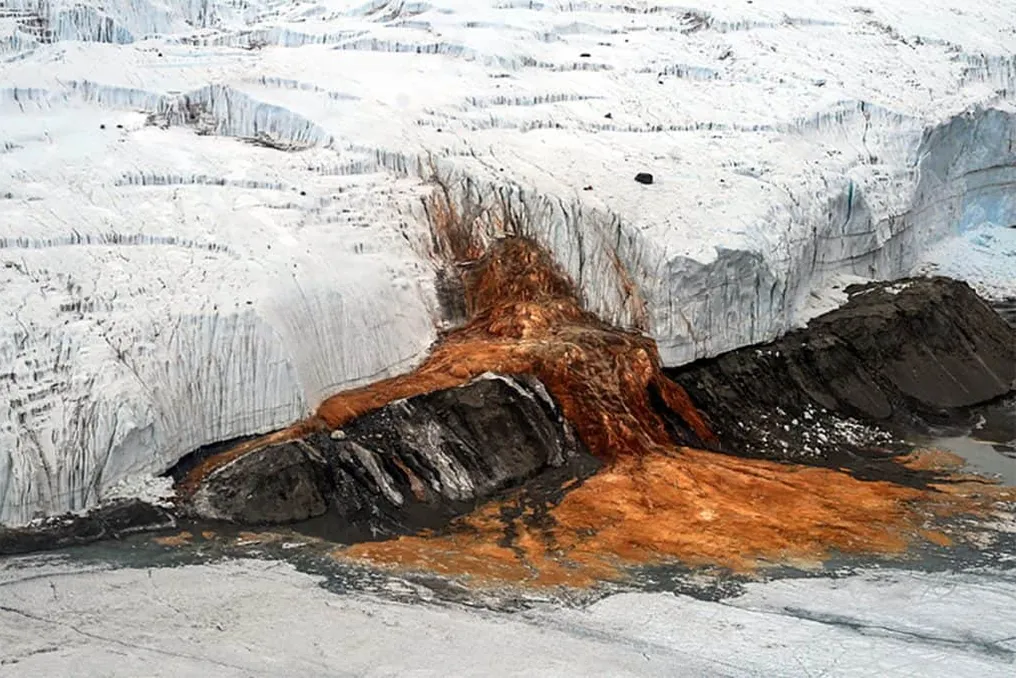
The research, conducted by microbiologist Angela Zoumplis from the University of California, San Diego, identified eukaryotic organisms living in the area known as Blood Falls. This environment is characterized by a reddish flow of water descending from the glacier to Bonney Lake, situated in the Dry Valley of McMurdo.
Scientists inferred that these living beings may be descendants of an ancient marine population that became isolated when ocean water was trapped beneath the advancing ice. The extreme environment served as a sanctuary, preserving life forms that survived profound climatic changes in Antarctica.
A living archive hidden beneath the Antarctic ice
The Blood Falls have attracted attention for over a hundred years due to their unique appearance. In an expedition in 1911, geologist Thomas Griffith Taylor was the first to notice the formation; initially, its red coloration was attributed to the presence of algae.
Subsequent research has shown that the origin of this hue is different. The phenomenon occurs because a subterranean reserve of salt water contains a large amount of dissolved iron. When this material comes into contact with oxygen upon reaching the surface, oxidation occurs, giving the flow its reddish appearance.
This reservoir has remained protected beneath the Taylor Glacier for at least 1.5 million years. The reason for its persistence lies in the properties of the water itself, whose high salt concentration lowers the freezing point, allowing pockets of liquid to exist even on a continent covered by ice.
Although the area was already known to host prokaryotes, such as bacteria and archaea, the new investigation focused on another group: eukaryotic microorganisms. These beings possess more elaborate internal structures, including a cell nucleus, and include organisms such as diatoms, dinoflagellates, haptophytes, and ciliates, groups typically associated with marine ecosystems.
To investigate the presence of these life forms, Zoumplis and her team examined 167 samples collected from various points in the region, covering the red current of the Blood Falls, sediments, ice, mud, areas of the McMurdo Dry Valley, and adjacent marine waters. Environmental RNA analysis was employed to distinguish between metabolically active organisms and those represented only by genetic traces in the environment.
The findings indicated that the microorganisms were not merely transported by wind from the coast. The high concentration of these beings near the Blood Falls and their genetic variations compared to current marine relatives suggested a history of prolonged isolation. Researchers concluded that this characteristic points to the possibility that the found community is descended from organisms that were retained when ancient masses of seawater invaded the area before the formation of the current frozen landscape of Antarctica.
The team also speculates that the survival of these microorganisms may be linked to distinct tactics. Certain species have developed adaptations to withstand high salinity, while others may have remained dormant for long periods until environmental conditions allowed them to resume activity.
For scientists, the relevance of this discovery lies in the chance to directly study organisms linked to an ancestral environment, rather than relying exclusively on fossils or geological records to reconstruct past Antarctica. According to the authors, the Blood Falls constitute a potential refuge for ancient lineages, offering a way to understand how isolated ecosystems react to major environmental changes.