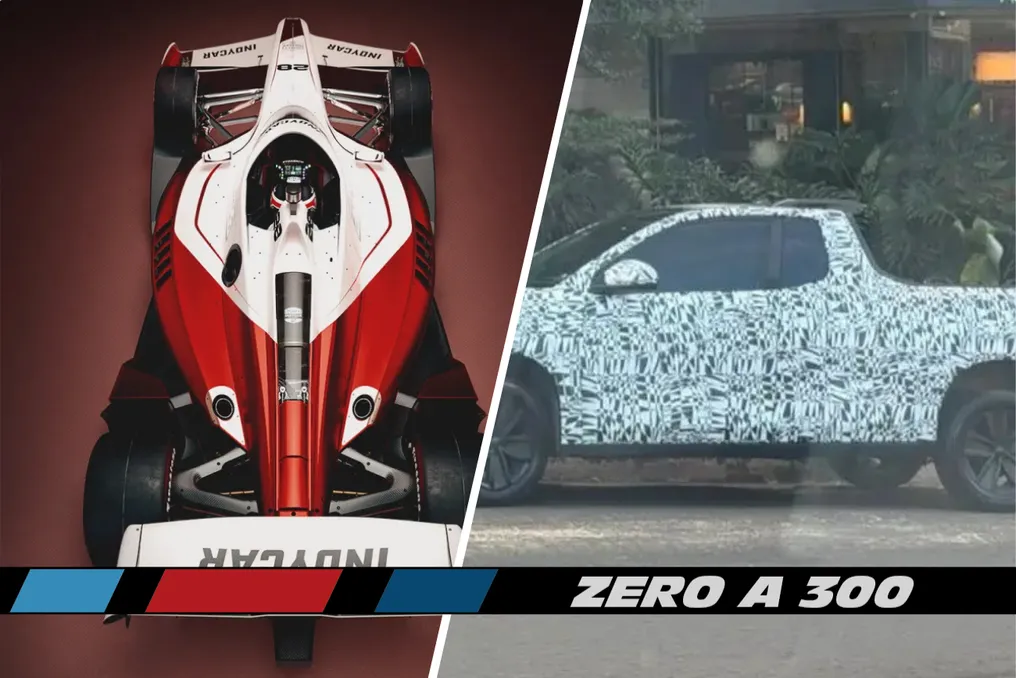
IndyCar announced the development of its new chassis, the IR-28, after 16 years of perfecting the DW12 engine. This project, currently in development by Dallara, aims to reduce weight, improve aerodynamics to facilitate overtaking, and integrate the aeroscreen more seamlessly into Formula models.
Details of the New IndyCar Chassis
The first representations of the IR-28 show a cleaner and more aggressive profile, moving away from the 'cut lid' appearance of the current aeroscreen, and resembling Formula cars more closely, while maintaining the characteristic simplicity of Indy. The cockpit has been redesigned to better accommodate taller drivers, optimizing comfort and ventilation.
Although details about the powertrain and aerodynamics are still pending, Indy informed that wings and underbody have been designed to reduce aerodynamic drag, allowing vehicles to operate closer in corners, which promises more intense braking races. For weight reduction, the supercapacitor was replaced by a standard battery and a lighter Xtrac transmission was adopted, resulting in a 45 kg reduction in the mechanical assembly.
The engines remain the same—a 2.4-liter twin-turbo V6 supplied by Chevrolet and Honda—but they have been adjusted with continuous development advancements, generating an unspecified power increase. Additionally, the suspension will receive a new set that will allow for more adjustments in spring, damper, and inertia without increasing team costs. Initial tests with the prototype will begin this week, with the debut scheduled only for the 2028 season.
Launch of the VW Tukan Simple Cabin
Volkswagen initially showed the Tukan, its new compact pickup truck, only in the double-cab configuration, focusing on color, name, and shape, which was seen as a response to the market's preference for SUVs with less practical cargo beds. Recently, however, the simple cabin version was revealed, which had previously circulated only camouflaged or as a test vehicle.
The Tukan CS holds strategic importance equivalent to its more sophisticated version, as it is expected to succeed the Saveiro and surpass the Strada, which dominates both the segment and the market. The key mechanical distinction lies in the rear suspension, which will use a robust solid axle with semi-elliptical leaf springs, following the same engineering as Fiat, which should ensure a load capacity close to 700 kg.
Regarding engines, it will inherit options from the T-Cross, sharing the modular MQB platform, ranging from 1.0 TSI up to the new 1.5 TSI mild hybrid, the latter intended for the higher-end double-cab versions. Although the Tarok concept was seen at the Auto Show in 2018, the official launch of the pickup is scheduled for the first half of 2027, representing a long wait.
Updates to European and American Models
Volkswagen presented the hybrid version of the T-Roc in Europe, an SUV derived from the Golf Mk7, equipped with a 1.5 turbo TSI Evo2 engine, two electric motors, and a 1.6 kWh battery. Although this powertrain seems distant for the Brazilian public, this unprecedented engine in the country will serve as the basis for the national T-Roc. Furthermore, the 1.5 engine will be adapted to run on gasoline and alcohol, anticipating mild and fully hybrid versions.
A crucial point is that the Brazilian T-Roc will have different dimensions from the European model. Sources indicate that the national version will use the MQB Evo platform but will feature a larger overall length and wheelbase. While it measures 4.37 meters in length and 2.63 m in wheelbase in Europe, in Brazil these measurements should be between 4.40 and 4.50 meters in length, and 2.65 to 2.70 m in wheelbase. This change mirrors what happened with the T-Cross in 2019, when the European project was adapted to the Brazilian market.
The information is confirmed by photos of prototypes testing in Brazil, where larger swings and a distinct design on the front bumper, with new air intakes for the cooling system, are noticeable. The T-Roc is expected to debut in Brazil in 2027, and it is speculated that it might replace the Nivus, although the coexistence of the models is also a possibility.
Audi Q9 Revealed in the United States
Audi revealed its largest SUV, the Q9, in the United States, a market where such vehicles have greater penetration. The Q9 will be produced in Bratislava, Slovakia, and will also be sold in Europe. Its arrival in Brazil has not yet been confirmed, but it is considered likely.
Audi's numbering follows a size progression, and the Q9, being the first with the number 9, reached a new dimensional level: 5.31 meters in length, 2.21 m in width, 1.81 m in height, and 3.14 meters in wheelbase. To realize the Q9, Audi abandoned the MLB platform used by the Q8 and adopted the PPC architecture, developed in collaboration with Porsche.
The four-liter twin-turbo V8 engine, similar to the one used in the Cayenne Coupe, is supplied by Porsche. In the launch sports variant, the SQ9, it generates 599 hp and 81.6 kgfm of torque. However, American consumers will also have the option of the 2.9-liter twin-turbo V6 engine, which produces 435 hp. The transmission is always an eight-speed automatic, coupled with the Quattro all-wheel-drive system, which directs most of the power to the rear axle and includes an electronic locking differential.
For the European market, the Q9 will also be available with a three-liter turbodiesel V6 engine, capable of delivering 245 hp or 299 hp, depending on the version, assisted by a mild hybrid system that provides an additional 24 hp when necessary. Plug-in hybrid versions will be introduced next year. Although there is no official forecast for Brazil, Audi generally launches new products quickly in the local market.
Dodge Presents Teaser of the New Super Bee
After an advertising incident with the new electric Charger, Dodge is focused on damage control and decided to revive past icons with a modern look, including the Copperhead concept, which is expected to become a production model.
More recently, the company announced a probable modern reinterpretation of the Plymouth Superbird and Dodge Charger Daytona combination, characterized by an aerodynamic nose and a raised rear wing. The images released so far are only conceptual projections, but the outlook is promising.
A more concrete announcement was made recently: Dodge released a teaser video focused on classic muscle car enthusiasts, highlighting yellow and black colors, dragstrip lights, and bees. This signals the return of the Super Bee. The original Super Bee was launched in 1968, based on the Coronet, and was known for offering the option of 426 Hemi V8 (seven liters) and Six Pack 440 (7.2 liters) engines.
The nomenclature was also briefly used in 2023 on the Charger sedan, with a special Super Bee edition limited to 1,000 units, launched in the Last Call farewell series. Even without official images or emblems in the teaser, the message is clear. An important date was marked: August 7, 2026, coinciding with the Roadkill Nights event, Dodge's annual drag racing festival organized in partnership with Motor Trend magazine, which often serves as a stage for concept and model debuts.