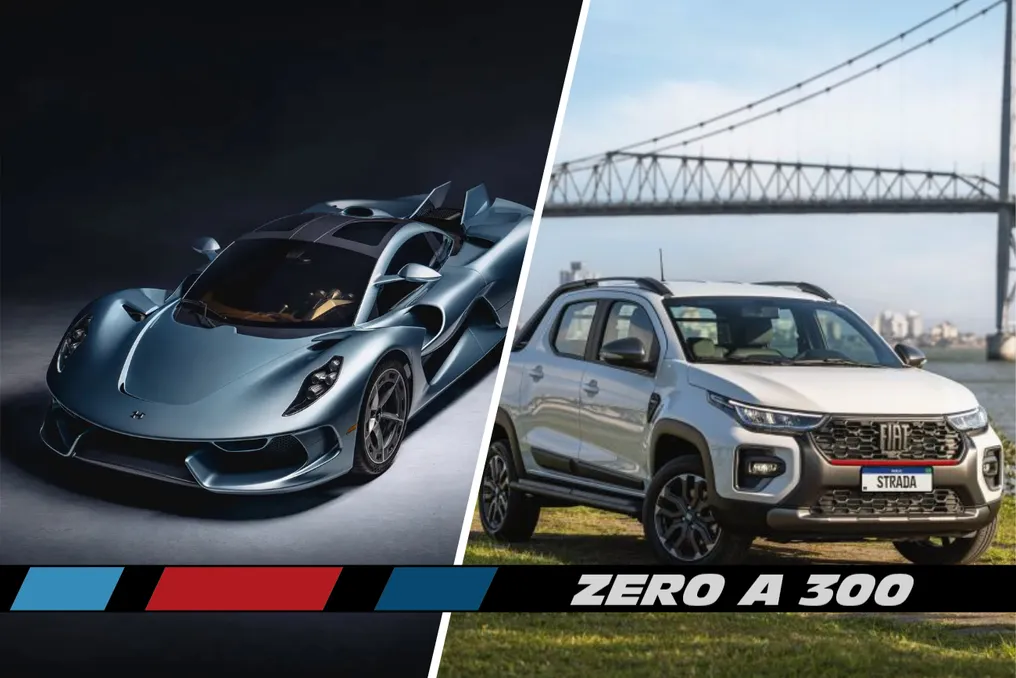
Hennessey unveiled the new Hennessey Blackbird, a hypercar distinguished by its naturally aspirated V8 engine, rear-wheel drive, manual transmission, and lack of dashboard screens. This model is intended to replace the Hennessey Venom F5, which was equipped with a 6.6-liter twin-turbo V8 capable of exceeding 2,000 hp in the Evolution version.
Instead of focusing solely on raw power, Hennessey opted to prioritize the driving experience. The Blackbird, named after the SR-71 Blackbird fighter jet, utilizes an atmospheric V8 engine developed by Ilmor Engineering. This engine, based on the Chevrolet V8, has 6.2 liters and is expected to produce between 800 hp and 850 hp, with a rotational capacity exceeding 9,000 rpm.
The vehicle's specifications include 0 to 100 km/h acceleration in 2.5 seconds and a top speed above 350 km/h. The company emphasizes weight reduction, aiming to keep the car under 1,360 kg, using a monocoque and carbon fiber panels. The chassis will be equipped with adaptive dampers, traction control, and ABS brakes, without other electronic aids.
The design reflects aeronautical inspiration, featuring active vertical stabilizers that rise at 114 km/h and four exhaust outlets styled after the Bell X-1. Internally, the goal was to create an analog and classic atmosphere, eliminating screens in favor of a large central tachometer, exposed manual gearbox, and physical ignition key. Connectivity is managed by the Hennessey Holster, a smartphone holder serving as the multimedia center.
Blackbird production is extremely limited, with only 71 units planned for 2029 and 2030, and each will cost US$ 2.5 million before options. Hennessey reported that more than two-thirds of this batch have already been reserved.
Best-Selling Cars in July 2026
In the Brazilian market, July recorded the sale of 265,148 passenger cars and light commercial vehicles, representing a 2.1% increase compared to the previous month. Although monthly volume grew, the sales pace slowed down, partly because July had two more business days than June.
The Fiat Strada led the ranking with 14,912 units sold, followed by the Volkswagen Polo (10,340) and Volkswagen Tera (10,165). Chevrolet Onix and Fiat Argo completed the top five. However, the scenario changes drastically when considering only retail sales, as fleet operators and rental companies account for almost half of the total market.
The top five were significantly dependent on fleet or rental sales: 74.4% of Strada registrations, 66.1% of the Polo, 56% of the Tera, 61.1% of the Onix, and 75.5% of the Argo went to this sector. In the second half of the top 10, there were three electric vehicles: BYD Dolphin Mini, Dolphin, and Geely EX2, which sell predominantly in retail.
Among urban SUVs, Chinese models gained prominence; the GWM Haval H6 entered the retail top 10 with over 5,500 units, the BYD Song Pro reached 4,158, and the Jaecoo 7 had 3,061 registrations. Together, these Chinese brands accounted for about 23% of the Brazilian market in July, their highest monthly share to date.
In compact SUVs, the Volkswagen T-Cross maintained the lead with 7,070 units, followed by the Hyundai Creta (5,880), Chevrolet Tracker (5,582), and Toyota Yaris Cross (5,036). Toyota's launch is already positioned ahead of established models such as the Fiat Fastback, Jeep Compass, Honda HR-V, Volkswagen Nivus, and Corolla Cross.
In mid-size pickup trucks, there was a fierce competition, with the Ford Ranger finishing July with 3,402 units, surpassing the Toyota Hilux, which registered 3,369. In mid-size sedans, the Corolla also achieved a narrow victory, with 1,666 units against 1,605 from the BYD King.
Ram 1500 Big Horn Arrives with 426 hp at Mid-Size Pickup Price
Ram introduced the new 1500 Big Horn in Brazil, which now serves as the entry-level version of the 1500 line. With a price of R$ 449,990, it is positioned below the Laramie, which starts at R$ 584,990, placing the 1500 in a price range previously dominated by more expensive mid-size pickup versions.
Despite being R$ 135,000 more affordable than the Laramie, the Big Horn maintains the 3.0-liter Hurricane biturbo inline six-cylinder engine, generating 426 hp and 64.8 kgfm. It comes equipped with an eight-speed automatic transmission and 4x4 traction. Weighing 2,663 kg, the vehicle can accelerate from 0 to 100 km/h in 5.3 seconds and reach 180 km/h, which Ram claims is the most powerful and fastest performance among full-size pickups available in the country.
This combination of price and performance suggests that Ram seeks to compete not only with the Ford F-150 and Chevrolet Silverado but also with the Ford Ranger Raptor. Although both have sporty and high-performance proposals, the Ranger focuses on off-road use, while the Ram has a profile more geared towards road and utility.
To reduce costs, the Big Horn features simpler finishes and equipment lists than the Laramie, but still includes 20-inch wheels, LED headlights, a 12-inch multifunctional screen, wireless Apple CarPlay and Android Auto, inductive charging, electrically adjustable driver's seat, and heated front seats. In terms of safety, it features adaptive cruise control with stop-and-go function, autonomous emergency braking, blind spot monitoring, lane-keeping assist, and six airbags.
BMW Abandons Rival for Mercedes-Benz G-Class
There were strong rumors that BMW would enter the rugged SUV segment, with the G74 project being pointed out as a direct competitor to the Mercedes-Benz G-Class and the Land Rover Defender. However, this plan has been canceled.
The idea emerged about three years ago after Bavarian automaker engineers were impressed by the capability of the Rivian R1T electric pickup during comparative tests. Initially conceived as a pure EV based on the Neue Klasse platform, the project evolved into the flexible CLAR architecture, receiving the codename G74. This change would allow for combustion, hybrid, and electric versions, with production planned for the Spartanburg, USA factory, in a three-row SUV with a rear spare tire, similar to the G-Class.
The main factor leading to the project's shelving was the extremely high development cost required to create a luxury 4x4 with extreme off-road capabilities, a niche market with limited sales volume. Additionally, BMW prefers to follow the recent strategy of portfolio simplification, concentrating efforts on segments where it already has a strong presence, avoiding risks of entering saturated markets.
The German brand never officially confirmed the project, which was widely speculated by the press. Although the original launch was scheduled for 2029, there remains a possibility that management in Munich could reconsider the decision if the market shows changes in the coming years. For now, the project's development has been suspended.