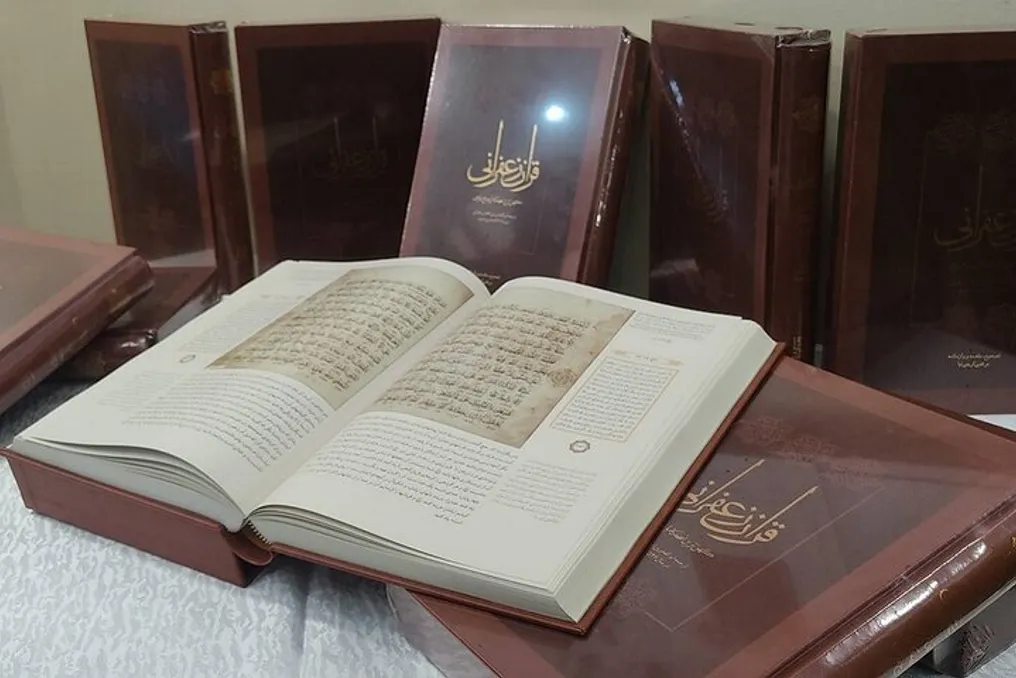
A ceremony was held at the National Library and Archives of Iran to present a high-quality facsimile copy of the 'Zafaran Quran.' This manuscript is recognized by scholars as the oldest known complete and dated handwritten copy of the Holy Quran, accompanied by a translation into Persian.
Manuscript and Event Details
The event was jointly organized by the National Library and Archives of Iran and the Farhang-e Siadat Publications in Tehran. Prominent cultural and scientific figures attended, including Ali Ashraf Sadeghi, Seyed Mohammad Emadi Haeri, Ahmad Masjed-Jami, Mohamrez Amirhani, Head of the National Library, Mortaza Karimi, a manuscriptologist, along with other researchers and officials. A recorded presentation by the renowned scholar of Persian literature, Mohammad Jafar Yahaki, was given.
This manuscript, which was housed in the Reza Abbasi Museum in Tehran, was copied in 546 AH (1151–52 CE) by Abolfazl Zafaran in the city of Rey. Researchers consider it the earliest surviving complete and accurately dated Quran with a Persian translation, making it a vital source for studying both Quranic translation and the historical development of the Persian language.
Scholarly Significance and Preparation
Karimi detailed the years of effort required to prepare this publication. He noted that the creation process demanded exceptional care to recreate the distinctive colors and physical characteristics of the manuscript. The project took almost eight years and utilized advanced color calibration methods to produce a facsimile maximally consistent with the original.
Speakers at the ceremony emphasized the significance of the manuscript from linguistic, historical, and religious perspectives. Emadi Haeri discussed the origin of the Persian translation, describing it as an independent scholarly tradition rooted in early Iranian exegesis of the Quran. He also highlighted the role of early Islamic scholars in legitimizing the translation of the Quran into Persian, which represented an intellectual development that influenced the language's religious literature.
Linguistic and Cultural Value
Persian linguist Ali Ashraf Sadeghi focused on the manuscript's linguistic value, calling it important evidence of the evolution of classical Persian. He pointed out that the diversity of early Persian Quranic translations reflects the regional linguistic landscape of medieval Iran and demonstrates the significant role such works played in preserving and enriching the Persian language over centuries.
Sadeghi noted that achieving a perfect, one-hundred-percent translation between two languages is practically impossible, adding that a translator's skill is measured by their ability to convey the full meaning of the original text in the target language. He explained that there are many different Quranic translations because Arabic and Persian words rarely have a perfect one-to-one equivalent, and usually, a word covers only the main part of the concept.
He also stressed that it would be unfair to criticize ancient translators for their choice of specific words, as they selected the best available equivalents based on the language and time in which they lived.
Significance for Iranian Heritage
Masjed-Jami, former Minister of Culture and Islamic Guidance, characterized the 'Zafaran Quran' as one of the most valuable treasures of Iran's written heritage. He stated that the manuscript stands at the intersection of religious scholarship, the Persian language, and the country's long tradition of manuscripts. Masjed-Jami noted that publishing a high-quality facsimile provides scholars and the public with a rare opportunity to study one of the earliest surviving Persian translations of the Holy Quran without endangering the original.
He also insisted that such manuscripts should not be viewed merely as museum exhibits but rather as living witnesses to Iran's intellectual and cultural history. According to him, preserving, publishing, and presenting such works to new generations is vital for protecting the nation's cultural identity, as the 'Zafaran Quran' reflects centuries of scholarly effort and demonstrates the deep connection between the Persian language and Islamic sciences.
Additional Aspects of the Manuscript
In his recorded remarks, Yahaki placed the manuscript within the broader context of the history of Quranic translation in Iran, describing the sixth century AH as a golden age of Persian exegesis and Quranic translation. He emphasized that manuscripts like the 'Zafaran Quran' provide invaluable evidence of the close link between Islamic science and the growth of Persian literary culture.
Beyond its religious significance, researchers view the 'Zafaran Quran' as a rich source of early Persian vocabulary and expressions that preserve linguistic forms that have disappeared from modern use. Scholars also note that the manuscript offers valuable insight into medieval practices of translation, manuscript production, and the intellectual currents of the Seljuk period.
Another feature of the manuscript is its interlinear format, where the Persian translation is written in smaller script between the lines of the Arabic text. In the opinion of researchers, the translation is closely related to the commentary on the Quran by the 11th-century scholar Abu Bakr Atik Nishapuri (Surabadi), while the manuscript itself was copied by Zafaran, whose work became an important subject of manuscript study.
The recently published edition is expected to make one of Iran's most valuable Quranic manuscripts more accessible to specialists in Islamic studies, Persian literature, codicology, and manuscript conservation, while highlighting Iran's enduring contribution to the history of Quranic science and the Persian language.