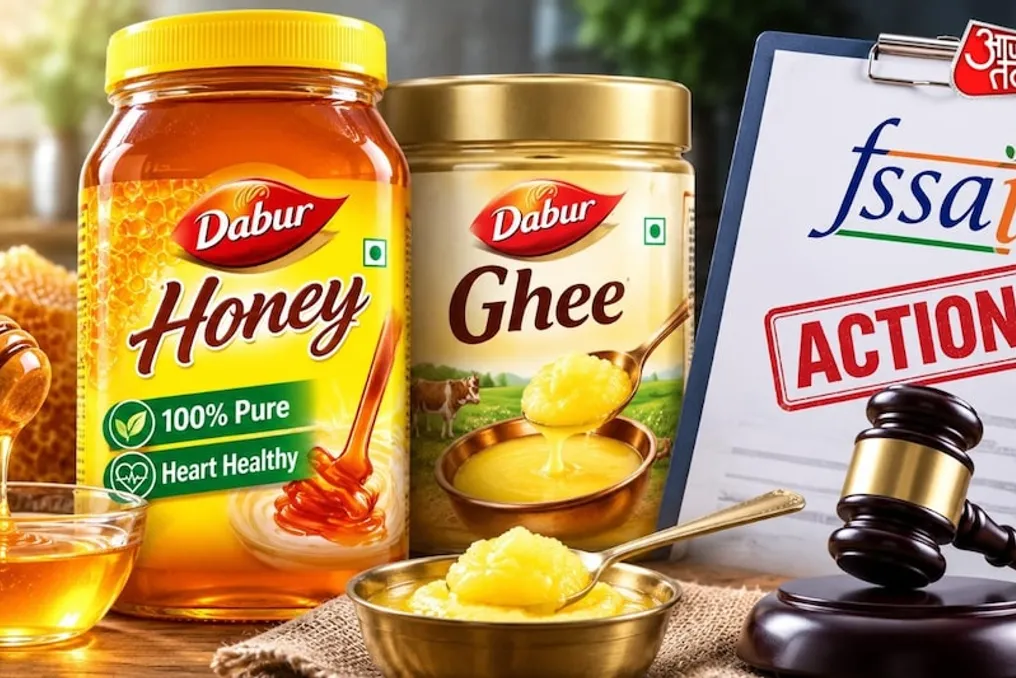

Recently, consumers often choose products based on prominent labels such as '100% pure' or '100% natural,' which create a sense of reliability. The presence of the FSSAI mark on the packaging also instills confidence. However, FSSAI (Food Safety and Standards Authority of India) recently issued a notification to Dabr India regarding such '100%' claims for a range of food products, including honey, ghee, and oil.
This incident has once again raised questions about the veracity of such claims on products. There is growing interest in whether medical tests exist to confirm product purity and whether having an FSSAI license number implies the absolute truthfulness of all statements on the packaging. To get answers to these questions, the authors of the appeal contacted a senior FSSAI official and the director of the medical department at Safdarjung Hospital.
According to a senior FSSAI representative, the presence of the FSSAI mark only allows a company to sell a product in the market, provided that moderate consumption does not harm health. Nevertheless, obtaining a license does not grant a company the right to make any claims about its product that contradict scientific data or FSSAI regulations.
The officer clarified that when applying for permission to sell a packaged product (be it honey, ghee, oil, milk, or biscuits), FSSAI checks the production process, compliance with sanitary standards, and raw material quality. Microbiological tests are conducted, and other parameters are assessed. Only after meeting all these criteria does the product receive permission to be sold and the FSSAI mark. Furthermore, FSSAI does not monitor the attractiveness of advertising or future marketing claims made by the company about its product, which often leads to public misunderstanding.
The FSSAI representative emphasized that the license confirms the product's compliance with all quality parameters but does not guarantee that every statement on the packaging is scientifically proven within the field of medical science. Consequently, companies cannot claim that a product is '100% natural' or '100% pure.'
The FSSAI official explained that phrases like '100% pure' are more akin to marketing tactics influencing consumer decisions. Legislation prohibits companies from misleading consumers with such claims, yet they use these terms to increase sales. This is precisely why appropriate measures are being taken.
According to FSSAI rules, the Food Safety and Standards Act of 2006 is used to take action. Under this act, an explanation is requested from the company, a notice may be issued, an inspection may be conducted, and violators may face penalties. The notification sent to Dabr was related to a violation of rules because the company positioned honey and ghee as '100% pure,' which the regulator considered misleading.
The Director of the Medical Department at Safdarjung Hospital, Professor Dr. Jugal Kishor, noted that many products undergo laboratory testing, but it is important to distinguish between food and medical tests. When a company tests honey, ghee, or oil, the goal of the test is to ensure the product's safety for consumption, the absence of dangerous bacteria, and the non-use of chemical substances, as well as to determine their quantity.
If all these indicators are normal, the product can be released onto the market. However, such tests do not prove that the product is '100% pure.' Dr. Kishor explained that honey is not simply collected from hives and packaged; it undergoes various processes, including the addition of preservatives. After processing, a food test is conducted to check for impurities and food safety, but this test does not confirm the '100% pure' or 'natural' status. Thus, while each claim might be true from a quality analysis perspective, it does not meet the requirements of medical science. This is why FSSAI takes such claims seriously and requires scientific substantiation from companies.
Dr. Kishor advised consumers not to make purchasing decisions solely based on large advertising slogans. It is necessary to carefully examine the ingredient list on the back of the packaging and always check the FSSAI license number. Products should be purchased based on factual data, not on advertising promises.