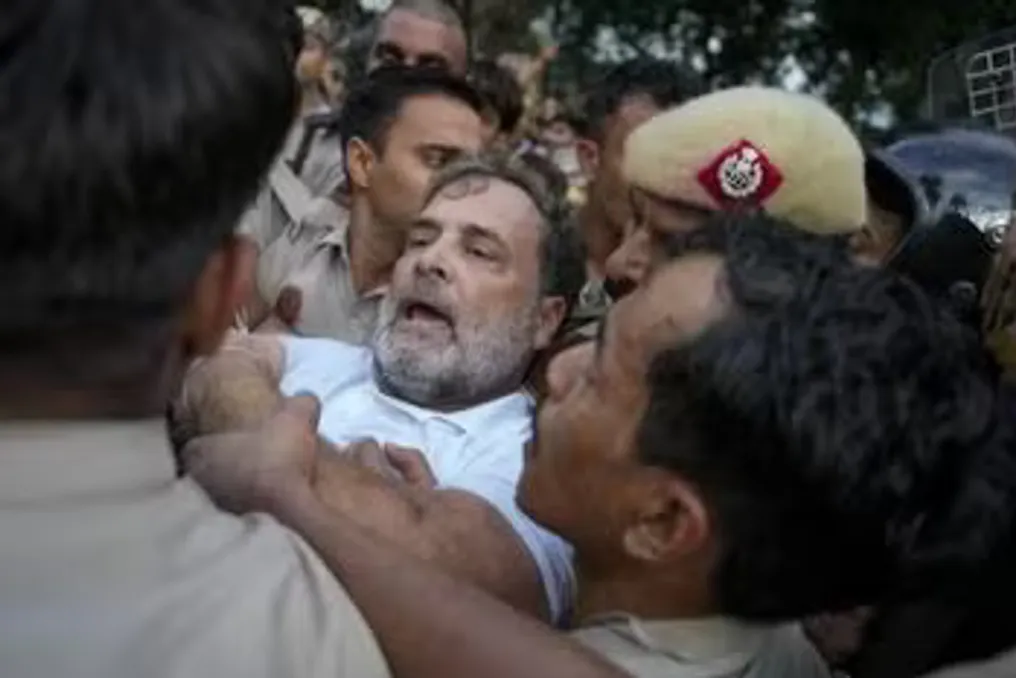
The central government has increased security measures in Delhi by deploying additional Central Reserve Police Force (CRPF) units due to escalating protests related to alleged irregularities in the NEET-UG exam, as well as the spread of opposition party demonstrations across the country.
Security Measures Tightened in Capital
The Ministry of Home Affairs ordered the transfer of twenty additional CRPF companies to Delhi. These forces are arriving from Kolkata. This measure aims to strengthen security in the national capital amidst the intensification of the Cockroach Janta Party (CJP) campaign, political actions, and the current Parliament session during the monsoon season.
CJP continued its night-time activities, gathering near Jantark Mandir and in other parts of central Delhi. However, the organization canceled a planned demonstration near the Delhi Police headquarters after the police released all detainees the previous evening. A CJP representative, Saurav Das, reported on Wednesday morning that his WhatsApp account had been blocked without explanation.
CJP Demands and Government Response
Ashutosh Ranka from CJP stated that the current protest is 'the largest movement in India's history since independence.' He warned that millions of people might come to Delhi if the government does not meet their demands. Speaking to ANI, Ranka added that if the government does not agree, 'millions more will come to Delhi because this time we will not hold back or remain silent.' He urged the government to 'get its act together,' otherwise the country's youth 'will overthrow them very strongly.'
Delhi Police reported that 11 First Information Reports (FIRs) were registered over the last two days for attacks on RAF personnel during the July 20th protest.
Spread of Congress Protests
Congress leaders Rahul Gandhi and Priyanka Gandhi were among those detained by Delhi Police on Tuesday after opposition figures staged a sit-in protest near Prime Minister Narendra Modi's residence. Congress President Mallikarjun Kharge and several other senior leaders also participated in this demonstration, which was organized in response to police action against CJP protesters. The detainees were released a few hours later.
These detentions sparked protests among activists and youth wings of the Congress in Assam, Kerala, West Bengal, Jammu and Kashmir, Maharashtra, Karnataka, and Haryana. Party leaders accused the central government of attempting to suppress democratic dissent. In a video message on X, Rahul Gandhi stated that the government was uninterested in discussing events related to the July 20th march to Parliament, which turned violent. He demanded 'firstly the resignation of Dharmendra Pradhan and Home Minister Amit Shah,' as well as action against those who beat and humiliated students, and the withdrawal of all cases against students. Gandhi also insisted that this issue be discussed in the Lok Sabha and Rajya Sabha.
Trinamool Congress (TMC) chief Mamata Banerjee called the police action against protesters 'unacceptable' and expressed support for her party's sit-in protest of the opposition. Mamata stated on social media: 'Police brutality against our youth in Delhi is unacceptable. Shame on the central government. All India Trinamool Congress fully supports the opposition's sit-in protest today near Akbar Road. Our full solidarity.'
Pradhan's Allegations Against Rahul Gandhi
Union Education Minister Dharmendra Pradhan, at the center of the dispute, accused the Congress and Rahul Gandhi of using students as 'political tools' to disrupt the monsoon session of Parliament. He wrote on X: 'Even after the Government announced its readiness for comprehensive discussion, the Congress preferred political spectacle over democratic debate. Their goal was never solutions for students; it was disruption for political headlines.' The minister emphasized that the government remains '100 percent committed' to discussing NEET and resolving student issues in plenary sessions of Parliament. Pradhan added that India's students deserve more than being puppets in a political campaign; they deserve certainty instead of chaos, solutions instead of slogans, and accountability instead of failures. He also noted that the government remains committed to providing answers, reforms, and accountability.
Vangchuk's Action and International Support
Union Ministers J.P. Natta and Jitendra Singh reportedly met with activist Sonam Wangchuk at Medanta Hospital on Tuesday evening. Wangchuk has been on an indefinite hunger strike since June 28th over alleged irregularities in the NEET examination. Delhi Police moved Wangchuk from the protest site at Jantark Mandir to Safdarjung Hospital last Saturday after his health deteriorated following more than three weeks of fasting. He was later transferred to a private clinic by order of the Delhi High Court. Opposition parties supported Wangchuk and CJP protesters, demanding that the government engage in dialogue with the hunger strikers.
Solidarity demonstrations with Wangchuk also took place outside India in New York, San Jose, London, and Dublin. Activists from the American human rights group Hindus for Human Rights gathered near Mahatma Gandhi's statue in Union Square in New York and in San Jose on Monday evening, according to PTI. They carried placards supporting Wangchuk and demanding the resignation of Pradhan. Similar actions were organized near the Indian Mission in London and the Indian Embassy in Dublin, the group reported. The organization stated: 'Our protests sent a clear signal, whether in New York or London, San Jose or Dublin: Indian students deserve fair and dignified treatment.' The group also strongly urged the government to contact Wangchuk and other protesting hunger strikers.
3.