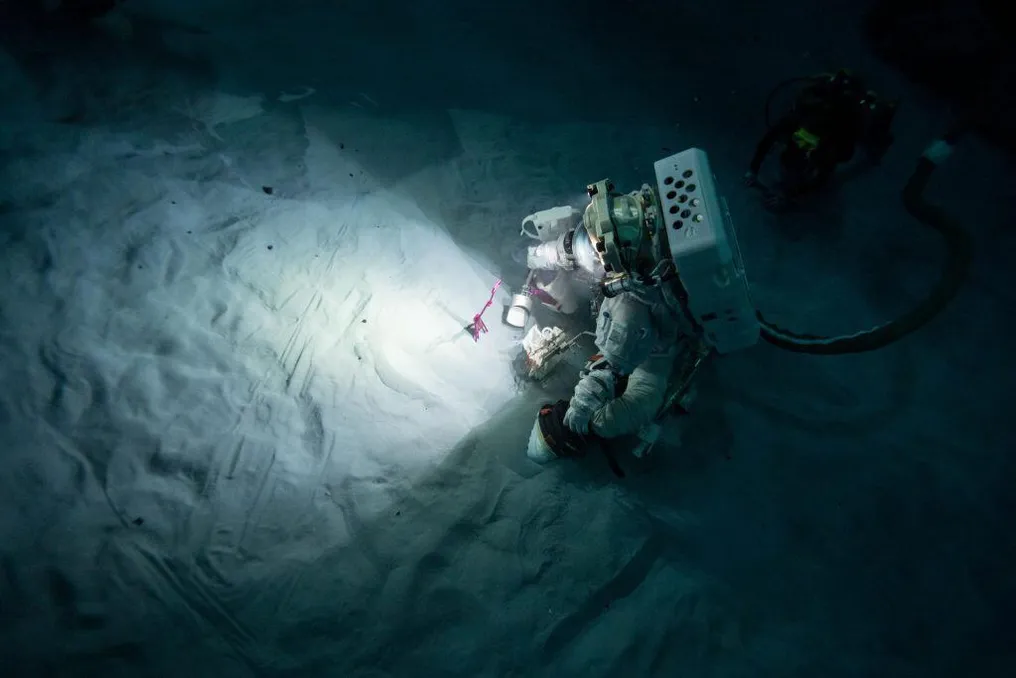
Astronauts involved in the Artemis IV program underwent underwater training before exploring the Moon. Recently, NASA geologists Trevor Graff and Angela Garcia participated in a simulation conducted at the Neutral Buoyancy Laboratory (NBL), located at the Johnson Space Center in Houston.
This facility contains a very large tank designed to replicate some of the conditions astronauts will encounter during future trips to Earth's natural satellite.
For those in a hurry:
The NASA geologists were in an aquatic training session that mimics some of the circumstances astronauts will face in upcoming Artemis missions to the Moon. The vast NBL tank was modified to recreate the characteristics of the lunar south pole, allowing for the testing of scientific equipment, tools, and exploration procedures.
The data obtained from these tests will serve to prepare astronauts for future crewed expeditions, focusing on sample collection and conducting research on the lunar surface.
How does a pool assist in preparing space missions?
Although water does not precisely replicate lunar gravity, it offers an ideal controlled environment for astronaut training and adaptation. Inside the tank, which reaches approximately 12 meters deep, team members can practice movements, check equipment, and improve safety protocols.
For the Artemis program training, a section of the pool was transformed into a setting resembling the lunar terrain. This area was equipped with soil and rocks mimicking the Moon's landscape, in addition to having low lighting to simulate the conditions found at the south pole of the natural satellite, an area that the Artemis IV mission intends to investigate.
In this simulated environment, Graff and Garcia evaluated geological instruments that may be used in future crewed missions, in addition to conducting tests on assembling scientific apparatus.
According to NASA, this was the first time two geologists jointly participated in lunar geology training at the NBL as part of the Artemis program.
The results of these tests will be used to support the training of astronauts who will participate in upcoming missions landing on the Moon. The main purpose is to ensure that the teams are capable of collecting samples and operating equipment in one of the most complex regions of the natural satellite.