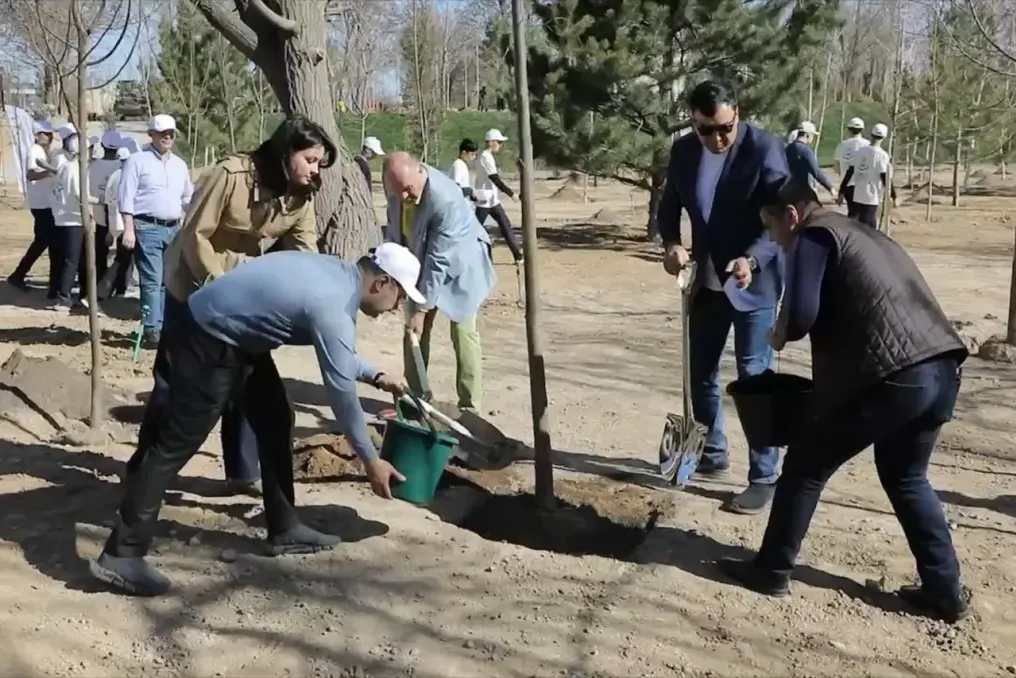
The nationwide project 'My Garden' (Mening Bog'im) continues to be implemented in Uzbekistan, aiming to create modern green public areas based on citizen initiatives. This project unites the efforts of the state, local authorities, the National Committee on Ecology and Climate Change, forestry services, and residents, contributing to the formation of a comfortable urban environment, improving the quality of life, and adapting settlements to the consequences of climate change.
A key feature of the project is the active participation of the public. Residents submit proposals for the creation of new green zones, which are then put to a public vote on the 'Open Budget' portal. Projects that receive the most support receive funding, and their implementation is carried out by the National Committee on Ecology and Climate Change together with relevant agencies.
More than 500 new green zones in three years
The scale of the project expands annually. In 2024, 789 initiatives were submitted to the 'Open Budget' portal, of which 212 projects became winners after voting. 140.1 hectares of land were allocated for their implementation, resulting in the appearance of 128 green gardens and 84 public parks.
In 2025, residents proposed 570 projects, from which 174 initiatives were selected. After assessing the locations, 18 projects were rejected due to non-compliance with established requirements. As a result, 89 green gardens and 67 public parks were created on an area of 104.9 hectares according to approved design and estimate documentation.
Work continues in 2026. The Council of Ministers of the Karakalpakstan Republic, together with the hokimiyats of regional and city administrations of Tashkent, prepared 610 proposals for the creation of new green zones. More than 152,000 citizens participated in the vote, with 97,400 supporting the winning projects. After selecting 208 initiatives, they received funding, guaranteeing at least one project in every region and city of the country. A total of 52 billion Uzbek soms has been allocated for the implementation of these projects.
New green zones across the country
Currently, the 'My Garden' project is being implemented in all regions of Uzbekistan. In the Surkhandarya region, in the Angor district, one of the region's largest green zones is being created on the territory of 'Korakir'. 270,000 ornamental trees are being planted on an area of 108 hectares to improve the ecological situation, combat desertification, and form a new green landscape.
In the Khorezm region, near the 'Arda Khiva' complex, a modern park of 9 hectares is being formed, where more than 4,000 ornamental trees have already been planted. Upon completion, it will become one of the largest recreational areas of historical Khiva.
In Samarkand region, a 'Green Garden' of 2 hectares has been created in the Olmazor mahalla of the Bulungur district, where more than 1,200 ornamental trees adapted to the local climate have been planted. The installation of lighting, benches, and other landscaping elements is nearing completion. Meanwhile, a new public park with pavilions, pedestrian paths, and comprehensive greenery has opened in the Akdaryo district.
Several large projects are being implemented simultaneously in the Jizzakh region. In the Yangiobod mahalla of the Sharaf Rashidov district, a public park of 10 hectares is being developed, where 2,500 ornamental and fruit trees have currently been planted. In the city of Jizzakh itself, construction of a new park of 13.6 hectares is underway, featuring over 4,800 planted trees and shrubs, including Crimean and Eldar pines, oak, ash, maple, chestnut, birch, elm, and catalpa. In the 'New Uzbekistan' massif of the Sharaf Rashidov district, a public park of 28 hectares and a protective green belt using terracing have been created, where 11,270 trees have been planted and a modern drip irrigation system installed.
The creation of new public gardens and the improvement of existing green areas continue in the Navoi region, with environmental protection services ensuring constant care for young plantings.
Additional contributions come from other environmental campaigns: a 'Tax Inspectors' Garden' of 10,000 trees has been created in Jizzakh, and an initiative dedicated to the 80th anniversary of UNESCO under the slogan '80,000 Trees' has led to the planting of 6,500 seedlings in the Sharaf Rashidov district alone.
In the Fergana region, a green belt with over 100,000 ornamental trees has been formed around the Karkidon reservoir, and a protective forest strip spanning 7.1 kilometers has been laid along the access road.
Modern approach to urban greening
The creation of green zones includes not only tree planting but also the organization of long-term professional care, with a special focus on summer watering and agrotechnical measures. Cooperation between the National Committee on Ecology and Climate Change and the International Fund 'Zamin' provides an additional impetus to development. Within the 'Yashil Zamin' project, active since 2022, thousands of trees and shrubs were planted this spring in Tashkent, Akhangaran, and Yangihoyod districts.
Only in the Yangihoyod district were over 2,000 plane trees, oaks, ashes, myrtle, and Sharon rose bushes planted on an area of 2 hectares, increasing the total number of plantings in this district to 18,790 on an area of 25.6 hectares.
Greening was also promoted along the Burzar canal embankment in the Chilanzar and Yakkasaray districts of Tashkent, as well as in Akhangaran, covering 4.5 hectares with over 5,000 trees during the spring campaign.
In 2026, seven joint environmental projects with the Zamin Fund are planned, including the creation of the youth eco-park 'Yoshlar Eco Bog'i' of 9.26 hectares in Khiva (where 3,082 trees and over 2,000 shrubs are already present) and the comprehensive reconstruction of a 22.6-hectare park in Angren, which will be equipped with walking alleys, modern lighting, picnic areas, an artificial pond, and an automated irrigation system.
Investments in the country's ecological future
The 'My Garden' project has become one of Uzbekistan's largest public environmental initiatives. By giving citizens the opportunity to vote on local projects, it increases green coverage while simultaneously fostering a culture of environmental care oriented towards creating sustainable and viable cities.