Chatsworth Hotel today appears dilapidated and worn out. In the mid-1960s, before newspaper delivery luxury was available in Umlatuzana, the memoir's author, as a ten-year-old boy, often visited the place to buy a newspaper from a street vendor.
Chatsworth Hotel today appears dilapidated and worn out. In the mid-1960s, before newspaper delivery luxury was available in Umlatuzana, the memoir's author, as a ten-year-old boy, often visited the place to buy a newspaper from a street vendor.
This vendor, standing at the entrance of the long green corridor, didn't just sell news; he offered folded newspapers for just two cents to city dwellers whose composure had waned after daytime entertainment. On Fridays, two girls joined him, helping with sales by offering hot peanut sticks and boiled beans, and their quiet pleas attracted coins from the pockets of drunken patrons.
These memories of the once majestic Chatsworth Hotel resurfaced when the author saw an advertisement for the sale of a state agency for a substantial sum of 26.5 million rands. Experts assess this price as highly inflated, arguing that even one-third of the requested value would be excessive given the building's current condition.
The author shares the story of his father, who moved to neighboring Umlatuzana in 1962 after the expropriation of a banana plantation in Cavendish (now Beyview) to build his dream home. Umlatuzana was the first settlement intentionally planned for Indians in South Africa, designed by the respected geodesist T.S. Shelin. The author's father feared that the noise and revelry of the hotel, which was soon to appear nearby, would destroy the peace he sought.
The 1960s were marked by expansion and population movement. Chatsworth itself was transforming into a vast Indian township, a result of forced removals related to apartheid. Families evicted from places like Cato Manor, Bellair, Civie, Riverside, Rossburg, Clairwood, and banana plantations in Cavendish were relocated to rows of municipal housing without any public amenities.
In the 1940s and 1950s, Munsemi Jivarautnam 'MJ' Naidu worked as a porter and loader at the famous Langham Hotel, located at the corner of Point Road and West Street in Durban. His mother sold snacks such as vadas and murukku at the hotel, walking there from Pantens Hill, a small Andhra enclave.
Munsemi Naidu managed to rise from a porter to a hotel owner. He started modestly, then became a waiter, and finally ended up behind the bar. Together with his brother Stanivasan, he opened a modest tea room on East Street in Overport. Profits accumulated carefully, forming the basis for his ambitions.
By 1961, these efforts bore fruit: the brothers acquired a plot for a hotel in developing Umlatuzana, beginning a new chapter of Indian entrepreneurship in South Africa. Munsemi Naidu's father-in-law, SP Chetty, was a builder who, along with his sons, constructed the first hotel in Chatsworth. The Chetty family already had experience building landmark buildings such as the Sri Vaiyatanatha Eswaran Alayam temple and the Naaz cinema.
Chatsworth Hotel opened its doors in early 1963. This hotel was a statement of intent: it featured a large reception hall, twelve stylishly furnished rooms, a public bar, three service bars, a dining room, and the Lyric Ballroom, capable of accommodating 400 guests. It served as a monument to Indian craftsmanship and a symbol of the two brothers' aspiration for perfection despite forced relocation.
On Friday and Saturday evenings, the surroundings of Chatsworth shone with anticipation. People arrived in dance attire, drawn by the rhythm of the music and the atmosphere of the dance floor. The Lyric Ballroom became a center of attraction, where hundreds of visitors, mostly Indians, gathered to forget the isolation imposed by the Group Areas and Separate Development Acts.
The hotel dining room served both Western and classic Indian dishes, but curries and snacks like samosas and fish patties gained the most popularity. Tamarind fish curry, as well as offal dishes, were favorites among regular guests. Saturday evenings were filled with music from groups such as Crescendos, Dukes Combo, and Hot Shots, which could be heard even by the author's father studying textbooks.
Sunday held a special charm: due to restrictions on alcohol sales to non-white people on Saturday, 'Sunday sessions' took place in the dining room. For 10 cents, one could get a drink in exchange for food such as cheese and crackers, which was a way for the community to gather and spend time together despite the petty rules of apartheid.
The hotel basement found new life when Dhanpal Naidu, a figure associated with horse racing, leased the space for a totalizer operation. By 1970, the hotel roof was converted into a glass pavilion, which became a popular venue for weddings and social events, as well as sporting competitions.
The bar had regular customers, including the author's uncle, Harry Naidu, who came in his green truck. Bartenders like Scampi Naidu and Chin Naidu knew their regulars well, providing them with comfort and friendly conversation. As Chatsworth Hotel prospered, two other brothers of Munsemi and Stanivasan—Harihar (Harry) and Devaraj (Tumba)—also entered the hospitality business. They founded the company Forbros, which eventually managed an entire chain of establishments.
The empire, built on resilience and vision, expanded beyond hotels to include the Greencat nightclub and the Odeon cinema. However, the fame of Chatsworth Hotel began to fade when hotels started hosting guests of all races. Visitors began seeking trendier spots in the city, and the music industry transformed, giving way to rock music and digital audio.
Some critics view romance novels skeptically, calling them 'predictable' or 'slow,' while others deem them 'toxic and deeply problematic.' Even when media promotes this genre, there remains a tone of condescension, visible in lists such as Cosmopolitan's 'romance books that don't disgust.'
Despite the romance genre continuing to gain momentum post-pandemic, selling about 63 million print and e-books last year (compared to approximately 39 million in 2020), and thanks to television adaptations of works like 'Heated Rivalry' and the 'Bridgerton' series, skepticism persists.
A researcher studying publishing in the romance sector asserts that the world needs romance novels more than ever. Firstly, the romance genre consistently satisfies women's need for physical pleasure, whether through the slow pacing of 'inspirational romance' or the passionate relationships in romantic fantasy.
Critics often challenge the genre's central element—the happy ending—arguing that life is unpredictable and complex, and novels offer false hope. However, the plots in romance books essentially revolve around life's difficulties, particularly women's struggles. For instance, in Jane Austen's 'Pride and Prejudice,' the Bennet sisters face poverty if they do not marry, and the heroines in Kennedy Ryan's novels cope with domestic violence, mental illness, and chronic diseases.
It can be argued that many women read romance because life can be hard: amidst chaos, readers find solace in stories of love, growth, and hope. Furthermore, the genre plays a critical role in the publishing industry by supporting it, as it accounts for nearly a quarter of print fiction sales, significantly higher than 15 percent in 2020. Meanwhile, literary fiction accounts for only 8 percent of the market.
Romance authors have also contributed to changing writing, production, and distribution methods, improving market conditions for many writers. Since publishers long offered romance authors modest fees and poor contract terms, these authors were among the first to explore digital self-publishing through e-books, proving that writers no longer need traditional publishers to succeed.
Studies have shown that between 2009 and 2014, amid the e-book boom, the median income of romance authors increased by 73 percent, while the overall income of US authors dropped by 42 percent during the same period. Ultimately, independent authors forced traditional publishers to change payment structures and launch new imprints.
While acknowledging that the quality of romance literature is not always flawless, and some stories may romanticize toxic behavior, such as Christian Grey's sadism in 'Fifty Shades of Grey' or kidnapping in 'Fire and Flower,' the author notes that readers understand the difference between fiction and reality.
Nevertheless, despite all these arguments, romance novels, their readers, and authors deserve respect. This genre continues to support the existence of specialized stores, such as the 150 stores dedicated solely to romance in the United States, and attracts attention through its screen adaptations.
Canal+ has acquired exclusive rights to all UEFA men's club competitions in Sub-Saharan Africa for four seasons, starting from mid-2027 until 2031. These rights cover the Champions League, Europa League, and Conference League in over 40 countries.
SuperSport, which has long been the broadcaster of these competitions in the region, retains its rights. However, in French-speaking Africa, Canal+ Sport is restoring full coverage of the Champions League and adding the Europa League and Conference League for the first time on an exclusive French-language basis.
The counterparty is UC3, a joint venture between UEFA and European football clubs (formerly the European Club Association). In March 2025, UC3 entrusted the American agency Relevent with a global mandate for marketing and selling commercial rights to the club competitions for six seasons, from 2027/2028 to 2032/2033. Canal+ signed a four-season package within this six-year cycle. The deal's value was not disclosed.
This move is seen as a clear statement about where Canal+ intends to compete after acquiring MultiChoice Group, as well as an acknowledgment of areas where it cannot compete. Since scripted entertainment content has become the cheapest on the internet, streaming services like Netflix, Disney, Amazon, and Apple sell content libraries in South Africa for much less than the most expensive DStv package. Consequently, a household interested in a prestigious drama series sees no reason to pay a premium for cable television for that content. Furthermore, global streamers are not yet ready to invest heavily in Africa specifically in this category.
Canal+ followed this logic since gaining control in September 2025:
Simultaneously, Canal+ was cutting back on entertainment spending: the Showmax service was discontinued in March and closed at the end of April, and the usual price increase in April was not applied.
Last week's half-year financial results for Canal+ help explain this strategy. Canal+ reported a 40% revenue growth in the first half and a 68% increase in adjusted profit before interest and taxes. Meanwhile, MultiChoice's adjusted EBITDA grew by 160%, reaching 143 million euros, and subscriber acquisition in MultiChoice countries increased by 40%. The total African subscriber base grew by 7%, and South Africa recorded its best month for new subscribers in a decade in June. Group CEO Maxim Saada acknowledged that this growth is largely due to the recently concluded FIFA World Cup.
Unlike the World Cup, the Champions League football takes place weekly over four seasons, which is likely an attempt to turn a temporary surge of interest into a permanent level, thereby stopping subscriber decline. Nevertheless, these are also ongoing costs: the inflation of broadcasting rights is relentless. Canal+ has secured four seasons of confidence in its most important asset for customer retention, as well as four seasons of guaranteed expenses. The bet is that Africans, including those in South Africa, will continue to pay for football even after they stop paying for movies.
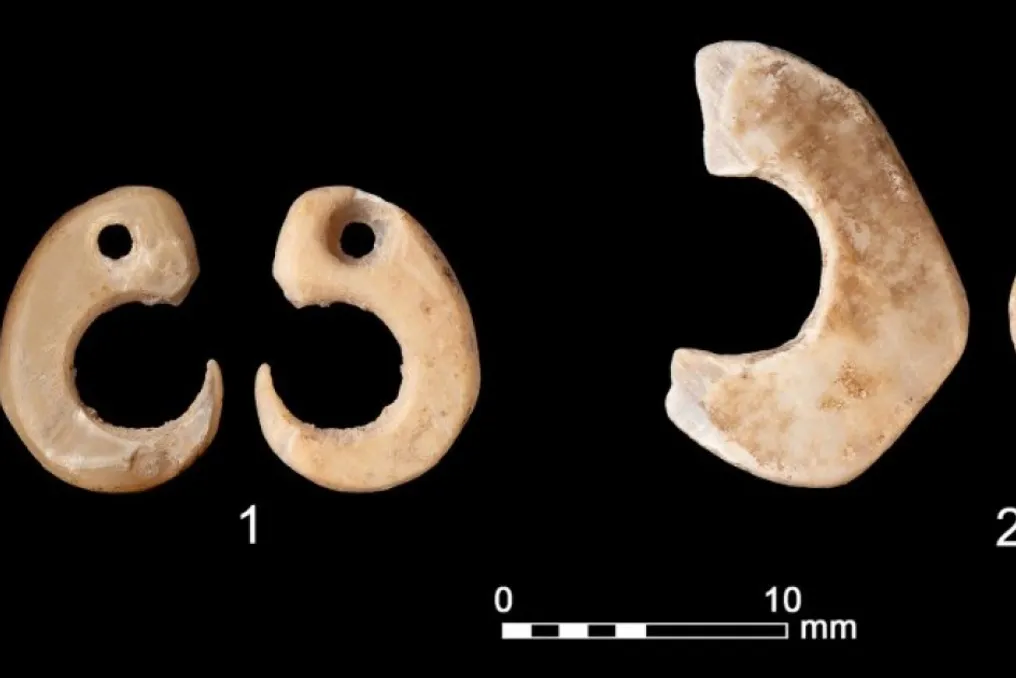
Archaeologists have discovered a pair of fishing hooks, crafted during the Middle Chalcolithic period and made from mollusk shells, in Israel. These unusual artifacts were found at the Tel-Tzaph site. According to a publication in Archaeological Research in Asia, the items date back to the late sixth to early fifth millennium BCE.
Based on these findings, it appears that ancient inhabitants of the region did not frequently consume fish, although there is evidence of using this food source as early as the Lower Paleolithic. A prime example is the Levantine site of Gesher Benot Ya'aqov, where traces of cooking over a Heidelberg fire were found alongside fish remains.
With the advent of the Upper Paleolithic era, not only animal remains began appearing at settlements, but also specialized fishing tools, among which fishing hooks are the most obvious. The earliest known finds of this type originate from Japan (dating back about 23,000 years) and Timor Island (dating back 16–23,000 years).
Danielle Bar-Joseph from Harvard University and her Israeli colleague reported on other interesting discoveries, though less ancient. During excavations at Tel-Tzaph in Israel, in layers dated to the late sixth to early fifth millennium BCE, two objects were found. One was a complete fishing hook with a drilled loop, and the second was an unfinished similar item. Both artifacts were only 10–16 millimeters long and were made from mollusk shells, but the exact species of mollusk could not be determined due to their condition and processing.
Scientists noted that such items had not previously been encountered at such ancient sites, although they were present at sites in the southern Arabian Peninsula, where they were presumably used for catching small fish, as well as in Egypt. The authors suggest that these artifacts may not be related to actual fishing but could have served as valuable imported ornaments, which is known from later periods.
Throughout history, people have used diverse methods of obtaining food, including not only rods but also hunting with bows and arrows, and likely inventing nets long before their remains began to be preserved in fossil form, as evidenced by a drawing on a stone slab found in Europe.
In another part of the study published in the Journal of Human Evolution, researchers presented new remains of a Heidelberg man who died in central modern Spain. Archaeologists discovered a fragment of the parietal bone of a prehistoric individual who lived, by estimates, between 224,000 and 160,000 years ago.