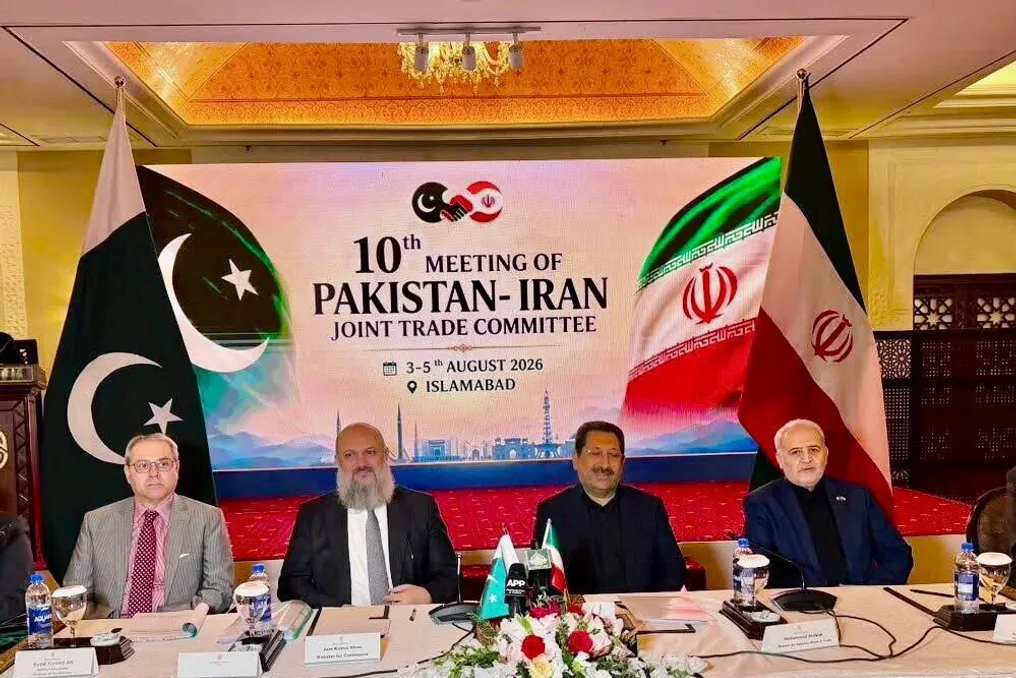
As part of demonstrating economic diplomacy, Iran and Pakistan held the nineteenth session of their Joint Trade Committee in Islamabad. High-level delegations from both countries set an ambitious plan to achieve an annual trade target of $10 billion, which is expected to fundamentally change the economic landscape of the two neighboring states.
The two-day meeting, co-chaired by Iran's Minister of Industry, Mining, and Trade, Seyed Mohammad Atabak, and Pakistan's Minister of Commerce, Jam Kamal Khan, became the most comprehensive bilateral trade discussion in recent years. Issues ranging from finalizing the long-awaited Free Trade Agreement to resolving urgent logistical problems at ports and border crossings were discussed.
Speaking at the opening ceremony at the Serena International Hotel in Islamabad, Minister Atabak emphasized that Iran's strategic policy involves the comprehensive development of cooperation with neighboring and allied countries, particularly Pakistan. He noted that the annual bilateral trade volume has already reached approximately $3 billion, indicating real and extensive potential between the two economies.
Pakistan's Minister of Commerce, Jam Kamal Khan, supported this view, stating: 'We are determined to conclude the Free Trade Agreement between Pakistan and Iran.' Khan stressed that the long-standing and fraternal relations between the countries serve as a solid foundation for continuing friendship and neighborliness on the path to improving comprehensive cooperation.
He added: 'We believe it is time to finalize the Free Trade Agreement between the two countries,' emphasizing that 'our common roadmap for increasing trade must be implemented.'
In addition to government-level negotiations, a high-level trade delegation from the Iranian Chamber of Commerce for Trade, Industry, Mining, and Agriculture, led by Vice President Hossein Pirmozen, arrived in Islamabad. The goal of this delegation is to ensure the full inclusion of private sector voices in the discussions.
The delegation includes the head of the Iran-Pakistan Joint Chamber, numerous chamber heads from across Iran, leaders of specialized chamber committees, as well as private sector representatives from various fields such as food industry, agriculture, transport and transit, energy, automotive industry, and polymer and petrochemical sectors.
Business representatives planned meetings with members of the Islamabad Chamber of Commerce and the Pakistani private sector, and will participate in the Iran-Pakistan Business Conference at the headquarters of the Federation of Pakistan Chambers of Commerce & Industry.
The Joint Trade Committee sessions are conducted within four specialized working groups covering the following areas: trade, transport and customs, free zones, and the Free Trade Agreement. Technical meetings began a day before the official opening, allowing officials to make significant progress on complex issues.
A critical agenda item is resolving issues affecting Iranian containers in the port of Karachi. Following the maritime blockade imposed on Iran, some containers were rerouted to Karachi, creating serious difficulties, including delays in cargo transshipment, changes in bills of lading, and rising demurrage costs for traders and cargo owners.
Minister Atabak demanded urgent control over the issuance of marine transshipment and transportation permits, exemption from warehousing costs, and resolution of administrative and procedural matters for customs clearance. He stressed that resolving these issues would facilitate transit routes through Pakistani ports and strengthen the position of the ports of Karachi, Qasim, and Gwadar in regional trade.
Perhaps the most striking statement was made when Atabak asserted that achieving the $10 billion target within one year is entirely feasible, provided existing obstacles are removed, the Free Trade Agreement is concluded, direct financial and banking links are established, and burdensome regulations and bureaucracy are reduced.
He welcomed recent Pakistani initiatives, including transit directives, the possibility of air transport for essential goods, and the exemption of certain export goods from financial and banking procedures, calling for the rapid implementation and expansion of these measures.
The Minister specifically highlighted the importance of diversifying transit routes—land, air, and sea—and pointed out that given the regional circumstances and Iran's program to shift the route from the UAE to Pakistan, the swift execution of transit directives could play an effective role in developing bilateral and regional trade.
Atabak also expressed concern about excessive waiting times at the Mirjaveh-Taftan border terminal, noting that the sharp decline in traffic in recent days requires urgent review and resolution. The Minister called for accelerating and simplifying border procedures to ensure the unimpeded movement of commercial fleets.
Strengthening economic ties between Iran and Pakistan has significant implications beyond bilateral relations. Improved transit cooperation can lay the foundation for connecting European and Asian markets, positioning both countries as key hubs in east-west trade corridors. Pakistani ports—Karachi, Qasim, and Gwadar—can serve as additional routes for reexporting Iranian goods and supplying raw materials needed by industries across the region.
As the Nineteenth Joint Trade Committee continues its work, with the closing ceremony scheduled for Wednesday, expectations are high for tangible results. Both sides have demonstrated genuine political will to transform their economic relationship from unrealized potential into a dynamic partnership that brings concrete benefits to businesses and citizens.
Coordinated steps taken by the governments of both countries to remove trade barriers, improve border infrastructure, and modernize customs procedures indicate that the $10 billion goal is not merely a wish, but a realistic objective based on the shared determination of two brotherly nations to build a prosperous economic future together.