In the second season of the 'Initiative Budget,' 23,551 projects were presented. The number of such projects increased by almost 12 percent, while the total funding amount remained virtually unchanged.
In the second season of the 'Initiative Budget,' 23,551 projects were presented. The number of such projects increased by almost 12 percent, while the total funding amount remained virtually unchanged.
According to data from Tashkent on August 4, 23,551 projects were submitted by citizens for the second season of the 'Initiative Budget' for 2026. 2 trillion 187.7 billion sums have been allocated for their financing to the respective regions.
Compared to the first season, the number of initiatives grew by 2,502 projects, which is 11.9 percent. In the first season of this year, 21,049 projects were presented, for which 2 trillion 188.2 billion sums were allocated.
Thus, despite an increase in the number of projects by almost 12 percent, the volume of funding has practically not changed, decreasing by 500 million sums.
Samarkand region ranked first in terms of the number of projects. Tashkent region led in the first season.
Fergana region was noted as second in the number of projects but took first place in allocated funding.
Regional indicators:
Data for Samarkand region includes:
Data for Karakalpakstan Republic includes:
In the first season, Tashkent region led in the number of projects with 2,129 initiatives. Fergana region contributed 2,050 projects, and Samarkand region contributed 1,832 initiatives. In the second season, Samarkand region increased the number of projects to 751, which is an increase of almost 41 percent, causing the region to take first place.
The provided data on the number of submitted projects reflects the figures as of August 3 before the selection process; it is possible that the number of initiatives to be put to a vote may decrease after moderation.
In recent years, Uzbekistan has been paying special attention to expanding access to higher education and supporting segments of the population in need of social protection.
The admission procedure to universities is being expanded through the introduction of preferential quotas, allowing a larger number of orphans, as well as children from low-income families and girls, to gain the opportunity to receive higher education. This mechanism is considered important for ensuring the principle of equal opportunities in education.
The State Commission for Admission to Educational Institutions of the Republic of Uzbekistan has approved the general admission parameters for state higher educational institutions for the 2026/2027 academic year. In accordance with this decision, additional state grants and special quotas have been allocated to support groups of people in need of social assistance.
Specifically, an additional state grant of 1 percent has been established for orphans and those deprived of parental care. This is aimed at increasing the chances of these young people entering university and helping them acquire a decent profession in the future.
Furthermore, an additional quota of 10 percent for a state grant has been allocated for children of families included in the 'Social Register'. This decision serves as an important social guarantee for children from low-income families, allowing them to pursue higher education without financial obstacles.
Measures to support women are also continuing. 2500 places under payment contracts have been allocated for women with at least five years of work experience. This gives working women the opportunity to improve their qualifications and obtain higher education.
In addition, an extra 4000 state grants have been allocated for women studying full-time. This measure is designed to stimulate women's interest in education and promote their role and economic activity in society.
According to experts, the strengthening of the social orientation of admission quotas demonstrates the country's consistent policy of improving human capital quality, ensuring equal opportunities, and supporting needy segments of the population.
Overall, the approved admission parameters for the 2026/2027 academic year are important not only for expanding coverage of higher education but also for ensuring social justice through education, enhancing the intellectual potential of women and youth, and preparing competitive personnel for the country's development.
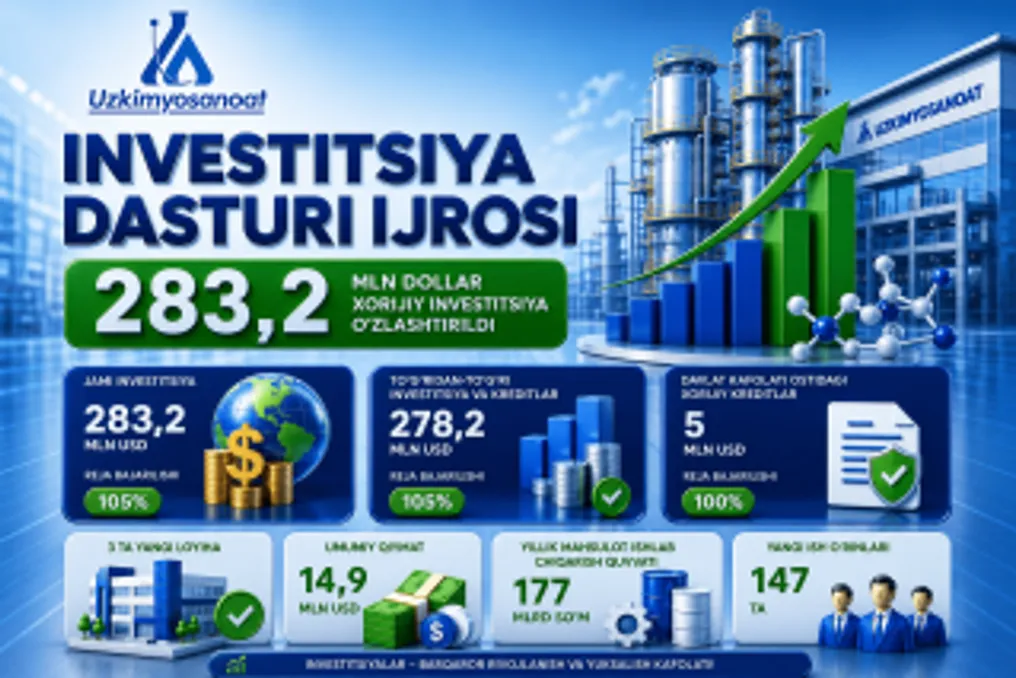
The joint-stock company 'Uzkimyosanat' successfully implemented the tasks set out in the Investment Plan during the first half of 2026.
Significant results were achieved during the reporting period in the areas of enterprise modernization, development of high-tech production, and job creation. Over six months, $283.2 million in foreign investments were attracted, resulting in the Investment Plan being fulfilled at 105%.
The attracted funds consisted of $278.2 million in direct foreign investment and loans, as well as $5 million in foreign loans under state guarantees.
Furthermore, three investment projects with a total value of $14.9 million were commissioned during the six-month period. These projects enabled the creation of production capacity worth 177 billion UZS annually and provided for the creation of 147 new jobs.
It is noted that these projects make a significant contribution to increasing production potential, expanding the output of import-substituting and export-oriented products, and ensuring employment of the population.