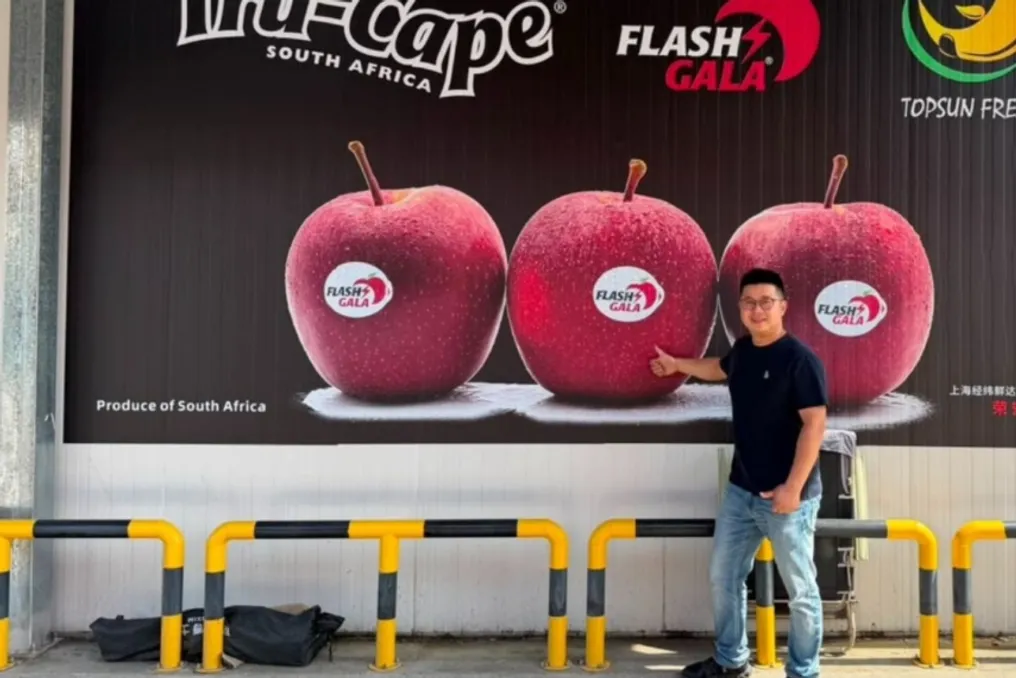
Topsun Fresh, a long-time Chinese importer of Tru-Cape Fruit Marketing, has invested in installing two large billboards to promote the Tru-Cape and Flash Gala brands. These billboards are located at two of China's largest fruit wholesale markets.
Topsun Fresh, a long-time Chinese importer of Tru-Cape Fruit Marketing, has invested in installing two large billboards to promote the Tru-Cape and Flash Gala brands. These billboards are located at two of China's largest fruit wholesale markets.
The campaign, which began at the start of this month, aims to strengthen trust in Tru-Cape apples among retailers, wholesalers, and end consumers in a market where buyers have a wide selection.
One of the billboards is installed in the importer's trading area at the Guangzhou Jiannan wholesale market, considered one of China's largest fruit wholesale markets and the country's main fruit import hub. The second billboard was erected at the Shanghai Huizhang wholesale market, which specializes in imported fruits. Topsun Fresh is also considering placing a more prominent advertising spot in the Shanghai market to increase visibility.
According to Neil Van, General Manager of Topsun Fresh, this campaign is the first of its kind for the South African apple and pear industry. Van noted that, to his knowledge, South African citrus companies previously placed billboards in these markets, but Tru-Cape is the first South African company to promote apples and pears in this manner.
For Van, these billboards mean more than just advertising; they contribute to building trust. He explained that since China produces more apples and pears than any other country, consumers do not experience fruit shortages. A strong brand gives buyers confidence in receiving expected quality with every order, allowing one supplier to stand out from others and fostering long-term customer loyalty.
Van also emphasized that Chinese buyers increasingly value consistent quality over just price. He added that consumers are willing to pay more for fruits that consistently meet high quality standards, and the market recognizes this through the improvements made by Tru-Cape's farmers and packing houses year after year.
He believes that Tru-Cape's close engagement with the Chinese market is a key differentiator. The Tru-Cape team regularly visits China with technical, marketing, and commercial specialists to better understand market trends and meet the specific quality and packaging requirements of Chinese buyers. This level of involvement is unique because they are not just discussing prices, but working together with partners to understand market and customer needs.
Van also noted a shift in consumer habits: whereas imported apples were previously bought mainly as gifts or symbols of a healthy lifestyle, today they are increasingly consumed as convenient daily snacks, despite consumers having many other options, including berries, grapes, and stone fruits.
Tru-Cape Marketing Director, Conrad Fink, welcomed the initiative by Topsun Fresh, noting that it demonstrates the confidence of Chinese partners in the company's brands. He stated that China remains one of the most important markets for long-term growth, and the potential here far exceeds current export volumes. Despite the market being regulated by strict phytosanitary protocols and registration requirements, exporters who consistently supply high-quality products receive deserved rewards.
Fink mentioned that South African apples have gradually gained recognition since gaining market access more than ten years ago. When South Africa first entered the Chinese market, there was skepticism because their apples were generally smaller than those of traditional suppliers. However, today consumers appreciate the sweet taste, eating quality, and convenience of South African apples, and repeat purchases are increasing as brand awareness grows.
He believes that South Africa is well-positioned to capitalize on changing consumer preferences. Fink concluded that Chinese consumers are increasingly preferring sweeter and redder apples, which aligns with South Africa's production profile. By continuing to invest in quality, branding, and strong customer relationships, the company can expand its presence in this vital market.
According to the National Automobile Dealers Association (NADA), the strong growth in new vehicle sales in South Africa is due to multiple factors, not just the rapid emergence of Chinese brands, as established manufacturers continue to hold leading positions despite increased competition.
The association reported on Tuesday that the record sales figures for June create the impression that affordable and technologically advanced Asian brands have completely changed the country's automotive landscape. However, NADA Chairman Brandon Cohen argues that the data suggests a more balanced picture.
Cohen noted that June recorded the highest sales figure in nearly two decades, dating back to 2007. He emphasized that many observers tend to attribute this boom solely to the rapid influx of budget Chinese brands, but this is not entirely accurate.
According to Cohen, traditional manufacturers still account for the majority of new car sales, demonstrating the loyalty of South African consumers to proven brands. In June, Toyota remained the top seller, with 12,417 units sold. It was followed by Suzuki with 5,689 units and Volkswagen with 5,613 units. Hyundai and Ford took fifth place with sales of 2,986 and 2,961, respectively.
Cohen added that new players are rapidly expanding their presence and achieving impressive volumes, but they are not displacing traditional brands. He also clarified that the current market recovery extends not only to passenger cars but also to light commercial vehicles, heavy trucks, and buses.
In Cohen's view, an increase in consumer confidence has played a significant role in the market recovery, supported by a more stable political situation and measures mitigating the impact of global oil price volatility for drivers. NADA also refuted concerns about job threats in the retail sector due to the growth in brands and the appearance of multi-franchise dealerships.
Instead, Cohen described this trend as an evolution of the dealership model, not its decline. He stated that sharing real estate and operating costs optimizes the functionality of dealerships, noting that multi-brand dealerships benefit from an increased flow of customers, especially in the price segment below 400,000 rand. Nevertheless, he warned that the long-term success of a dealership depends on more than just selling new cars, emphasizing the importance of after-sales service, workshops, parts availability, technical expertise, and customer support.
The shift in the new car market is also transforming the used car sector. Cohen reported that increased competition from attractively priced new cars is putting downward pressure on prices in the secondary market ranging from 350,000 to 500,000 rand, as dealers adjust pricing to remain competitive. Furthermore, he expects a shortage of premium used vehicles in the medium term, as buyers increasingly opt for cheaper options instead of trading in luxury models.
In conclusion, Cohen stressed that the industry transformation should be viewed as an opportunity, not a shock. He concluded that the influx of new participants has not resulted in a complete revolution, but rather an evolution marked by adaptation and innovation, ultimately benefiting the South African consumer who has a wide choice.