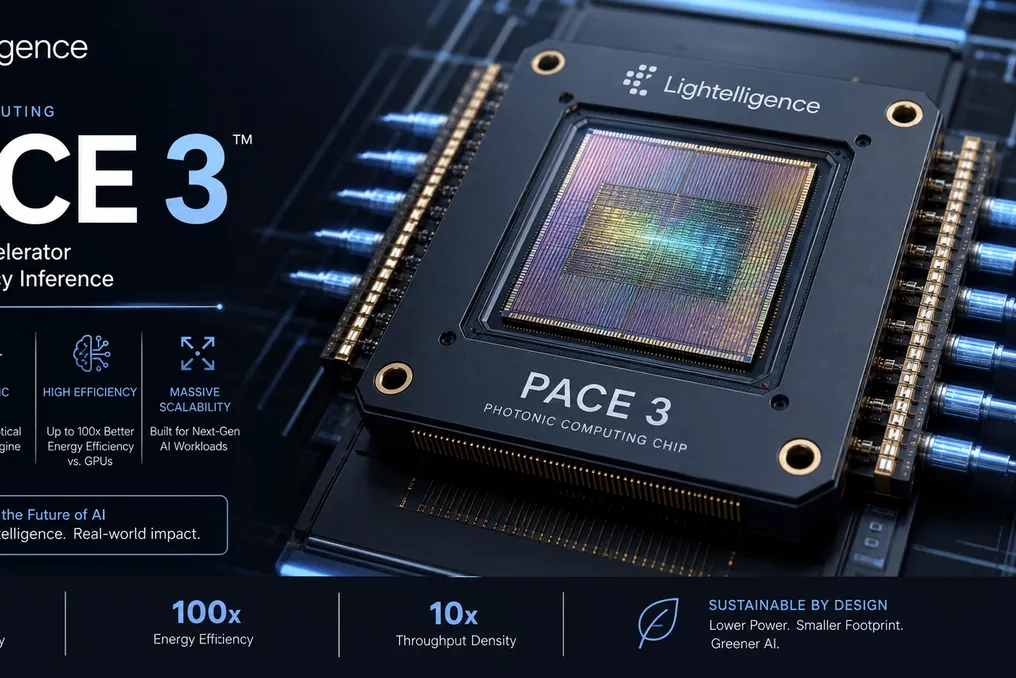
Lightelligence announced the achievement of a commercialization milestone for optical computing by introducing the PACE 3 chip featuring a 256x256 photonic matrix. At the WAIC 2026 forum, the company demonstrated the world's first deployed photonic computation in real-world conditions using the Tianshu Light Cube access control system.
PACE 3 Concept and Architecture
The PACE 3 chip is specifically designed for performing inference on large models, not for training them. It utilizes a photonic in-memory computing architecture to execute matrix-vector multiplications, which is the primary computational pattern during neural network inference. This architecture provides lower latency and better energy efficiency compared to electronic counterparts.
Overcoming Adoption Barriers
The hybrid photo-electric architecture addresses a fundamental problem: while photonic computing offers advantages such as high throughput, reduced transmission losses, and inherent parallel processing capability, its practical application requires integration with electronic systems for data conversion and control. The main obstacle to scaling was a contradiction: end-users saw no incentive to reconfigure software for unproven hardware, and suppliers lacked market demand to cover the costs of producing optical devices.
Lightelligence's Integration Approach
Lightelligence's method involves combining the capabilities of optical switching, optical interconnects, and the photonic computations themselves within its product line. This allows for the creation of integrated photo-electric solutions that do not require clients to completely overhaul their software stack. Co-founder and CTO, Dr. Meng Huaiyu, noted that the size of the photonic matrix was intentionally chosen to achieve an optimal balance, as large computations require effective coordination between matrices of different sizes, rather than one excessively large one.
Vision for Future Optical Computing
Dr. Shen Yichen compared the current stage of development to creating a hardware lottery for future applications, drawing parallels with how NVIDIA's gaming processors spurred the development of neural networks. Lightelligence also places simulators in classrooms so that next-generation algorithms can evolve on photonic hardware. The company asserts that photonic computing is not a replacement for GPUs but forms an entirely new ecosystem, and the demonstration of the access control system confirms long-term operational stability.