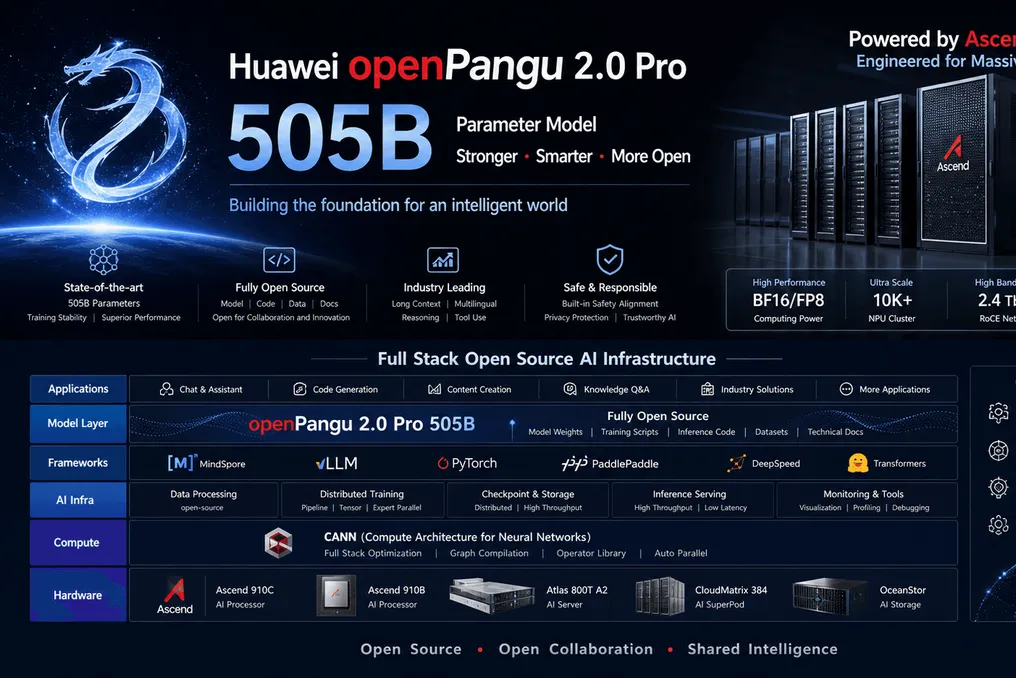
Following statements about the aspiration to make Pangu a world-class leader, Yu Chengdong unveiled openPangu-2.0-Pro. Huawei has released the source code for openPangu-2.0-Pro along with weights, inference code, and a technical report. This model is the first in the series of 500 billion parameters to be fully trained on hardware other than NVIDIA, strengthening the domestic computing ecosystem.
On July 31, Huawei made openPangu-2.0-Pro publicly available. The model features 505 billion total parameters, approximately 180 billion sparse activations, and a context window of 512K. It was trained on Ascend NPU based on 34 trillion tokens. A key distinction is the fully functional open-source nature: unlike many other open-source models that only provide weights, openPangu-2.0-Pro offers a completely reproducible chain from training on Ascend to native Ascend inference. This is the first frontier-level model with over 500 billion parameters fully trained on non-NVIDIA hardware. Seven components were released, including pre- and post-training code. Yu Chengdong explained the choice of 505 billion parameters by stating that computational power is largely utilized by other domestic enterprises, leaving limited resources for Huawei.
The model's architecture is optimized for resource constraints and incorporates hybrid DSA plus SWA attention, four-thread mHC residuals, three-head MTP self-speculation, and the Muon optimizer. With a 128K context window, the minimum TPOT latency is 9.55 milliseconds, and single-card throughput reaches 1326 tokens per second, enabling real-time operation at the edge. The 512K context window with sparse activation allows the model to comprehensively analyze data and perform computations efficiently: it can read an entire set of contracts or a factory's annual log in a single pass while maintaining cost control. The model is oriented towards long-context agent tasks, becoming a digital employee capable of multi-step decision-making, planning, and tool invocation, marking a transition from simple chat to full functionality for devices, vehicles, and industrial control. The report frankly admits that openPangu-2.0 still lags behind leading models in complex real-world software engineering tasks, reflecting a long-term strategy.
The Pangu model acts as an industry expert in AI for industry, utilizing the L0 foundation, L1 industry, and L2 scenario architecture. State-level models operate entirely locally. For instance, Pudong Development Bank created the Pu Hui Cloud Cang warehouse bank, which improved cargo detection by 5–10% and reduced development time from months to days. PetroChina Kunlun achieved a 40% increase in sub-millimeter defect elimination, and manufacturers began saving 20 tons of fuel daily per furnace. Intelligent driving benefits from understanding trajectories within the 512K window. Guangyao reduced early drug discovery costs by 70%, and Hanyu improved production decision-making efficiency by 90%. Tianjin Energy achieved 100% heating balance while reducing energy consumption by 10%. Small businesses benefit the most: now district hospitals or local agricultural institutes can own industry agents.
The release was deliberate: the unveiling of seven components began on June 30 at HDC 2026. Initially, a 92-billion parameter Flash model was released, followed a month later by the heavier Pro version, allowing for the provision of training methodologies and engineering knowledge, rather than just releasing a repository. This approach echoes the view of Jian Zhengfei on Apple: open collaboration focusing only on the most advantageous part. In the age of AI, ecosystem victory precedes the performance of a single machine. Open channels guide developers into the Ascend plus Pangu river, and as users grow, this river expands. openPangu-2.0-Pro serves as a 'keystone' for the domestic community: when leading players collectively disseminate their capabilities, lower-level applications flourish, and Chinese enterprises can form a unified force on an independent stack for the first time. For a company under intense pressure, handing over the heaviest core technology to everyone is the highest form of trust.