After the Wukong project disappeared four months after its launch, Alibaba is moving its Qianwen Office platform into public beta testing. This platform integrates QoderWork, Wukong, and MuleRun, indicating that competition in office AI solutions extends beyond individual agents.
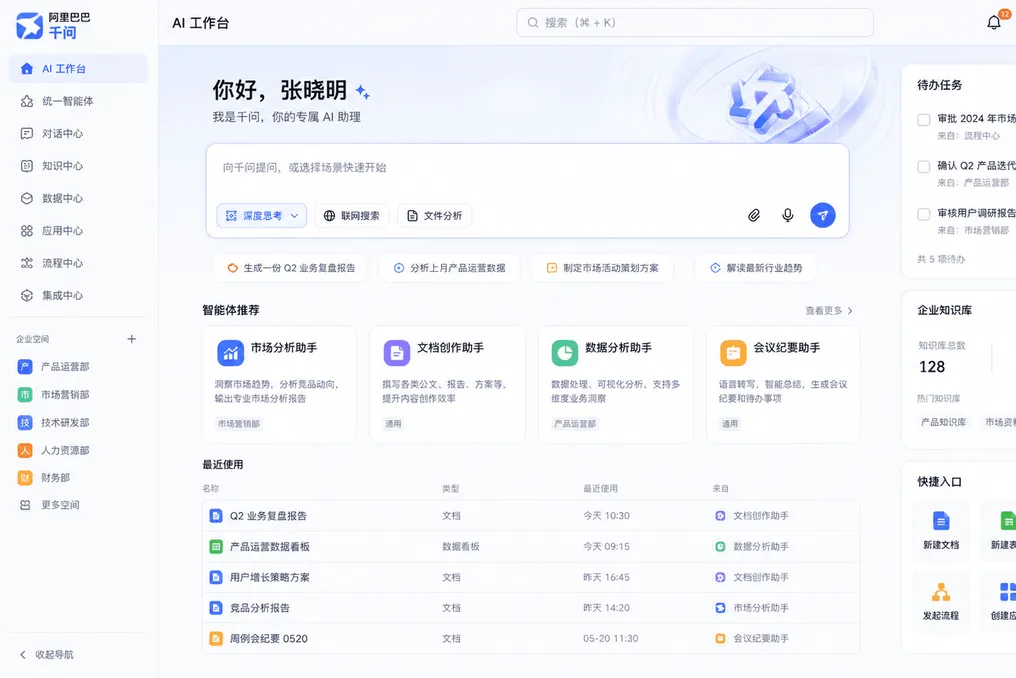
On August 3rd, Alibaba introduced Qianwen Office in public beta mode. This is a comprehensive AI-based office platform that allows users to describe tasks, which the agent then breaks down into subtasks, calls necessary tools, and provides a final result. Initially, the platform was integrated with DingTalk IM. It includes QoderWork, Wukong, and MuleRun, which will no longer exist as separate products; the former Wukong module has been promoted to a first-level division within the Alibaba Token Hub group.
More than four and a half months ago, Wukong was a central element of Alibaba's corporate AI strategy. Launched on March 17th as an AI-native working platform for the enterprise sector, it featured the ability to rewrite code in DingTalk for CLI formatting, as well as converting assertions, schedules, and documents into callable interfaces. At that time, DingTalk's former CEO Chen Hang stated: 'Today we are dismantling DingTalk and rebuilding it with AI to create Wukong.'
Despite the disappearance of the Wukong brand, the direction of enterprise AI has received a higher organizational status. This demonstrates a shift in office AI competition from the stage of creating individual agents to unifying models, desktop execution, corporate data, permissions, and commercialization within a single product.
Microsoft defined the first phase of this trend: in 2023, 365 Copilot appeared in Word, Excel, and Teams, performing drafting and summarization functions under human supervision. By June 2026, paid subscriptions exceeded 30 million, with Accenture acquiring over 740,000 such seats. However, Microsoft's scenarios did not confirm that AI could complete tasks autonomously.
Changes occurred in the coding domain: Claude Code was introduced in May 2025 and reached an annual revenue of $2.5 billion by February 2026, proving users' willingness to pay for task completion.
Anthropic Cowork added the capability for agents to operate in the field of intellectual labor: users specify a folder, the agent reads materials, analyzes data, generates documents, and supports browser operations, scheduled tasks, and corporate plugins. Its impact was that the logic verified by Claude Code became accessible to all knowledge workers.
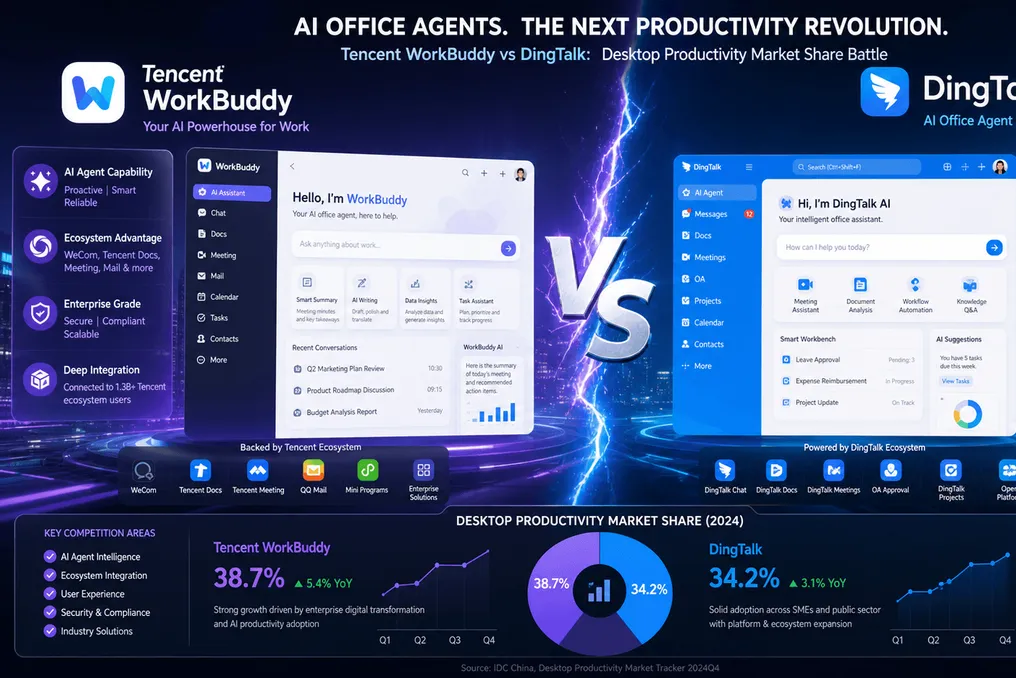
Five days after the launch of Cowork, the Tencent team developed WorkBuddy 0.01 over a single weekend, and its public beta started on March 9th. For this, they used their proprietary CodeBuddy Agent framework to adapt code execution for non-programmers. ByteDance renamed TRAE SOLO to TRAE Work on June 9th, expanding the scope of AI beyond pure code. Thus, AI coding became a key technological matrix.
In early 2026, OpenClaw pushed desktop agents into the mainstream, showing that agents could operate locally, access files and software, and accept remote commands. Alibaba offered three solutions: QoderWork for desktop execution, MuleRun for task delivery, and Wukong relied on DingTalk for organization and security. None of these paths closed the full corporate loop.
In June, according to Analysys, the total number of visits to Chinese AI-based desktop office agents exceeded 60 million, with WorkBuddy being the most frequently used efficiency agent among daily active accounts. Microsoft updated Copilot to an asynchronous colleague, OpenAI launched Frontier, and Google named Gemini in Chat a unified command line for work. The four-month cycle of Wukong demonstrated that AI work is becoming a point of entry for software value redistribution, where integration determines who owns the unified productivity interface.