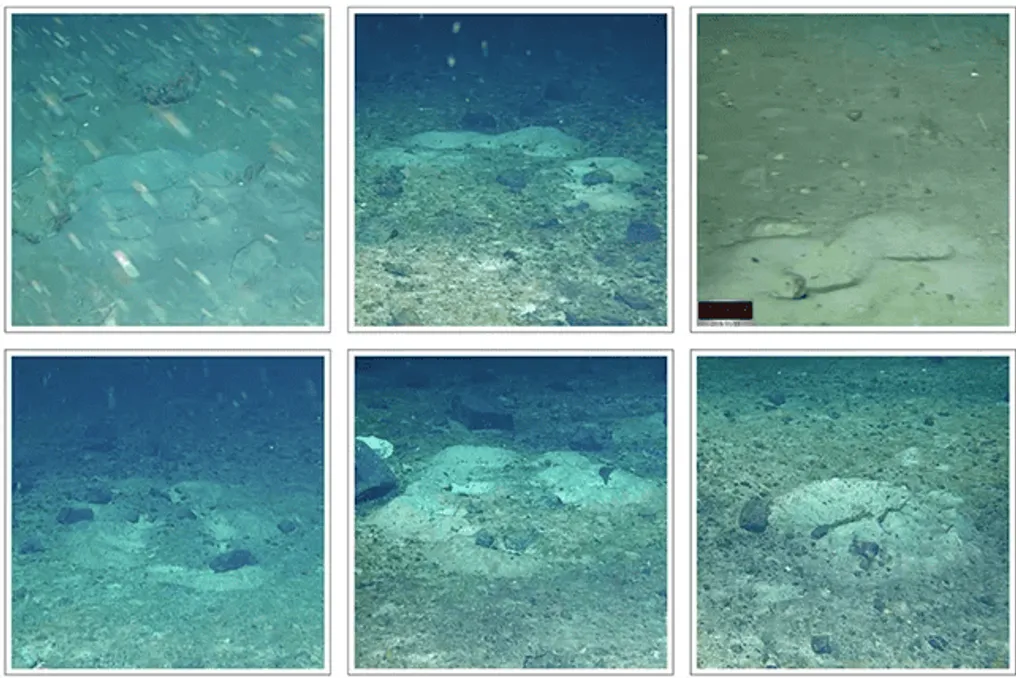
A vast area filled with fish nests was revealed on the seabed of Antarctica after the breakup of a massive iceberg, exposing a region that had been covered by ice for thousands of years. This discovery, considered unprecedented by researchers, has the potential to support efforts to designate part of the Weddell Sea as a protected marine zone. The findings were detailed in the scientific journal Frontiers in Marine Science.
The iceberg paved the way for the discovery
The opportunity arose in 2017 when the gigantic iceberg A-68 separated from the Larsen C ice shelf. With the removal of this mass of ice, scientists from UK institutions were able to investigate an extensive area of the deep ocean that was previously inaccessible. Using a remotely operated underwater vehicle, the team located over a thousand fish nests scattered across the seafloor. These nests are defined as meticulously cleaned spaces between the ocean floor sediments where fish lay their eggs.
The nests exhibit geometric patterns
The most notable aspect for the researchers was not just the quantity of nests, but the way they were arranged. The team identified six distinct geometric configurations of organization, with clustering being the most frequent, representing approximately 42% of the observed nests. In this arrangement, the nests are very close, sometimes touching or even overlapping.
According to the researchers, this organization appears to be primarily linked to defense against predators, rather than environmental conditions. The authors reported: 'Our results document a large and widely dispersed aggregation of Lindbergichthys nudifrons fish nests in the west of the Weddell Sea, a region that became accessible after the calving of the Larsen C ice shelf.'
They argue that identifying these geometric patterns corroborates the theory that interactions between the animals themselves, particularly pressure exerted by predators, are responsible for the colony's structure.
The strategy increases egg survival
The species under study, known as the yellowfin notie (Lindbergichthys nudifrons), can reach about 19.5 centimeters in length. Each nest is capable of containing thousands of eggs, which are guarded by males for up to four months. Scientists argue that these clusters provide crucial benefits for offspring survival. In addition to multiple males simultaneously protecting the edges of the colony, the high concentration of nests can make it difficult for predators to detect the eggs by smell.
The researchers stated: 'This would significantly reduce the risk to the nests located in the center of the cluster.'
This defensive behavior had been seen in colonies of shallow tropical reef fish, but had never been recorded in this Antarctic species.
Interestingly, the original scientific mission was not primarily focused on studying fish. During the 2019 Weddell Sea Expedition, conducted aboard the SA Agulhas II, researchers were also searching for the remains of the Endurance, a vessel captained by British explorer Ernest Shackleton, which sank in the area in 1915. Although the ship was only found in 2022, scientists found fish nests in all locations investigated during the expedition.
The discovery reinforces the call for environmental protection
Researchers emphasize that Lindbergichthys nudifrons plays a vital role in the Antarctic food chain, making these colonies essential for the balance of the local ecosystem. According to the study, this finding offers new evidence to classify the area as a Vulnerable Marine Ecosystem and strengthens the proposal to establish a Marine Protected Area in the Weddell Sea.
The authors concluded: 'These discoveries provide critical evidence about unique and structured reproductive habitats, strengthening the argument for creating the proposed Weddell Sea Marine Protected Area.'