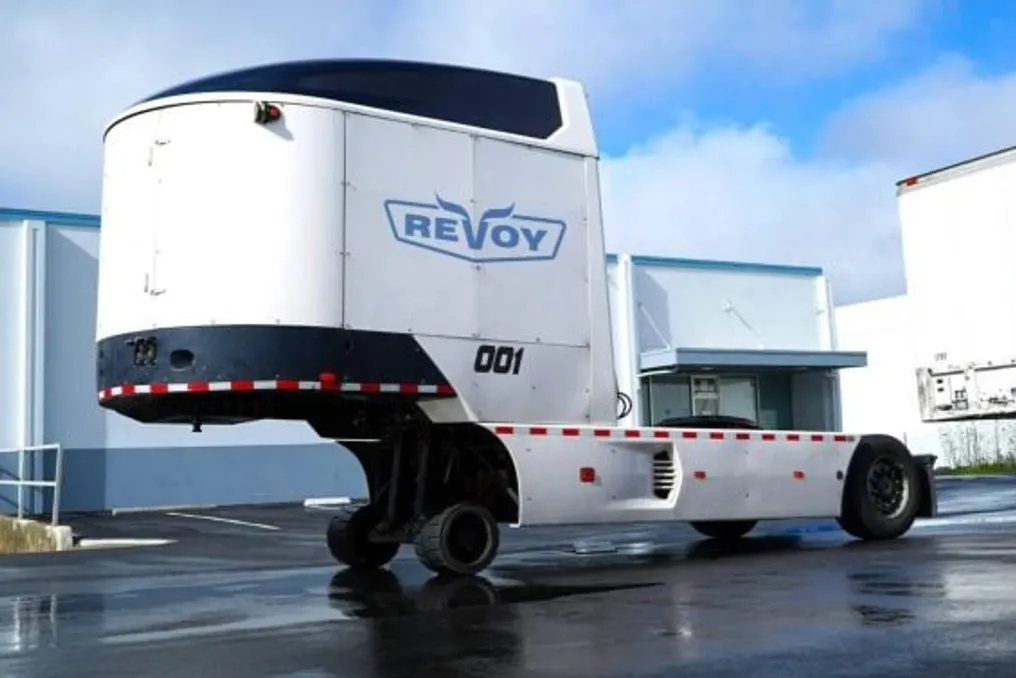
An electric powertrain developed by the American startup Revoy from San Francisco is a detachable electric dolly capable of transforming diesel trucks into hybrids. This solution allows for a reduction in fuel consumption and carbon dioxide emissions by up to 85% without modifying the main engine.
To overcome obstacles associated with the high cost of fully electric trucks, limited range, and long charging times, the company created an autonomous electric dolly that attaches between the tractor and the semi-trailer.
Revoy received approval from the NHTSA, the US road safety agency, in 2023. In 2024, the company completed a one-year pilot project with the transport company Ryder. The first commercial operation will begin this year on a 322 km stretch near Portland, Oregon, using four units assembled from Chinese components.
How the wheel battery works
This unit is 3.96 meters long and weighs 9.9 tons, equipped with a 575 kWh lithium iron phosphate (LFP) battery, equivalent to the capacity of a full-sized electric truck. This battery powers its own motorized axle. When the driver accelerates, the system determines the required load and takes on part of the tractive effort, thereby relieving the diesel engine.
When braking, the system operates in regenerative mode, charging the batteries. According to Revoy, this effect can reduce braking distance by up to 30%. The total weight of the assembly is 36.3 tons, and in fully electric mode, it can cover over 322 km. The unit does not require modification of the truck or trailer itself, and the module also includes active anti-rollover and scissor effect protection systems.
The expected benefits are significant. According to the company, the average fuel consumption of a heavy truck decreases from a range of 29.4–39.2 liters per 100 km to 6.7–11.8 liters per 100 km, and on routes up to 241 km, it can reach 5.9 liters per 100 km. CEO Peter Reinhardt notes that fuel accounts for more than one-fifth of the driver's operating costs, and the retail price of diesel fuel in America remains about 40% higher than the $3.80 per gallon level that existed before the current Middle East conflict.
Per-kilometer subscription
To avoid downtime due to long charging times, Revoy is betting on quick swapping: at stations along highways, a discharged module is replaced with a charged one in less than five minutes. The hardware is not sold as a product; Revoy retains ownership of the dolly and charges the carrier via a subscription fee per kilometer traveled.
The market potential explains investor interest: there are 3 million heavy trucks registered in the United States, which are responsible for 6.7% of all greenhouse gases in the country. Revoy recently raised $27 million, bringing the total to $41 million. The company plans to develop a second generation of dollies—cheaper and with a smaller battery but equivalent range—aiming to have dozens of units on American routes by the end of 2027.