A recent excavation in Egypt revealed hundreds of ushabtis, small statuettes intended to substitute the deceased in their obligations in the afterlife. Ancient Egypt is known for its complex funerary rituals, which included mummification and the burial of goods, amulets, and food, all with the expectation that they would be useful in the hereafter.
The most famous necropolises of this period are those reserved for royalty, where pharaohs and members of the elite were buried in sumptuous monuments, accompanied by sarcophagi, jewelry, and sacred texts, as seen in the Giza and Saqqara complexes.
However, Egyptians who did not belong to the royal class also followed detailed funeral ceremonies, often being buried in large community cemeteries, such as Tell Athar Quesna, one of the most significant non-royal sites in the Nile Delta.
This site was identified in 1991 and continues to be investigated by archaeologists, who are gradually reconstructing the funerary customs of the time, as well as the cultural and commercial connections of the region.
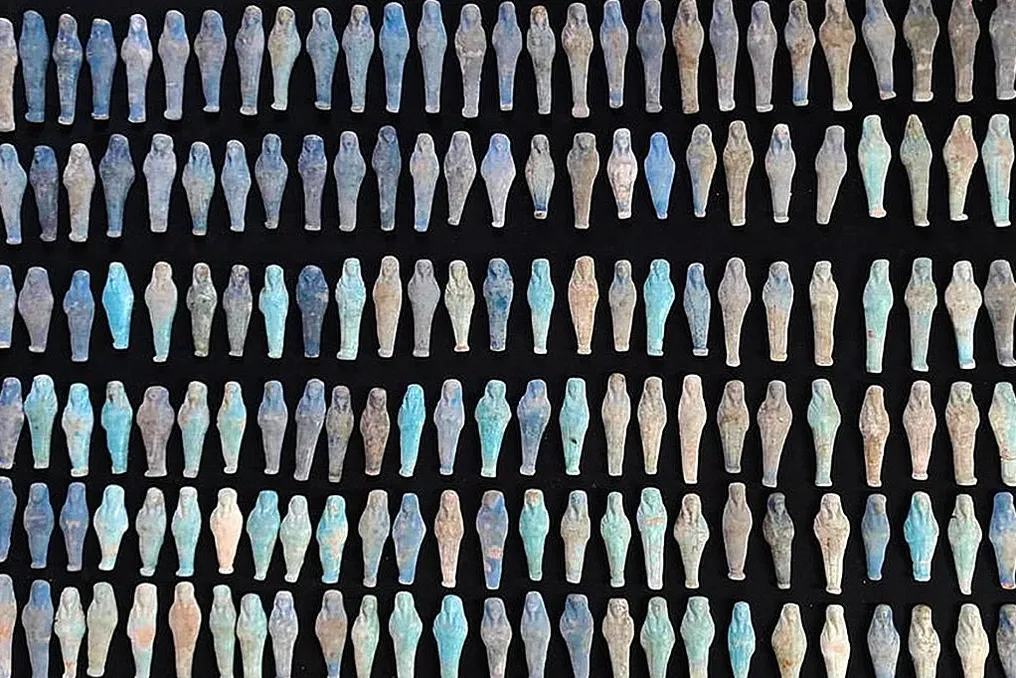
During a new excavation campaign, conducted by the Supreme Council of Antiquities of Egypt, researchers located an unprecedented funerary unit. This location contained dozens of burials, 560 funerary statuettes, and several other artifacts. These findings were communicated by the Egyptian Ministry of Tourism and Antiquities in July.
The funerary structure, which maintained good architectural preservation, consists of a central hall connected to several chambers with arched openings. Archaeologists speculate that the ceilings also had an arched shape, although this part of the construction did not survive over time.
Inside the rooms, numerous human bodies were found. Some individuals were arranged in the soarian position, a posture inspired by the representation of the god Osiris. Notably, one of the deceased was found with ceramic plates under the arms and thighs, a disposition considered atypical.
The burials were accompanied by a vast collection of funerary items, including bowls, plates, vases, and oil lamps. One of the containers held traces of substances used both in mummification and in other rituals.
Protective, strength, and resurrection amulets were also recovered. Some of these amulets represent the Eye of Horus, while others depict figures related to Egyptian deities.
One chamber caught the attention of archaeologists because it contained 560 funerary statuettes, known as ushabtis. According to Egyptian belief, these figures accompanied the deceased to perform, in their place, the tasks required in the afterlife, thereby exempting the person from arduous labor in the underworld, such as field cleaning.
According to the National Museum of UFRJ, the quantity of ushabtis can serve as an indicator of the social status of the buried person: the greater the number of ushabtis, the greater the wealth and the less the expected work in the afterlife.
The statuettes found in Tell Athar Quesna exhibit variations in size, style, and color, but they were made of Egyptian faience, a type of ceramic. Some of them carry inscriptions from the Book of the Dead, a compendium of spells and magical formulas intended to guide the soul on its journey.
Researchers continue to analyze the collected material, seeking to understand the meaning of certain body postures and the quantity of artifacts. So far, they have determined that some of the ceramics were imported from the island of Rhodes, Greece, which confirms the trade routes connecting Egypt to the Mediterranean during the Late and Greco-Roman periods.