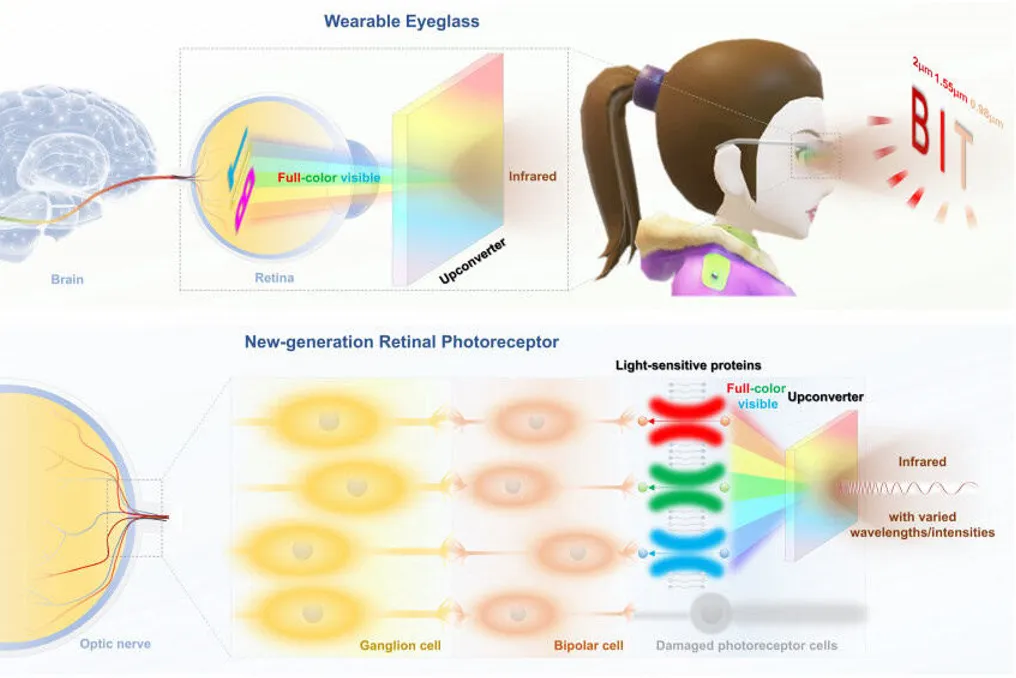
Researchers have created a prototype of glasses capable of transforming infrared light into visible colored images, allowing users to perceive both the common environment and information normally imperceptible to the human eye simultaneously.
This technology, which is still in an experimental stage, has the potential to drive new uses in visual prosthetics and the enhancement of human sensory capabilities. The advance was made by scientists from the Beijing Institute of Technology (Japan) and detailed in an article published in the scientific journal Science Advances.
How the technology expands human vision beyond the light we see
Human eyes cannot capture infrared light because the photons in this spectral range do not possess enough energy to activate the retina. Although existing equipment, such as thermal cameras and night vision goggles, can detect this radiation, they usually display it in a single tone, either green or grayscale.
The new approach proposed differs by not only representing the intensity of infrared radiation but also converting different wavelengths and intensity levels into various colors. Due to the ease with which the human brain processes colors, this conversion allows for the identification of subtle nuances in infrared light with greater accuracy compared to conventional methods.
The authors of the study themselves state that the technology 'redefines infrared vision by transcending the monochromatic paradigm, translating spectral and intensity signatures of the infrared into discernible color variations, rather than mere brightness changes.'
How the infrared glasses work
The prototype employs microscopic particles called mercury telluride colloidal quantum dots. When hit by infrared light, these particles absorb the radiation and convert it into electrical charges. These charges are subsequently sent to an organic light-emitting diode (OLED), which consists of two emitting areas: one red and one cyan.
Lower energy infrared signals generate just enough charge to illuminate the red region. Conversely, higher energy signals activate both regions of the OLED, resulting in distinct color combinations that reflect the characteristics of the received radiation.
The prototype weighs only 23 grams
The researchers managed to build a model of glasses weighing only 23 grams and conducted tests using infrared light projected onto various objects and moving shapes. During the tests, the device produced sharp, color-coded images while maintaining the ability to allow visible light to pass through. This means the user can view the normal environment while receiving information from the infrared radiation.
The team also monitored electrical responses in the human retina, which confirmed that the light converted by the system was capable of stimulating the participants' eyes normally.
Future applications
Although the device is still in the prototype phase, researchers believe this technology may have implications far beyond infrared vision. In the scientific article, they mention that by 'surpassing the evolutionary limits of biological photoreception,' this innovation could pave the way for a new generation of visual prosthetic systems and tools capable of expanding human senses.