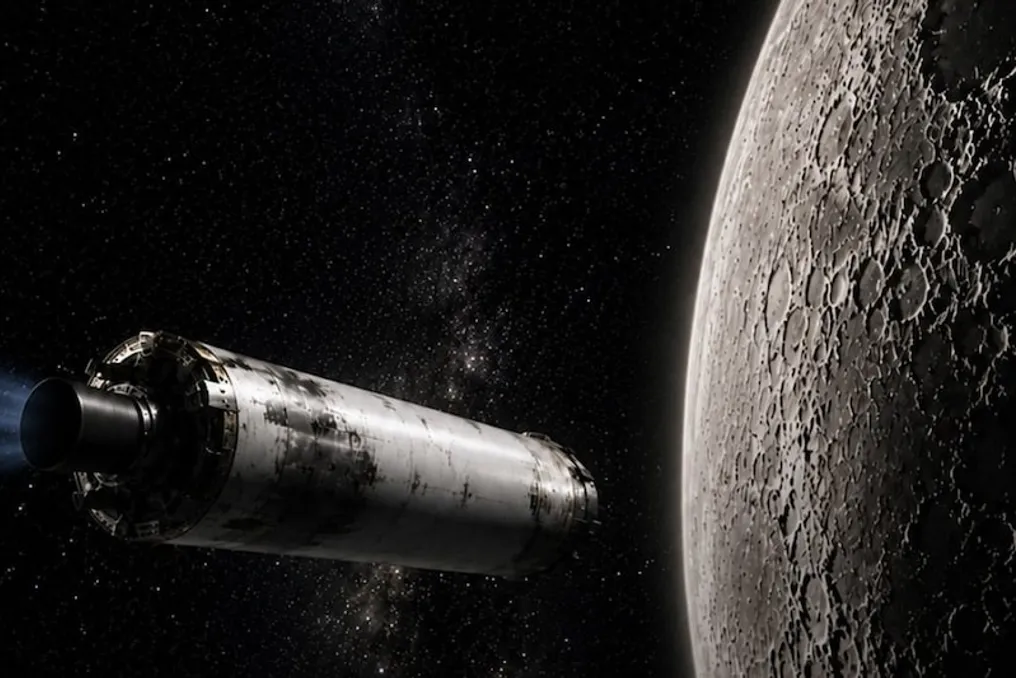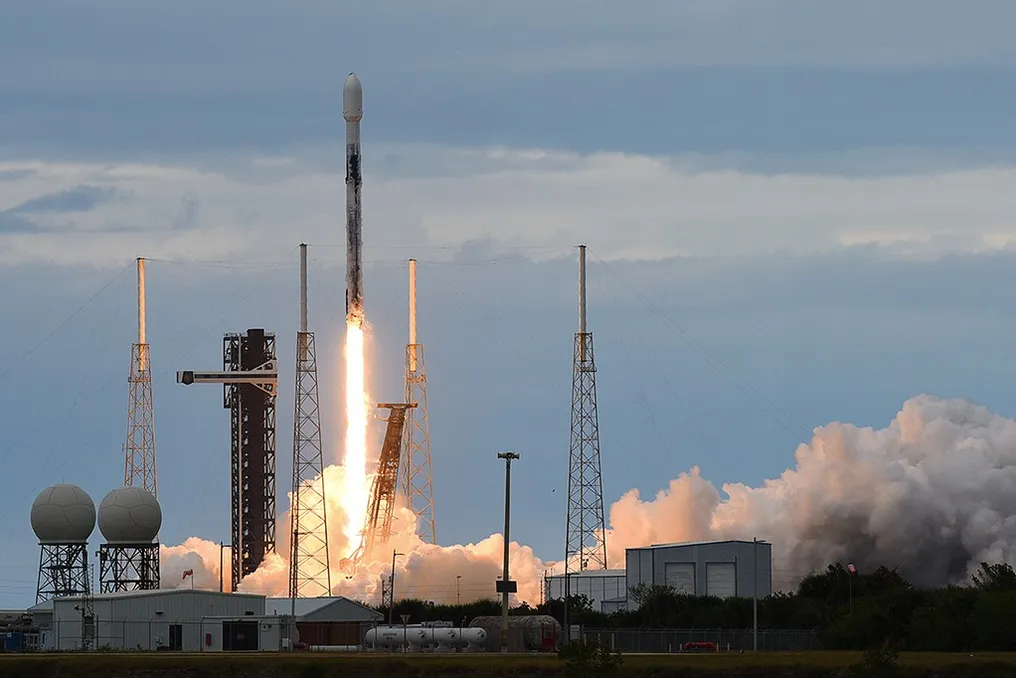
The Falcon 9 rocket, left by SpaceX, is set to collide with the Moon this Thursday. This impact will result in a crater 5 meters deep and lift a debris cloud up to 20 kilometers high, which could potentially be visible from Earth.
The Falcon 9 rocket, left by SpaceX, is set to collide with the Moon this Thursday. This impact will result in a crater 5 meters deep and lift a debris cloud up to 20 kilometers high, which could potentially be visible from Earth.
The collision, occurring at a speed of approximately 8,700 km/h, is expected near the Einstein crater, located on the western side of the visible face of the Moon. According to a scientific study published by researchers from the University of Texas, the impact should raise a cloud of dust and debris measuring 183 km wide and up to 20 km high.
Scientists note that this cloud is 'potentially observable' from Earth, although the visibility level remains uncertain. The disintegration of Falcon 9 will also cause a flash lasting about one second. Seven days after the collision, the NASA Lunar Reconnaissance Orbiter will pass over the site to take pictures.
The impact will possess energy equivalent to 3 tons of dynamite and is expected to create a hole 27 meters long and 5 meters deep on the lunar surface. Although SpaceX could have prevented the collision by altering the trajectory of Falcon 9, the company decided not to do so.
Falcon 9 is anticipated to be the second rocket to accidentally crash on the Moon. The first such rocket was the Chinese Chang'e 5-T1, launched in October 2014; its third stage struck the lunar surface in 2022. At that time, China denied this, claiming that the rocket remnants re-entered the Earth's atmosphere and were destroyed.
Although the glasses to observe the eclipse have run out in several locations, Ciência Viva announced that it will provide more free units so that the public can follow the astronomical event.
A SpaceX rocket fragment that has been in space since last year is preparing for a significant collision with the Moon on Wednesday. According to American time, this will occur early in the morning.
This object, which is approximately the size of a school bus and weighs 4,000 kilograms, belongs to the SpaceX Falcon 9 rocket. This rocket was used to launch the Firefly Aerospace lunar lander in January 2025.
The collision is expected around 06:35 GMT (ET), when this piece of rocket will reach the lunar surface at a speed of 8,690 kilometers per hour. Upon impact, a cloud of lunar dust will be raised, which may glow under sunlight, but it will be difficult to see with the naked eye from Earth.
SpaceX states that this collision is unintentional. The fragment may strike the Einstein crater on the Moon's western side, which is often difficult to observe from Earth.
Typically, after delivering its payload into orbit, rocket stages burn up in Earth's atmosphere or fall into the ocean. However, for the lunar lander mission in January, more thrust was required compared to missions closer to Earth, causing the second stage to remain in space. It has been drifting aimlessly among thousands of other pieces of space debris that active satellites must avoid.
Earlier this year, experts discovered that the rocket was on an orbital path leading toward the Moon. By that time, it had already expended its remaining fuel, making it uncontrollable.
According to Reuters, Juliana Shaiman, Director of NASA Science and Dragon Program at SpaceX, stated that a combination of solar activity and gravitational forces directed the rocket toward the Moon. She said this does not pose a danger. Nevertheless, it demonstrates some negligence in disposing of leftover space equipment.
Collisions between space debris and the Moon happen rarely. For instance, in March 2022, a Chinese rocket stage collided with the Moon after completing a lunar test mission. In 2009, NASA intentionally landed part of a rocket on the Moon to study the dust and debris raised by the impact.
Shaiman noted that NASA and SpaceX are discussing ways to prevent such collisions in the future. The American space agency plans to establish a base on the Moon and regularly send astronauts there later this decade as part of its Artemis program. They do not want wandering pieces of space debris to collide with these assets.
SpaceX has disclosed a strategic ambition focused on artificial intelligence (AI), announcing that all of the company's future AI data centers will be built exclusively using chips supplied by Nvidia.
Additionally, the company revealed a collaboration with the manufacturer to create computers capable of running AI models directly on orbital satellites. Elon Musk stated that SpaceX's goal is to achieve over 2 gigawatts of computational capacity dedicated to AI by the end of 2026, with plans to expand this infrastructure to approximately 10 gigawatts by the end of 2027.
This infrastructure will serve both the development of SpaceX's own AI models and the provision of cloud computing services to clients. During the presentation, Musk praised the new Nvidia platform, stating: 'We consider the Vera Rubin the best computer for artificial intelligence. And we highly value our close cooperation and partnership with Nvidia at various levels.'
The partnership between the companies aims to develop space computing systems capable of executing AI models directly on solar-powered satellites. The project, named Starmind AI1, will involve the use of Nvidia Rubin GPUs and Vera CPUs, aiming to deliver performance comparable to terrestrial data centers.
According to SpaceX, the idea is to perform part of the processing in space and only send the results back to Earth via the Starlink satellite network. This would help reduce latency and take advantage of the constant availability of solar energy in the space environment.
SpaceX argues that space computing can be a solution to the growing difficulty in obtaining sufficient energy for new data centers on the Earth's surface. The satellites will utilize technologies already present in the Starlink constellation but adapted to handle the demands of artificial intelligence workloads. Among the highlighted advantages are:
To realize this project, SpaceX is building the Gigasat Factory, located in Bastrop, USA. This facility will be responsible for the large-scale manufacturing of satellites intended for artificial intelligence and should enable the production and launch of thousands of units starting from the end of 2027.
The company has already expressed its intention to put up to one million satellites dedicated to computing into orbit. This plan, which has not yet been proven in practice, raises concerns among scientists due to the risk of increased space debris and potential environmental consequences.