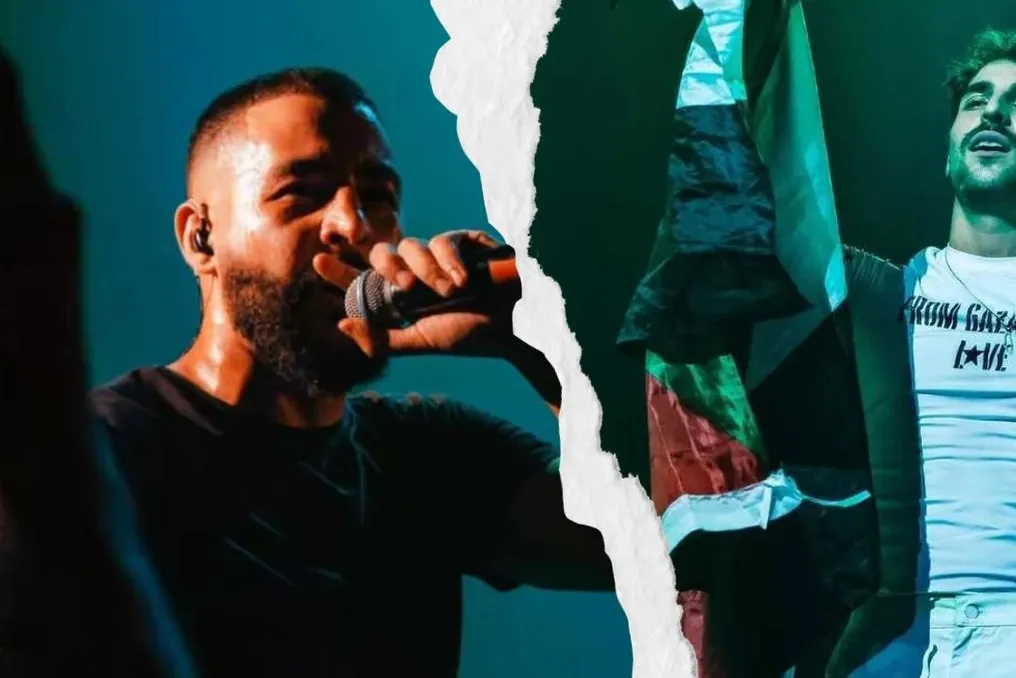
When Palestinian rapper Shabjdeed released the track 'SLV' on Saturday, which is a harsh diss track aimed at his colleague Saint Levant, listeners initially perceived it as the start of another celebrity feud.
} , 3.When Palestinian rapper Shabjdeed released the track 'SLV' on Saturday, which is a harsh diss track aimed at his colleague Saint Levant, listeners initially perceived it as the start of another celebrity feud.
} , 3.However, within a few hours, the discussion went beyond musical battles and rivalry. Palestinians on social media began discussing something much larger: whether Palestinian identity has become a brand, if suffering grants an artist greater legitimacy, and what audiences expect from cultural figures representing a people undergoing war and occupation.
The conflict between Saint Levant and Shabjdeed is compared to the Arab analogue of the Drake and Kendrick Lamar confrontation. The timing intensified the situation: both artists scheduled separate concerts in Amman, Jordan, for August 13th, leading to speculation about the possible influence of competing performances on the creation of the diss. Neither artist publicly linked the track to these concerts.
In less than two minutes, Shabjdeed criticizes Saint Levant's carefully constructed public image. He begins by acknowledging: 'Sometimes I respect your ability to achieve goals,' but quickly moves to criticism, stating: 'I will teach you a lesson through this diss track.'
A significant part of the song questions Saint Levant's public persona. The artist repeatedly asks: 'Why is your name like that?', joking that given the frequent mentions of women and romantic relationships in his music, he might be better known as 'Saint Women.' Later, he accuses Saint Levant of 'mixing Palestine with every speck of flattery and European lust,' reducing Palestinian symbolism to aesthetics, and sings about 'a bunch of watermelons on my hips, just so you know how much I love my country.'
These lines reflect criticism that has followed Saint Levant throughout his rise to fame. Saint Levant was born in Jerusalem to a Palestinian-Serbian father and a French-Algerian stepmother; he spent part of his childhood in Gaza, and then moved between Jordan and the US for his studies. His music blends English, Arabic, and French, often exploring themes of love, nostalgia, and diaspora, complemented by high-quality aesthetics.
On the other hand, Shabjdeed emerged from the Palestinian underground rap scene after growing up in Kafr Aqab and is currently based in Ramallah. His work draws inspiration from life in occupied West Palestine, local slang, and realities of Israeli occupation, checkpoints, and restricted mobility, offering a perspective rooted within Palestine itself.
This contrast lies at the heart of the debate. For some listeners, Shabjdeed voiced frustrations they had long felt. One supporter wrote: 'Shabjdeed, my dear!! Thank you for finally speaking out.' Another user stated that they were 'not surprised by the negative reaction' to Saint Levant, asserting that they had 'never been convinced by his activism,' as it seemed 'very different from the image he previously presented.'
Some argued that Saint Levant's multilingualism, international background, and collaboration with a luxury fashion house made him more appealing to Western audiences than artists working from inside occupied Palestine. One Instagram user wrote: 'The industry rewards voices that are easiest to package: multilingual, aesthetically polished, commercially appealing, and culturally familiar to the West,' adding that when one artist becomes 'the face of Palestine on the international stage,' other Palestinian experiences risk being overlooked.
At the time of publication, Saint Levant had not publicly responded to the track or commented on Shabjdeed's criticism. However, many social media users spoke out against this negative reaction, stating that Palestinian art should not be limited to themes of resistance and suffering.
For them, the question was not whether Saint Levant was 'Palestinian enough,' but how Palestinian identity is packaged and consumed internationally. In response to the argument that Palestinians are 'allowed to write love songs,' one user noted that the issue was not whether Palestinians should create such music: 'Palestinians have the right to sing, write, and think whatever they want. There is no problem with that at all. What Shabjdeed pointed out about Saint Levant is much deeper than any event or love songs.'
Others warned against reducing Palestinian identity to a single narrative. One commentator wrote: 'The Palestinian diaspora is extremely diverse.' They continued: 'Palestinians from Syria have absorbed the resilience and soul of Syrian camps, while those living in Lebanon, Jordan, Europe, and the US carry a unique experience shaped by their place of residence.' They added that 'diversity is a sign of strength and cultural richness, not weakness,' arguing that Palestinian representation 'is not limited to one genre, one tone, or one rigid framework.'
Not everyone supported Shabjdeed's approach. Some criticized the lyrics as misogynistic, especially his references to women and Saint Levant's female collaborators. Others deemed the diss unnecessary, stating: 'Great artists should be remembered for what they create, not for whom they attack,' while others defended the track as part of rap culture.
The discussion also raised questions about whether Palestinians should even focus on music amid the ongoing genocide in Gaza by Israel. Journalist Faten Elwan shared a video showing an unborn baby found among the rubble after an Israeli strike, writing: 'I hope you spread this just as you spread Shabjdeed's and Marwan's nonsense.'
Her comments drew criticism. Some argued that discussing culture alongside documenting destruction in Gaza is not mutually exclusive, and that Palestinians should not only talk about death to be considered legitimate voices. Perhaps this is why 'SLV' resonated outside of hip-hop. The track became a broader debate about class, diaspora, authenticity, and visibility. At its core lies a question that goes far beyond rap: who has the right to represent Palestine?
On the 75th anniversary of the Refugee Convention, adopted in 1951 at the UN conference in Geneva, Britain, as one of the participating countries, faces questions about its responsibility for creating one of the world's longest refugee crises.
This anniversary highlights an uncomfortable irony: the same convention ultimately excluded Palestinian refugees—a population whose displacement was largely driven by British policy—from its standard protection through a separate legal regime.
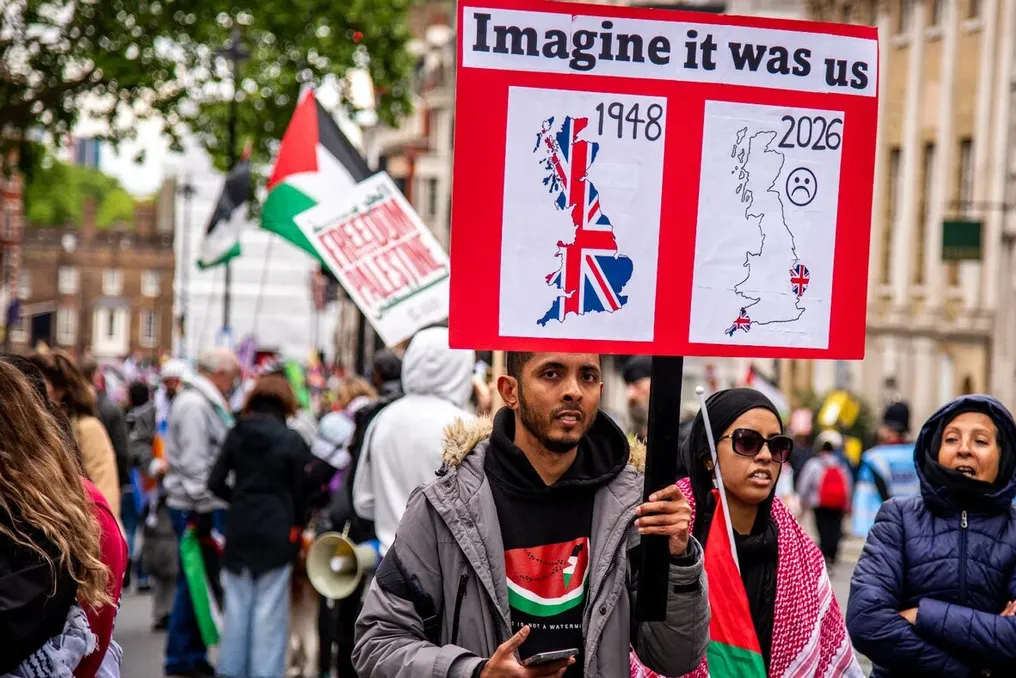
The article's author, who dedicated much of their career to studying how international law shaped Palestine, argues that legal obligations do not cease simply because they become inconvenient. This forms the basis of the 'Britain Owes Palestine' petition—a 400-page legal document co-authored by the writer.
This petition asserts that Britain acted illegally in Palestine between 1917 and 1948, and that the United Kingdom is now obligated to officially acknowledge and apologize for this history.
Through the Balfour Declaration, Britain promised to support a national home for one people in a land inhabited by another, without the consent of the majority of local residents. For three decades, the country governed while bound by incompatible obligations, which entrenched division and suppressed Palestinian self-determination, sometimes using emergency powers that legitimized collective punishment while closing courts to victims.
In 1948, Britain left the instability caused by its own policies, leaving the population unprotected. The Nakba—the 'catastrophe'—followed, resulting in over 750,000 Palestinians fleeing or being expelled from their homes. Today, the number of these refugees and their descendants runs into the millions.
The Refugee Convention established a universal framework for refugee protection, overseen by the UN High Commissioner for Refugees (UNHCR). However, Palestinians were excluded from this system. Since they were already receiving assistance from the UN Relief and Works Agency (UNRWA), Article 1D of the convention excluded them from its scope as long as that aid continued. This was viewed as a temporary measure awaiting a swift political settlement.
Refugees whose displacement is most closely linked to British policy are the least protected under a regime that Britain helped create. Seventy-five years later, this 'temporary' arrangement still defines the status of the Palestinian refugee.
Although UNRWA provides vital services, it lacks the mandate to implement long-term solutions—voluntary return, local integration, or resettlement—which UNHCR offers to other groups of refugees. Since this agreement has never ended, generations of Palestinian refugees have remained without guarantees available to all others.
This unresolved legal anomaly is one reason why the petition presented to the government matters. It calls for the examination of classified archives, a full public response, an acknowledgment of wrongdoing, official apologies in Parliament, and serious consideration of reparations.
A coalition of 45 MPs from all parties and Lords urged the Prime Minister to respond. Nearly ten months after the petition was submitted, and despite Andy Burnham replacing Keir Starmer as Prime Minister this month, the government has made no statements.
This silence carries both legal and moral costs. Britain frequently cites the Refugee Convention and international law to criticize other states and defend its own reputation. Nevertheless, the authority of the law depends on consistent application, including its application to itself.
Britain cannot credibly advocate for refugee protection while refusing to acknowledge its role in creating a population of refugees excluded from the regime it helped build. A state confident enough to honestly examine its history is a state whose word on international law carries weight.
Acknowledging mistakes can take various forms: an apology in Parliament and investment in teaching history, which remains insufficiently covered in British schools. There are precedents: Britain has previously acknowledged and settled claims regarding colonial abuses, notably in the 2013 settlement with Kenyan victims affected during the Mau Mau uprising.
The Refugee Convention was born from the conviction that displacement demands responsibility. The petition merely asks Britain to apply its own principles consistently. Seventy-five years after the adoption of the Refugee Convention, Britain must answer Palestine.
Israeli political figures and settler organizations have called for 'revenge' against Palestinians, stating that they 'want to see blood' and 'erase the village of Tel.'
Israel's Finance Minister Bezalel Smotrich demanded on Friday the destruction of the villages of Tel, Irraq Burin, and Beit Furik. He noted that these settlements 'should look exactly like refugee camps in Nablus and Tulkarm,' referencing the large-scale destruction caused by Israeli military forces in those areas.
Smotrich added that the population must be evacuated and called on Israeli Prime Minister Benjamin Netanyahu to absolve the Palestinian Authority of responsibility for this territory.
Israel's National Security Minister Itamar Ben Gvir stated that 'for every Jew killed, the enemy must suffer a loss of land and homes,' calling for the application of Israel's strategy of demolishing entire towns in the Gaza Strip also in the West Bank.
These statements came after armed Israeli settlers, accompanied by military personnel, raided the Palestinian village of Tel amid escalating settler violence in the occupied West Bank.
Four members of the Saifi family were killed in the incident after Israeli military forces claimed one of them had taken a weapon from a settler, leading to the settler being fatally wounded.
According to the Palestinian Ministry of Health, at least 87 Palestinians have been killed by Israeli forces in this area in 2026, including 21 killed by settlers.
Zvi Sukkot, a member of Smotrich's 'Religious Zionism' party, also advocated for destruction, telling Channel 14 News on Friday that the village of Tel 'should turn into ruins.' On the same day, he posted a black screen with the caption: 'Revenge' on his Facebook page.
The Israeli settler militia group Hilltop Youth supported this call. Messages reviewed by Middle East Eye from a settler group chat contained demands to 'erase the village of Tel' shortly after reports of killings.
One message stated: 'We want revenge. No more settlements, no promises of more housing units.' Another message read: 'We want to see blood. There is no comfort without revenge,' and was accompanied by an image of a river of blood.
Elchanan Groner, a prominent hill settler, stated that 'the village of killers, Tel, needs to be erased now,' and in a memorial message to the deceased settler wished to 'take revenge for your pure blood.'
Netanyahu announced on his X account that 'we will pursue terrorism everywhere' and that Israel 'will settle accounts with them.' The Prime Minister added that he ordered Israeli military forces to demolish the family home of a Palestinian man who killed a settler and to act quickly and decisively against other villages in the area.
Netanyahu also stated that he ordered the acceleration of the legalization and creation of new settler outposts, from which, according to him, many settler attacks originated, including the incident in Tel.
In response to the clashes, which Israel qualifies as a terrorist attack, Haaretz reported on Friday that the Israeli army mobilized troops in the West Bank for a large-scale operation around Nablus in the northern part of the Palestinian territory.
According to a report by the Palestinian news agency Wafa, the Israeli army has currently arrested 66 Palestinians across the West Bank, including 30 civilian Palestinians detained in Tel.
Haaretz reported on Saturday morning that the military closed entry points to Tel and the neighboring village of Burin, completely surrounding the city of Nablus. The Israeli army, it is reported, conducted raids on Palestinian homes in various West Bank communities, detaining civilians and conducting searches, while Palestinian reports indicate military vandalism.
Furthermore, Quds News Network reported on Friday that the Israeli army raided a hospital in Nablus, claiming to have arrested two Palestinians involved in violent clashes in Tel earlier that same day.
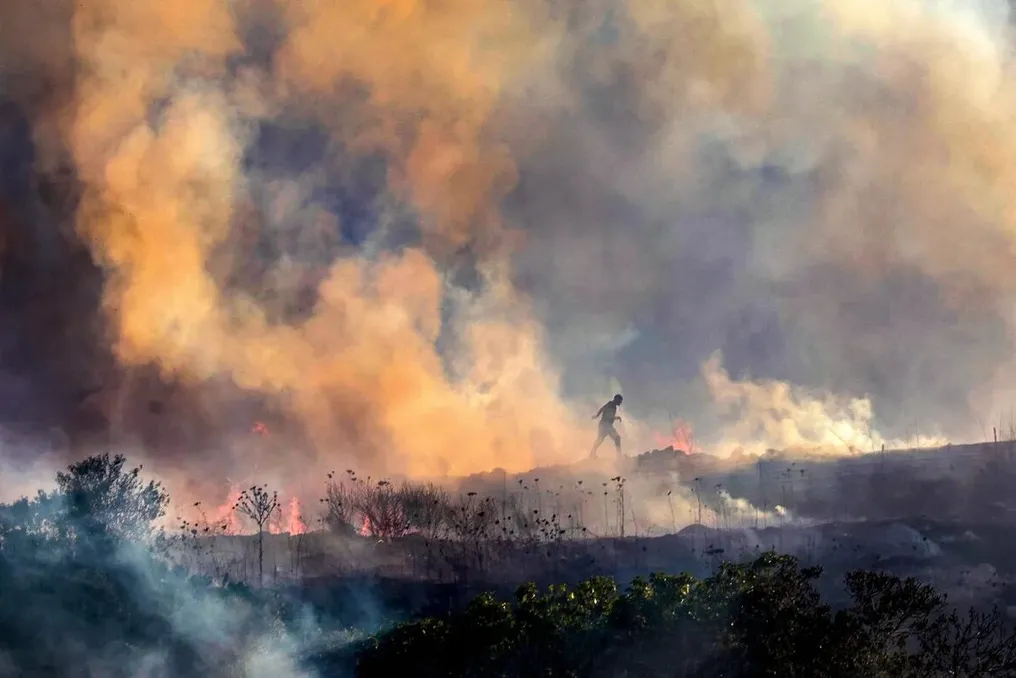
Meanwhile, settlers were raiding Palestinian communities across the West Bank after Israeli leaders and settlement organizers called for revenge against Palestinians.
The Palestinian Red Crescent Society (PRCS) reported on Friday that eight Palestinians were injured during a settler attack on the village of Far'ata near Kalkilya, one of whom is in critical condition. Palestinians claim that settlers set houses on fire and threw stones.
In addition, PRCS reported that three other Palestinians were injured on Friday during a settler raid on the town of Sarra, near Nablus. Palestinian reports state that settlers burned houses and damaged property in the town.
Quds News Network reported violent settler attacks in other locations, including Masafar Yatta, south of Hebron, and in the villages of Avarta and Urif, near Nablus, where settlers reportedly burned property and uprooted olive trees.
Quds News Network also reported that in the town of Karwat Bani Hassan, near Salfit, settlers seized a house and raised the Israeli flag over it.
The Wafa news agency reported similar settler attacks on the village of Birin, east of Hebron, the village of Abu Najim, southeast of Bethlehem, and on the water infrastructure of Kafr Malik in the Ramallah Governorate.
Haaretz reported additional settler attacks on the villages of Yit, Irraq Burin, and Tel in the Nablus area, while settlers reportedly inflicted knife wounds on a Palestinian man in Wadi al-Muarradajat in the Jordan Valley.