Italian scientists conducted a study analyzing data from numerous schoolchildren and concluded that starting to use social media at an early age correlates with a decline in students' academic performance.
Italian scientists conducted a study analyzing data from numerous schoolchildren and concluded that starting to use social media at an early age correlates with a decline in students' academic performance.
Marco Guidi from the University of Bicocca in Milan and his team studied information on 5227 students from Northern Italy aged 7 to 16. Data on digital behavior was obtained through a special questionnaire, and academic performance was assessed based on the results of long-term tests in mathematics, Italian, and English.
According to the data, the median age of starting to use game consoles was in the fourth grade, and independent tablet use was in the fifth grade. Computers and smartphones with internet access became available in the sixth grade, coinciding with the appearance of the first messengers. By the eighth grade, 98% of students already owned smartphones. Regarding social media, 11.2% created an account in primary school, 29.5% in the sixth grade, 25.0% in the seventh, 18.0% in the eighth, and only 16.3% in the ninth grade (which is the minimum age according to Italian law).
The analysis showed that the duration of time spent on social media by the eighth grade had a negative correlation with performance in Italian (a decrease of 0.05 standard deviations for each additional year) and mathematics (a decrease of 0.04). These relationships persisted even after accounting for other digital technologies (-0.06 and -0.02, respectively). The application of the difference-in-differences method, adjusted for confounding factors and previous results, demonstrated a causal negative effect of early social media use on academic performance.
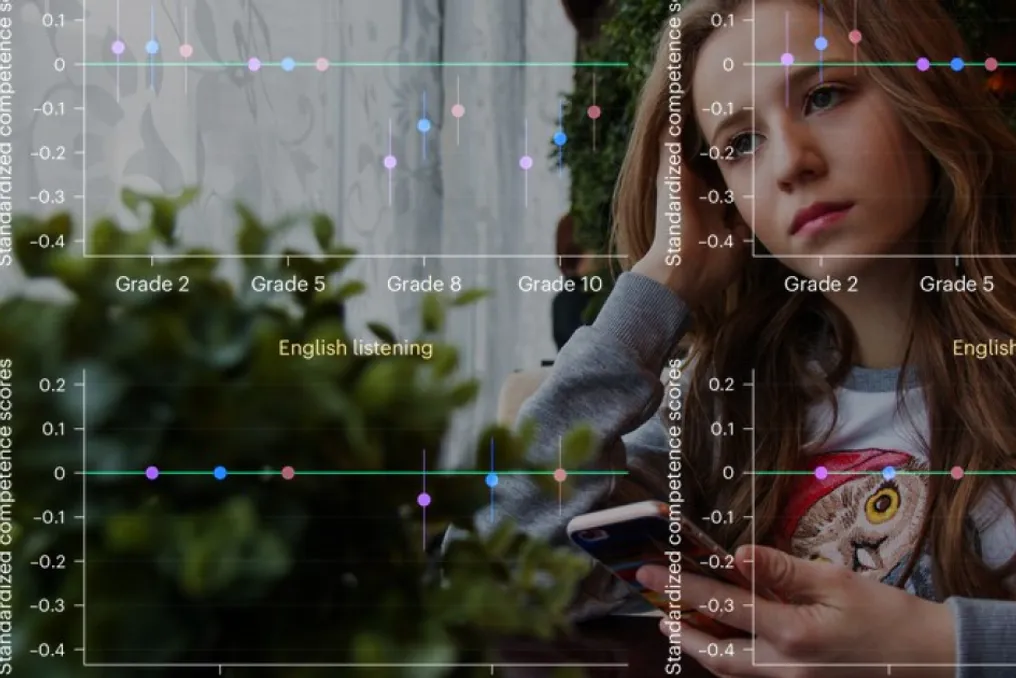
Specifically, students who started using an account in the sixth grade had lower results in Italian by 0.22 standard deviations and in mathematics by 0.18 in the eighth grade; these deficits persisted up to the tenth grade (0.22 and 0.27 standard deviations). For those who started in the seventh grade, the effect was less pronounced but significant (0.14 and 0.10 in the eighth grade; 0.17 and 0.22 in the tenth). In the eighth grade, those who started later saw their Italian language performance drop by 0.11 standard deviations, and math by 0.07 (which did not reach statistical significance) in the same grade, but both subjects showed a decrease of 0.11 in the tenth grade. Furthermore, no influence of social media on English language proficiency was found.
Additional analysis revealed that more intensive smartphone use according to the SPS-A scale was associated with worse results in Italian and mathematics, as well as earlier creation of a social media account. Parental control and access to children's online activities proved more favorable for academic performance and later account creation. Students' subjective well-being showed no significant link to academic performance, demonstrating only a weak negative correlation with increased time spent on social media.
Thus, the data obtained confirm that premature immersion in social media negatively affects school academic performance, with the intensity of daily smartphone use playing a key role in this process.
The article also mentions that it was previously established that adolescents who overuse social media are less likely to maintain a healthy diet, and abuse of these platforms increases the risk of ADHD and early smoking, with social media and television being recognized as more dangerous for teenagers' mental health than video games.
A separate section presents data from the World Health Organization (WHO) on global tobacco use, noting that over 100 million people worldwide use vapes, of which at least 15 million are adolescents aged 13–15.
A new study revealed a correlation between early access to social media and lower academic performance over the years in Italian students.
In 2022, it was found that 92% of children and adolescents aged 9 to 17 used the internet, with 86% of these individuals having at least one social media profile. This data comes from a survey conducted by TIC Kids Online in 2022, which is linked to the Internet Steering Committee in Brazil. Brazil ranks among the countries with the highest global screen and social media usage, as Brazilians aged 16 to 64 spend an average of nine hours daily connected to the internet.
In this context, the scientific community has been investigating the effects of excessive screen time on health, especially in children. Known problems include concentration difficulties, sleep disturbances, visual problems, and mental health issues, in addition to sedentary lifestyle and other factors.
However, there is still little research focused on the impact of the age at which children and adolescents create their first social media accounts, a practice that often occurs before the minimum age established by the platforms themselves. Platforms such as Instagram and TikTok, popular among pre-teens and children, have an age rating of 16.
A recent study conducted with Italian youth demonstrated that students who started using social media earlier showed lower academic performance than those who chose to wait a few more years to start using them.
The findings were published on August 3rd in the scientific journal Nature Human Behaviour. To reach this conclusion, researchers analyzed information from over 5,000 students, aged between 7 and 16. These participants answered a questionnaire about digital media use throughout their lives and took standardized tests in Italian, English, and Math.
Subsequently, a comparison was made between students who created their first account in the 6th, 7th, and 8th grades, and those who only started using social media from the 9th grade. Only 16.3% of those involved waited until the 9th grade to create an account.
When compared with this waiting group, students who joined social media in the 6th grade exhibited lower grades in Italian and Math throughout their school career. In the 8th grade, the disparity reached 0.22 standard deviations in Italian and 0.18 standard deviations in Math. In the educational field, differences above 0.2 standard deviations are generally considered significant and correspond to approximately a six-month learning delay. In the 10th grade, the difference observed in Math was even more pronounced.
Effects were also noted among students who created accounts in the 7th and 8th grades, although with slightly less intensity. This indicates that the earlier students started using social media, the greater the link to lower academic performance.
Interestingly, the researchers did not identify statistically significant differences in English grades, which may be attributed to the vast amount of content available in that language within the social networks themselves.
The study's authors state that the results provide robust evidence that early engagement with social media negatively impacts learning. They also found evidence that a considerable portion of this effect is influenced by the continuous presence of smartphones in students' routines during crucial times of the day.
One theory raised by the researchers is that constantly checking notifications during study periods acts as a significant distraction factor. However, the authors warn about the limitations of the research, mentioning that it did not analyze variables such as students' academic performance before account creation, family composition, or parents' education level, paving the way for future investigations that can better detail this relationship.