The release of Grand Theft Auto VI is anticipated as a major entertainment event, despite controversies related to high cost and the distribution of physical versions containing only codes. However, what truly captures attention is the evolution of the franchise's premise, transforming what was once revolutionary into a consolidated genre.
Today, it is common to have the freedom to drive a virtual vehicle, traffic on sidewalks, evade the police, and cause destruction in a three-dimensional metropolis. Nevertheless, in the late 90s, the idea of driving like an unstoppable individual in an open virtual environment was unprecedented and generated great debate among young people.
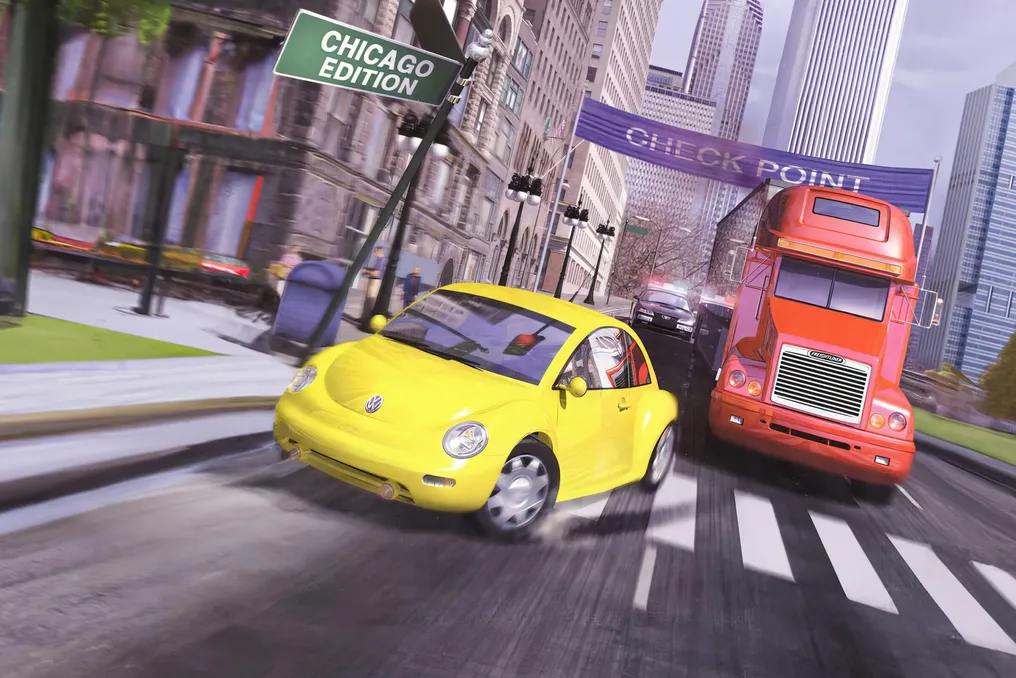
The path that led to the billion-dollar phenomenon of GTA VI did not begin with a major Rockstar production, but rather on the virtual streets of Chicago, in a lesser-known PC title released in 1999: Midtown Madness.
During that period, for many PlayStation players, the peak of virtual racing was represented by Sony's Gran Turismo. This title was considered the pinnacle of light simulation (or simcade), offering a technical balance with mass transfer and the need to choose the ideal route, without being excessively punitive for those using only a joystick.
This perception was challenged by a cousin who showed him a game called Midtown, played on a friend's computer. The description was fantastic: there were no defined tracks or invisible barriers; it was possible to explore the entire city, invade sidewalks watching pedestrians jump to escape, and accelerate in a fast vehicle, like the Panoz Roadster, nicknamed 'little buggy.'
Although it is fun today to notice the difference between Gran Turismo and Midtown Madness—a closed-circuit racing game with advanced physics versus a more relaxed arcade sandbox—for young people of that time, both were seen as mere 'car games.' The prospect of an unrestricted open city seemed like a significant advance in terms of immersion.
Years later, it was confirmed that the cousin's account was true: the game was revolutionary and contained the technology capable of permanently altering the history of video games.
From baseball fields to Chicago asphalt
To understand this transformation, it is useful to define what a game engine is. It can be thought of as the chassis, engine, and electrical system of a car, while the game itself represents the bodywork and paint. The engine is the set of fundamental tools that manage aspects invisible to the player, such as gravity, collision physics, lighting calculation, and artificial intelligence.
It was this modular structure that allowed Angel Studios to achieve something remarkable at the time: using the same base technology, called ARTS (Angel Real Time Simulation) and later AGE (Angel Game Engine), to develop titles of opposite natures. In 1998, Angel Studios released the acclaimed Major League Baseball Featuring Ken Griffey Jr. for the Nintendo 64, and a year later, in 1999, released Midtown Madness for PC.
The ability of a single engine to support a baseball game on the N64 and an urban racing game on PC lay in the engine's core mathematics: the calculation of three-dimensional trajectories, real-time impact physics (whether a bat hitting a ball or a truck hitting a traffic light), and 3D scene rendering. Angel Studios specialized in real-time simulation, and AGE possessed the necessary flexibility to be applied to both batters in the stadium and the busy traffic of Chicago.
Released in May 1999 by Angel Studios and distributed by Microsoft, Midtown Madness presented a 3D representation of Chicago, including landmarks such as the Willis Tower (then known as Sears Tower), Wrigley Field and Soldier Field stadiums, and the elevated subway. The striking difference was the destructive physics: elements such as parking meters, trash cans, fire hydrants, mailboxes, and traffic lights were thrown upon every collision.
The game offered four distinct modes: Cruise, for free exploration without time limits or opponents; Blitz, a timed race to pass through checkpoints; Circuit, the traditional format with barriers isolating sections of the city; and Checkpoint, the core of the game, where a race from point A to point B was conducted without predefined routes. Although regular traffic obeyed traffic lights, the player could cross sidewalks, parks, and alleys to win.
The garage featured everything from iconic sports cars, such as the Panoz Roadster and Ford Mustang, to unusual vehicles, such as Ford F-350 pickups, Volkswagen New Beetles, Freightliner trucks, and a public transport bus. Driving a huge bus in the middle of urban traffic was the height of arcade chaos. In multiplayer mode, accessible via MSN Gaming Zone, GameSpy, and XFire, the highlight was the Cops and Robbers mode, a 'capture the flag' variant where teams competed for gold bars in the streets.
Upon reaching stores in 1999, Midtown Madness received praise from specialized press. IGN highlighted its accessibility, mentioning that the title 'does not heavily rely on driving realism; it's all about fun,' and praised the simplicity of 'choosing a real car and starting to drive.' GameSpot captured the spirit of the time by stating that it was fantastic 'to drive like a maniac knowing you can't do that in real life.' Computer and Video Games (CVG) magazine celebrated the drivers' humor and the 'carnage unfolding before your windshield,' while PC Gamer considered it the best racing game of 1999 for creating 'a living 3D city and allowing you to destroy it.' Thus, the type of scenery that is basic in GTA today was seen as extraordinary.
The sound aspect was also praised: each vehicle had its own engine sounds (including the characteristic reverse beep of the bus), and drivers and pedestrians uttered insults in real time when overtaken.
However, there were criticisms. Portals like Total Video Games and GameSpot itself pointed out issues with unstable frame rates and jagged visuals on PCs without dedicated graphics cards. The artificial intelligence of the traffic cars was also questioned for being 'too loose,' leading common vehicles to cut corners and collide with the player without showing any reaction.
Despite this, the game sold over 100,000 copies in the United States alone by April 2000, proving the public demand for open urban environments.
If Microsoft gives you lemons...
The greatest innovation of Midtown Madness, set amidst pedestrian insults and widespread destruction, arose from an internal requirement of Microsoft: players should not run over pedestrians, preventing severe age ratings or controversies about road violence. Instead of removing people from the map, Angel Studios developed 3D pedestrian models equipped with reactive evasion AI.
Next Generation Magazine praised the 'pedestrians shrinking and jumping in panic when you invade the sidewalks.' When a vehicle sped up on the sidewalk, the NPCs calculated the car's trajectory and jumped sideways to protect themselves. This system gave the city an unprecedented sense of life and established the model for how virtual citizens would react in future open-world games.
While Midtown Madness demonstrated the potential of a vibrant 3D city in 1999, the Grand Theft Auto franchise was still in its early 2D top-down phase. Playing GTA 1 or GTA 2 today requires the player to change their mindset, similar to appreciating a classic 2D turn-based RPG (like Chrono Trigger or Final Fantasy VI) in the era of photorealistic graphics. Expecting a modern cinematic experience in these old titles can be jarring, but by adjusting expectations to the proposal of the time, one discovers pure, addictive, and extremely fun arcade gameplay.
The big turning point came in 2001, when Rockstar historically migrated to 3D with GTA III. However, contrary to what many assume, the famous RAGE engine did not exist at that time. GTA III, Vice City, and San Andreas used a third-party engine called RenderWare, developed by Criterion Games.
The transition from the Angel Game Engine to Rockstar's proprietary engine constitutes one of the most interesting business transactions in gaming history. It all began in 1999, when Rockstar observed the success of Midtown Madness and realized that Angel Studios held the necessary technology to bring urban racing to consoles.
The collaboration was swift: Rockstar hired the studio to create a street racing game for the newly announced PlayStation 2, giving birth to Midnight Club: Street Racing (2000). Using the AGE base from Midtown, Midnight Club served as an ideal laboratory, proving that the engine worked on consoles and mastered high-speed vehicle physics in 3D open metropolises.
Impressed by the success of the Midnight Club franchise and the team's talent, Take-Two Interactive (Rockstar's parent company) invested about $28 million in November 2002 to definitively acquire Angel Studios, renaming the studio Rockstar San Diego.
However, the inflection point that forced the creation of a proprietary engine would occur two years later. In 2004, the giant Electronic Arts (EA), Rockstar's main market rival, acquired Criterion Games. Rockstar found itself in a delicate strategic situation: depending on technology maintained by its biggest competitor to develop its most popular franchise represented an unacceptable risk.
From the old AGE to the new RAGE
The solution found was to seek technological autonomy internally. Within Rockstar San Diego, the RAGE Technology Group division was established. The goal of this team was ambitious: to take the original source code of the old AGE, which powered the traffic in Midtown Madness and the races in Midnight Club, and completely rewrite it for the PC architecture and the seventh generation of consoles (Xbox 360 and PS3), naming the new tool RAGE (Rockstar Advanced Game Engine).
The RAGE engine was presented in May 2006 in the game Rockstar Games Presents Table Tennis (Xbox 360), a table tennis project intentionally used as a controlled test before facing open maps. Subsequently, Rockstar incorporated two auxiliary physics engines into RAGE: Bullet (for collisions) and Euphoria (for biomechanical simulation of characters' muscles and weight).