In the context of another tour of South Africa, which marks the greatest rivalry in rugby, a wonderful story of human interest has emerged, illustrating the essence of the 105-year confrontation between the Springboks and the All Blacks. This story tells of intense battles on the field, memories preserved over half a century, and a book that crossed oceans to reconnect an All Black legend with the country where he became widely known.
The central figure is Billy Bush, a legendary forward from New Zealand, whose fearless performances during the All Blacks tour of South Africa in 1976 captivated South African rugby fans. He is now 77 years old, and Bush fondly recalls South Africa, stating that 'I would love to visit South Africa again. It is a great rugby country.'
These sincere words came after he received a copy of the book 'The Fireside Springbok,' a historical work on Springbok rugby written by Mike Greenaway, from South African rugby enthusiast Michael Lynch. Lynch was deeply moved by one of the stories about Bush in the book and set out to deliver a copy of the All Black legend to his home province of Canterbury.
This gesture greatly pleased Bush. In 2006, 25 years after the controversial defeat of the Springboks by Māori New Zealand in the 1981 tour match, captain Wynand Claassen rectified the unfair result by presenting the Māori captain, Billy Bush, with a traditional Springbok head.
Bush wrote to Lynch and Greenaway: 'It is a very interesting read. I am very grateful.' He recalled his first match in East London during the intense 30-match tour in 1976. He recounted that during the three-month tour, they had 30 players, a manager, and a coach, and the daily allowance was 2.50 New Zealand dollars (about 2.20 South African rand in 1976).
He also mentioned that he was offered to lead the tour in South Africa for the Greatest Rivalry tour, depending on interest. Acknowledging his age, he added: 'I am 77 years old now. Eleven members of our 1976 team have passed away, but I would like to visit South Africa again, the great rugby country.'
It was a touching admission from a player whose boisterous appearance and uncompromising style made him one of the most popular All Blacks to ever visit South Africa. Billy Bush, with his thick hair and beard, lived up to his name. His fierce play harmonized with his rugged appearance, and South African fans embraced him, even though the Springboks won the series 3-1 in 1976.
Along with stars like Sid Going, Grant Batty, and Brian Williams, Bush entered the folklore of South African rugby. Five years later, he took the field again against the Springboks, leading the Māori New Zealand team during the controversial 1981 tour. The mid-week match before the second test match spawned one of rugby's long-running moments. When the Māori were leading 12-9 in the final minutes, Springbok flyhalf Colin Beck attempted a drop goal. Even biased spectators in South Africa feared the kick would miss, while the Māori insisted it did not count. The confused referee, unable to contact the official match representative via television, ultimately awarded the goal. The match ended 12-12.
This controversial draw became a source of memorable sportsmanship a quarter of a century later. In 2006, Bush was invited to a meeting in Pretoria to celebrate the 25th anniversary of the 1981 tour. Springbok captain Wynand Claassen presented him with a mounted Springbok head. Traditionally, since the start of the Springboks tours of Great Britain in 1912, the mounted Springbok head is given to the first non-test team that defeats the tourists. During the 1981 tour, no team managed this, as the Springboks did not lose any of their 17 tour matches outside of the three test games.
Bush accepted the gift from Claassen with tears in his eyes, uttering a phrase that has since entered rugby folklore: 'We always knew we beat the Springboks 12-12!'
The story described in 'The Fireside Springbok' fascinated Lynch. As a 15-year-old schoolboy in Port Elizabeth during the 1976 tour, he snuck into the old Boet Erasmus stadium to watch the All Blacks practice before the match against the Eastern Province. Lynch recalled: 'The training run took place on the main pitch of the stadium. The open stand rose smoothly, like a huge concrete pyramid. At that time, Boet's stadium could only be filled by the All Blacks and the British Lions. That match was sold out.'
He vividly remembers the moment the All Blacks giants emerged from the tunnel. 'There were no electronic media then, but the nation was captivated by Andy Leslie's All Blacks through newspapers and film chronicles. At the center was the unique Billy Bush, a massive front-row forward and a dominator of newspaper pages, full of life. We saw him live!'
Reading Bush's witty remark about 'beating the Springboks 12-12' sparked an idea. Lynch contacted Greenaway to find out if 'The Fireside Springbok' was available in New Zealand. It was not at that time. Therefore, a copy of the book, accompanied by a handwritten letter, was sent to the Land of the Long White Cloud.
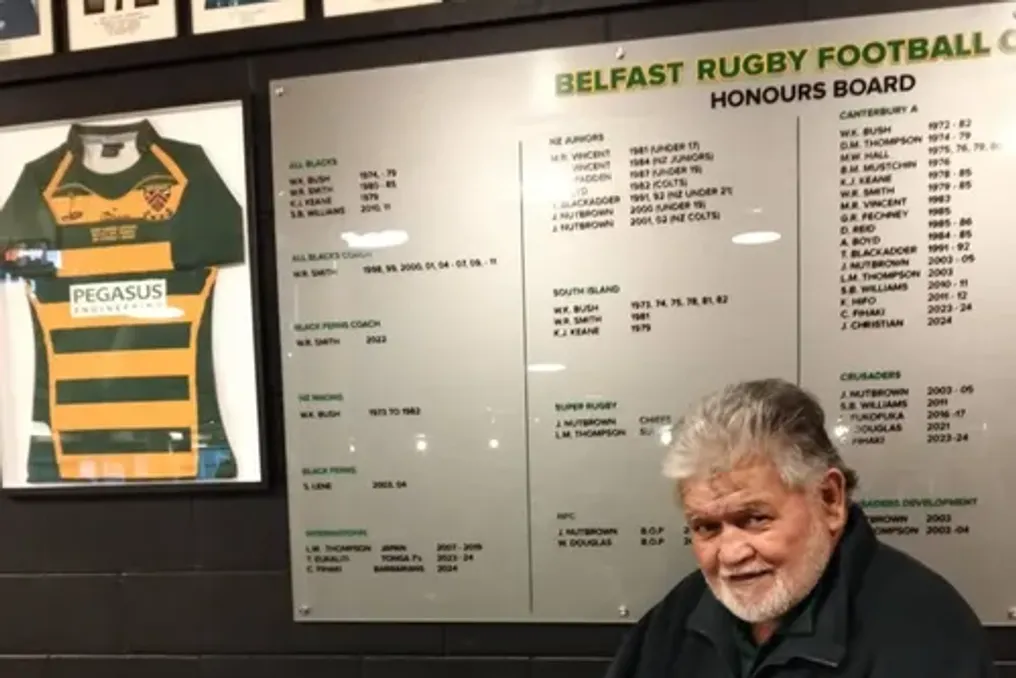
Lynch's son-in-law, Luke Grothjon, living in Dunedin, organized a presentation for Bush at the Belfast Rugby Club, of which the former All Black was a member for over 50 years. The result was much more than just delivering a book. It revived memories dating back half a century and reminded all participants that although the Springboks and All Blacks remain the fiercest rivals in rugby, respect has always been the foundation of their wonderful relationship.
As the next chapter of the Greatest Rivalry in rugby unfolds, the story of Billy Bush serves as a timely reminder that the greatest legacy of this famous competition lies not only in the matches won and lost, but also in the friendship and mutual respect that continues to flourish long after the final whistle.