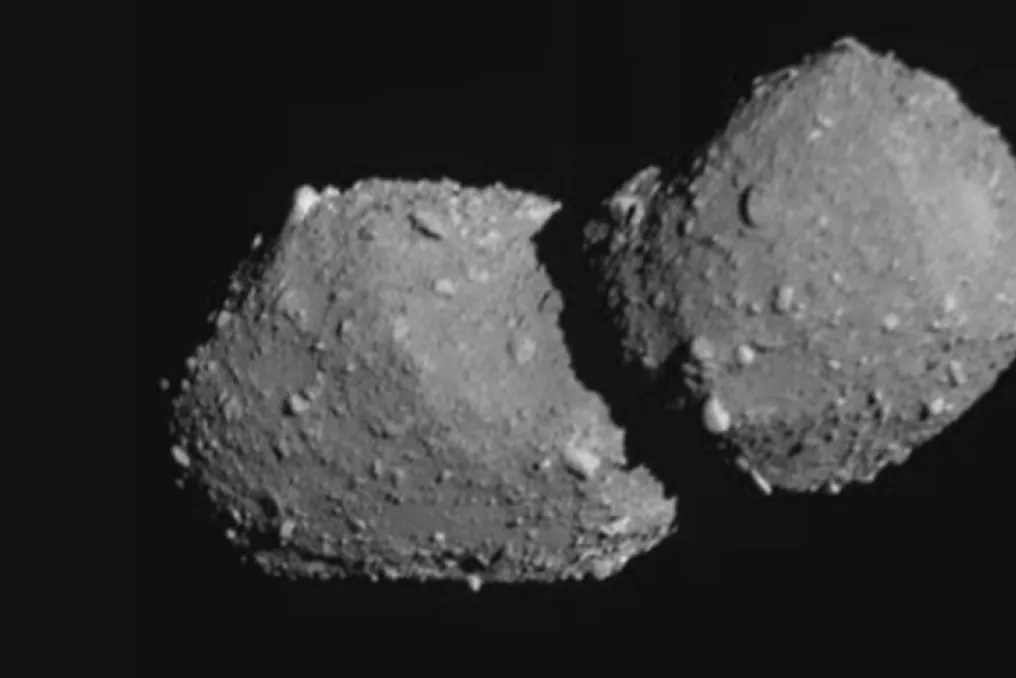
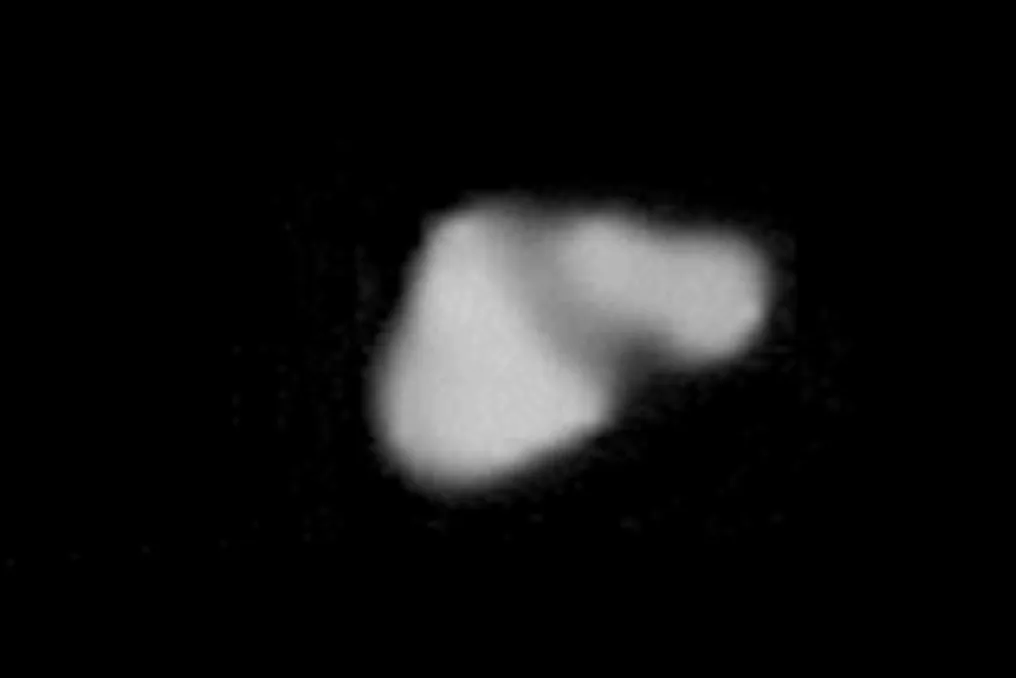
A group of astronomers has managed to create a detailed three-dimensional model of asteroid (44) Nysa, establishing that it is the first known three-lobed asteroid that also possesses a small moon. The results of this discovery are presented in a preprint on arXiv.org.
Research on Small Solar System Bodies
As large telescopes and interplanetary probes allow scientists to conduct more detailed observations of numerous small bodies in the solar system, their dynamic evolution is becoming increasingly complex and diverse. Currently, many such objects are known, possessing from one to three moons, contact binary systems, or even rings. This knowledge helps not only to better understand the evolution of the solar system but also to improve the accuracy of modeling exoplanetary systems.
Methodology and Observation Data
The group of astronomers led by Kate Minker from the Lowell Observatory presented the results of observations of asteroid (44) Nysa, conducted on February 15 and March 21, 2026, using the SHARK-VIS instrument on the Large Binocular Telescope. Additional observations were made between March 3 and April 4, 2026, using the SPHERE instrument installed on the VLT ground telescope complex. To reconstruct the asteroid's volume shape, the researchers also utilized archival light curves collected by several small ground-based telescopes.
Characteristics of Asteroid Nysa
(44) Nysa belongs to the large known asteroids of the rare type E, and similar bodies are associated with meteorites containing enstatite. It is hypothesized that they formed from material similar to that which formed terrestrial planets. Although Nysa was discovered in the mid-nineteenth century, it has always interested planetary scientists due to its large size and high albedo, but its exact shape remained unknown for a long time—it was previously suggested that it might be elongated or composed of two parts.
New data allowed Nysa to be classified as a unique object. Eight edge indentations and two depressions were observed on its surface, interpreted as three connected lobes linked by two isthmuses, as well as five craters. This confirms Nysa's status as the first known three-lobed asteroid. Furthermore, a moon with a diameter of about one kilometer was discovered, located at a projected distance of 170 to 180 kilometers. Analysis showed that the surfaces of all lobes have a similar composition, as no obvious changes in color or albedo were observed. The asteroid's rotation period is approximately 6.42 hours, and the equivalent spherical diameter it can be inscribed in is estimated at 75 kilometers.
Hypotheses on System Origin
The researchers put forward two main theories regarding the origin of this unusual system. The first hypothesis suggests that if the body has a high density (over three grams per cubic centimeter), it may have a solid, iron-rich core and formed from a single parent body that survived intense collisions, or it may be a fragment of a protoplanet or planetesimal. However, scientists lean more towards the version that Nysa represents a contact triple system, formed by the merger of three bodies at low velocity. These initial bodies could have been fragments of one object that came into too close contact with another, leading to the deformation of the less dense mantle and its subsequent rupture under tidal forces. Future observations and evolutionary modeling of Nysa will help clarify its structure and nature.