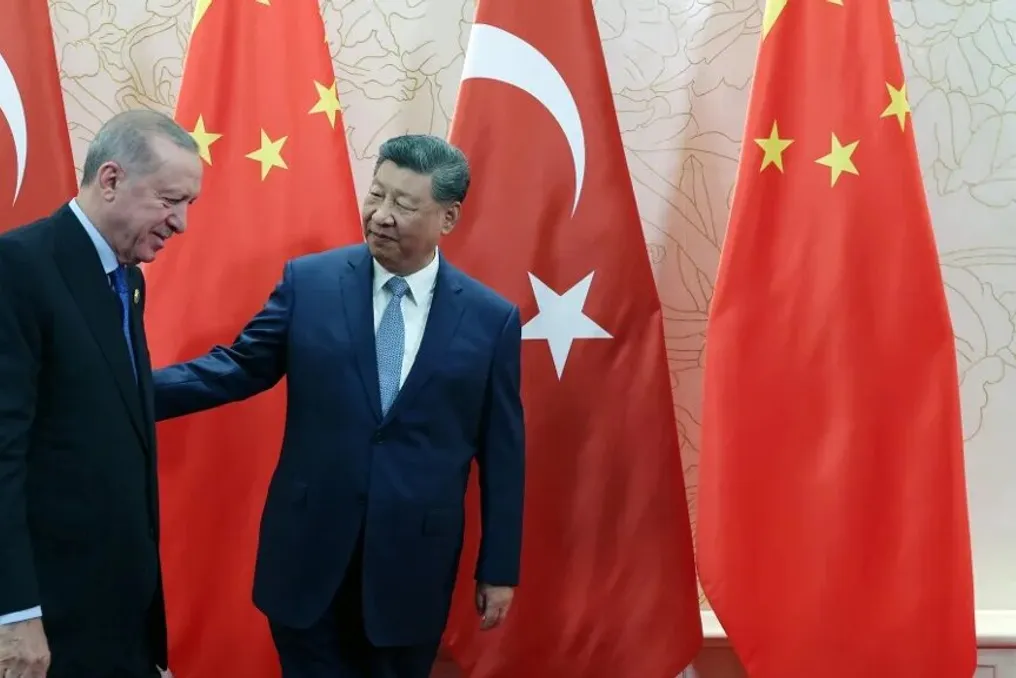
The Chinese government has significantly ramped up its public relations activities in Turkey amid reputational damage caused by the cancellation of investment plans by the manufacturer BYD.
In June, the Chinese electric vehicle company announced the suspension of work on a factory in Turkey, redirecting priorities to production in Europe. This sharp turn by BYD was a serious humiliation for the Turkish government.
To attract the company, Ankara offered generous tax incentives for the sale of BYD vehicles in Turkey even before the factory construction began. Thanks to these incentives and a new commercial strategy, BYD sales in Turkey sharply increased, exceeding 45,000 units in 2025. Experts believe that due to the tax advantages, the company could have gained an additional profit from the Turkish market ranging from $500 million to $1 billion.
A Turkish government consultant told Middle East Eye that 'the collapse of the BYD deal put China's image in Turkey in a precarious position,' adding that China is now conducting a 'propaganda offensive to change the situation.'
The consultant also noted that Ankara is tired of China's negotiation tactics, which he described as creating the appearance of reaching an agreement, only for Beijing to resume negotiations with an expanded list of demands. This public relations campaign is evident to anyone closely monitoring China's activities in Turkey.
The Chinese Embassy in Ankara places unpublished propaganda articles in pro-government media, emphasizing the importance of high-level interaction between the Communist Party of China and the ruling Turkish party, the Justice and Development Party (AKP). Furthermore, the embassy promotes the release of the fifth volume of Xi Jinping's book, 'Governing China,' through government-loyal media.
Propaganda Offensive
Nurettin Akçay, a scholar specializing in Chinese affairs, stated that the crisis surrounding BYD undoubtedly contributed to negative sentiment towards China in Turkey. He specified that while there has been a significant quantitative increase in China's diplomatic efforts in Turkey recently, such efforts have been underway for a long time. Even before the BYD issue arose, Chinese representatives invited journalists and other opinion leaders in Turkey to visit China.
Relations between Turkey and China have remained tense over the past decade, largely due to the Uyghur issue. Before 2020, Ankara sought to minimize coverage of Uyghur suffering in Turkish media in hopes of securing Chinese investment. Akçay believes that 'China is trying to minimize domestic criticism in Turkey by using a broad engagement strategy.'
At the request of Beijing, Turkish Foreign Minister Hakan Fidan visited the Xinjiang Autonomous Region, where most Uyghurs reside, in June 2024, attempting to resolve one of the main obstacles to bilateral relations. However, the promised investments in electric vehicle factories from BYD and the Chinese automaker Chery were never realized, despite lengthy negotiations following this visit.
Akçay's social media, where he tracks China's lobbying efforts in Turkey, has also drawn attention in China, where he received his doctorate from Shanghai University. In a separate post on X, Akçay reported that Shanghai University had sent him an email with numerous complaints regarding his critical reporting on China. He added that because of this, he was asked to stop mentioning his doctoral degree from Shanghai University, and that, as far as he understands, the doors to China are closed to him forever.
Akçay noted that China is focused on what it calls 'elite engagement,' which includes inviting prominent figures to the country as part of demonstration diplomacy presenting a carefully curated image of China. Last month, the China-Turkey Friendship Foundation, a state institution of China, organized an eight-day press tour for Turkish journalists working in opposition media. They were taken to the Xinjiang Autonomous Region, home to a large Uyghur population. None of these journalists, affiliated with T24, Halk TV, Cumhuriyet, Haberturk TV, and several independent publications, reported on alleged mistreatment of Uyghurs; instead, they focused on attacks by 'terrorists' carried out by radicals in the region and on China's integration efforts.
Turkish reports used similar vocabulary, with some repeating the same concepts almost verbatim. They emphasized the region's importance for China's industrial revival and the 'Belt and Road' initiative, portraying tourism as an increasingly vital part of Xinjiang's development plans.
Lack of Accountability
Human Rights Watch, in its 2026 report, stated that Chinese authorities intensified ideological control over the previous year, continuing harsh forced assimilation of Tibetans and Uyghurs. The report noted: 'There was no accountability for crimes against humanity in Xinjiang, where hundreds of thousands of Uyghurs remain unjustly imprisoned.'
Since 2017, China has placed hundreds of thousands of Uyghurs in 're-education camps,' destroyed mosques and Islamic cemeteries, and banned religious education. Akçay argues: 'Everything is planned, and China gets exactly what it wants because visitors are only shown what they are meant to see.' Consequently, journalists visiting China see a positive picture without understanding the broader context.
Recent attempts by China to influence public opinion in Turkey also included working with opposition parties, such as the Islamist-conservative New Dawn Party and the Turkish nationalist Victory Party. A delegation from the New Dawn Party visited China in June, and the Chinese ambassador Jian Xuebin met with the chairman of this party, Fatih Erbakan, last month. Akçay believes that China has begun building good relations with almost all opposition parties in Turkey. He posits that 'the Uyghur issue is once again an important factor in China's interest in opposition parties of any size in Turkey.'
He added that right-wing opposition parties in Turkey can speak relatively freely about the Uyghur issue because it attracts their electorate. Akçay concludes: 'China seeks to minimize domestic criticism in Turkey—or at least prevent the emergence of such criticism in radical campaigns—by implementing a broad engagement strategy.' In his view, China is succeeding, at least partially, by implementing an effective strategy to prevent the emergence of a radical counter-campaign.