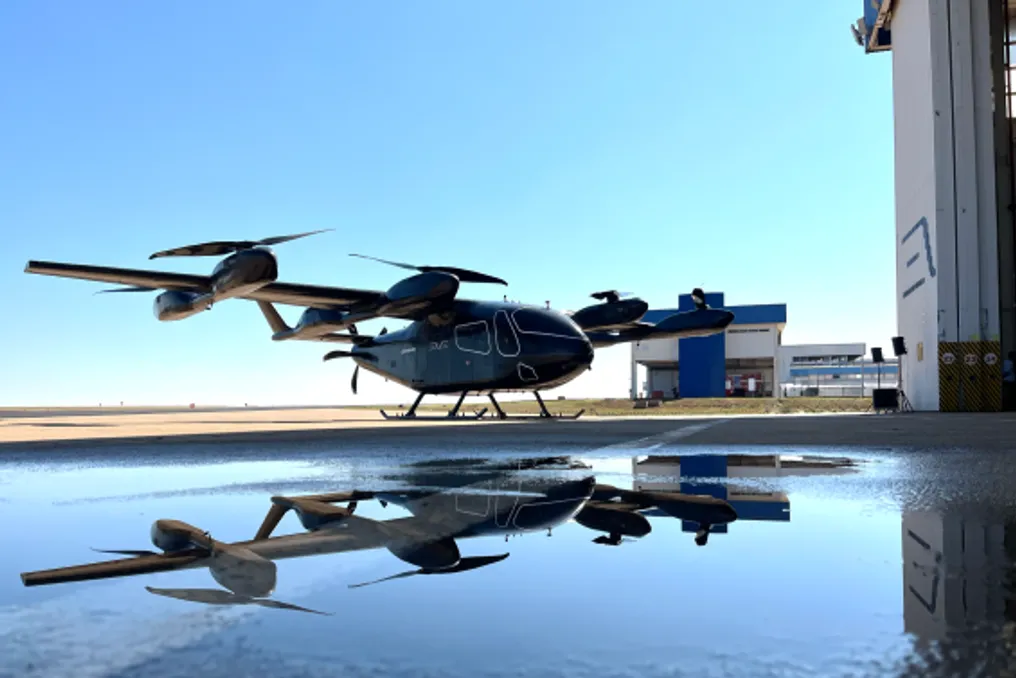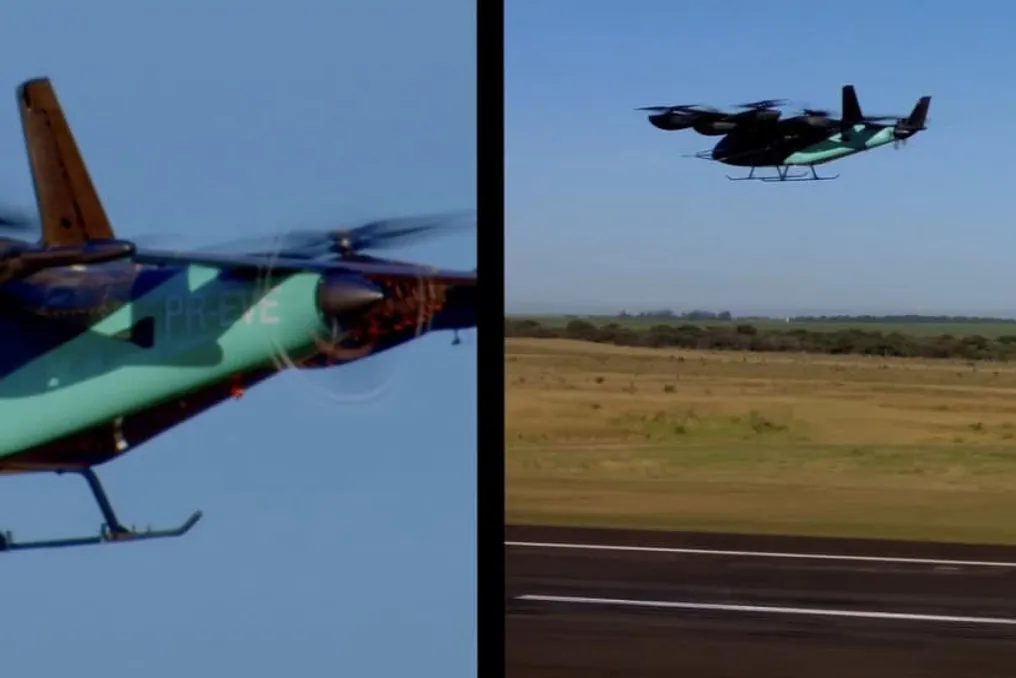
Eve Air Mobility, which operates as an Embraer subsidiary, has advanced in the development of its eVTOL by conducting the first flight of the transition phase. This test focused on evaluating the change from vertical to horizontal flight mode, considered one of the most complex phases for this type of aircraft.
During the trial, the propeller located at the rear of the prototype was activated, a crucial element for increasing speed during transit and confirming the concept developed by the company.
The prototype begins the most delicate phase of testing
Flight transition is a fundamental moment for any eVTOL, as it is at this point that the aircraft stops depending exclusively on vertical lift and begins to incorporate characteristics similar to those of a conventional airplane.
In the test conducted by Eve, the rear propulsion propeller, called a 'pusher,' was turned on during the flight and managed to operate at a frequency of 1,200 revolutions per minute. The prototype remained airborne for a period of 3 minutes and 9 seconds, reaching an altitude of 27 meters and a maximum speed of 55 km/h.
The primary results of this flight included: activation of the rear propeller during the transition phase; achieving a maximum speed of 55 km/h; covering an approximate distance of 1,550 meters; and collecting essential data for future performance tests. This first partial transition flight marks a significant advance in Eve's development journey.
Johann Bordais, CEO of Eve Air Mobility, commented on the achievement in an official note.
Test data aids in increasing the eVTOL's capacity
The flight served to verify the functioning of various systems and accumulate information that will be used in the next stages of the project. The engineering team will continue to examine operational and structural aspects before gradually increasing the aircraft's operating limits.
This set of parameters, known as the flight envelope, establishes conditions such as altitude, speed, and the expected behavior of the vehicle during its use. According to Marcelo Basile, engineering director of Eve Air Mobility, the test confirmed important goals from the beginning of the transition phase. He emphasized that 'this flight successfully demonstrated the activation of the rear propulsion propeller during flight and validated the main performance goals at the start of the transition phase.'
Upcoming flights will increase the vehicle's speed
Eve plans to continue the testing campaign, conducting new transition tests and evaluating the data link system, which is responsible for the aircraft's radio communication.
It is expected that the prototype will be prepared to operate at speeds of up to 50 knots, equivalent to approximately 92 km/h, while the flight envelope will be progressively expanded. This advancement represents another step in the development of electric aircraft capable of vertical takeoff and landing, a technology aimed at creating new urban air mobility solutions.