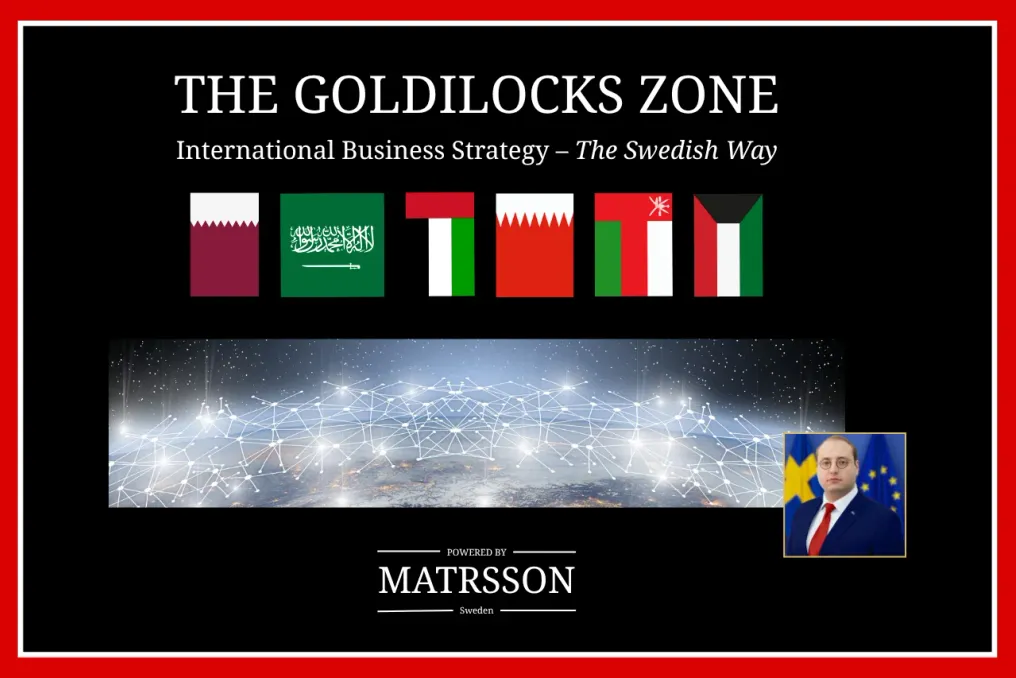
A Swedish pragmatist and international business strategist, Alex Matsson, is launching a new phase in international business education. He is presenting the 'Golden Mean: International Business Strategy — The Swedish Approach' program to higher education institutions in the Gulf Cooperation Council (GCC) region. This initiative aligns with the strategic goals of the Gulf countries by offering a global perspective that combines Swedish innovation, strategic thinking, and responsible leadership. The program aims to prepare leaders capable of stimulating sustainable growth, strengthening international cooperation, and enhancing global competitiveness.
Program Architecture
The 'Golden Mean: International Business Strategy — The Swedish Approach' program is an exclusive international strategy course developed under the guidance of Alex Matsson. It is designed for individuals and organizations motivated by curiosity, creativity, and the desire to transform imperfection into long-term positive impact for local communities, regional ecosystems, and global society.
Participants will refresh fundamental business concepts while gaining a modern understanding of the international business landscape. The core principles of the course are Resilience, Lagom, Serendipity, and Synergy-Making. These concepts help participants make balanced, thoughtful, and effective decisions.
The program is adapted for students, faculty, entrepreneurs, investors, and policymakers. It equips participants with the strategic vision, practical skills, and adaptability needed to navigate the complexities of global trade. Special emphasis is placed on finding a balance between tradition and innovation, opportunities and risks, and global integration versus local responsiveness. Participants are prepared not just to understand the mechanisms of international business, but to actively shape them through vision, creativity, and social impact.
Through a combination of lectures, seminars, case studies, simulations, collaborative projects, and critical discussion, the program develops advanced strategic insight and resilience. Participants are ready to lead organizations with flexibility, ethical integrity, and a far-sighted view in an increasingly interconnected and dynamic global business environment.
Understanding Global Markets and Making Strategic Decisions
The journey begins with studying global problems and opportunities, fostering a deep understanding of the forces shaping international markets and the strategic decisions organizations must make to succeed. Participants analyze both mature and emerging markets, studying their unique economic, cultural, and regulatory specificities, as well as how these affect strategic choices.
Innovation, Knowledge, and Internationalization
The curriculum highlights the interplay between knowledge, innovation, and opportunity, demonstrating how intellectual resources, organizational learning, and creative practices ensure a sustainable competitive advantage on the world stage. Participants gain insight into the internationalization process, studying how firms expand abroad, adapt to different conditions, and build resilience to overcome uncertainty, recover from setbacks, and maintain long-term growth.
Organizations, Markets, and Institutional Strategy
The program examines the nature of entrepreneurial firms, small and medium-sized enterprises (SMEs), multinational corporations, funds, and governmental bodies, providing participants with a comprehensive understanding of their individual functions and interactions. By exploring their strategic approaches, participants learn how these structures operate effectively, shape markets, influence policy, and impact both local and global economies.
Commercial Diplomacy and Intersectoral Collaboration
Focusing on commercial diplomacy, industrial marketing, and the dynamics of business-to-business, business-to-government, and government-to-government interactions, participants will develop an understanding of the complexity of these relationships. They will study the strategies necessary to create value and promote collaboration across these diverse sectors, ensuring effective outcomes for all stakeholders.
Digital Transformation and Modern Business Challenges
Modern challenges are examined through the lens of interaction with advanced digital technologies, illuminating tools that change operations, strategy, and decision-making. Critical analysis of current trends, dilemmas, and ethical aspects allows participants to confidently and insightfully confront the strategic and social consequences of globalization.
Leadership, Ethics, and People-Centric Business
The human aspect of the business world is equally important. Participants study networking, relationships, persuasion, negotiation, and intercultural communication as vital tools for influence, collaboration, and organizational sustainability. Ethical leadership and social responsibility are cultivated through modules on corporate social responsibility and business ethics. Strategic thinking is deepened by studying business planning, management, and leadership, preparing participants to guide organizations with prudence and foresight.
The Swedish Approach: Integrating Art, Science, and Strategic Thinking
The program concept celebrates the integration of art and science in business. Participants develop an interdisciplinary mindset, analytical rigor, and creative vision. They work with approaches that embrace complexity and adaptability, including Resilience, Lagom, Serendipity, and Synergy-Making. These methods foster the ability to recognize opportunities, facilitate collaboration, and achieve sustainable results.
Alignment with National Visions and Strategic Priorities of GCC Countries
The 'Golden Mean: International Business Strategy — The Swedish Approach' program aligns with the national visions and development plans of the member states of the Gulf Cooperation Council (GCC), including Bahrain Vision 2030, Kuwait Vision 2035, Oman Vision 2040, Qatar National Vision 2030, Saudi Vision 2030, and the UAE strategies 'We Are UAE 2031' and 'Centenary 2071'. The program supports these national priorities by encouraging innovation, entrepreneurship, science-based economic development, digital transformation, sustainable growth, international competitiveness, and human capital development. By emphasizing strategic leadership, sustainability, commercial diplomacy, ethical business practices, and global engagement, the program provides students, academics, entrepreneurs, policymakers, and industry leaders with the necessary competencies to make a meaningful contribution to economic diversification, private sector growth, scientific research, and international cooperation. By integrating top-tier business strategy with principles of sustainability and responsible governance, the initiative serves as a catalyst for training future talent and advancing the long-term prosperity and global competitiveness envisioned by the GCC countries.
Sustainable Development and UN Sustainable Development Goals
The program embodies a firm commitment to the principles of sustainable development. Through its comprehensive and forward-looking approach, it promotes the United Nations Sustainable Development Goals, including Quality Education (Goal 4), Gender Equality (Goal 5), Decent Work and Economic Growth (Goal 8), Industry, Innovation, and Infrastructure (Goal 9), Sustainable Cities and Communities (Goal 11), Responsible Consumption and Production (Goal 12), Climate Action (Goal 13), and Partnerships for the Goals (Goal 17). This integrated vision underscores the deep connection between personal development, societal progress, and global responsibility. By inspiring participants and organizations toward purposeful innovation that considers broader social, economic, and environmental consequences of their work, the initiative cultivates leaders capable of shaping a sustainable, inclusive, and prosperous future for business, policy, and higher education worldwide.
About Alex Matsson
Alex Matsson is a Swedish pragmatist and international business strategist. He is a visionary global leader, mentor, entrepreneur, senior lecturer, researcher, and distinguished international business consultant. He ranks first among graduates in international business strategy in Sweden. He possesses extensive experience in launching, running, and managing enterprises within global value chains, as well as in international engagement with investors, SMEs, MNCs, governmental agencies, universities, and interdisciplinary research institutes. He advocates for strategic issues related to policy, business strategy, industrial marketing, commercial diplomacy, and research commercialization.
Regarding higher education, Matsson believes in serendipity, innovation, and the power of synergy creation. Therefore, these concepts form the foundation of his efforts to disseminate knowledge. He employs a pragmatic approach that is inherently rigorous. He systematically ensures the successful transfer of core business concepts while developing students' capacity for reflective thinking. His goal is to enable students to constructively apply their advanced knowledge so that they can become an invaluable source of prosperity, contributing to the 'social' and 'economic' well-being of their local communities, regions, and the world. His research focuses on promoting trade, emerging markets, business sustainability, and a networked approach to internationalization. Alex Matsson is a member of the 'Matsson House,' a Scandinavian family originating from the coastal city of Kalmar in southeastern Sweden. Strongly committed to conservative principles, he is dedicated to knowledge, tradition, and the greater good globally. In his personal life, his interests include blue whales, Arabian horses, classical music, ethical capitalism, religion, culture, Nordic countries, the GCC region, and Central Asia, especially Kazakhstan.