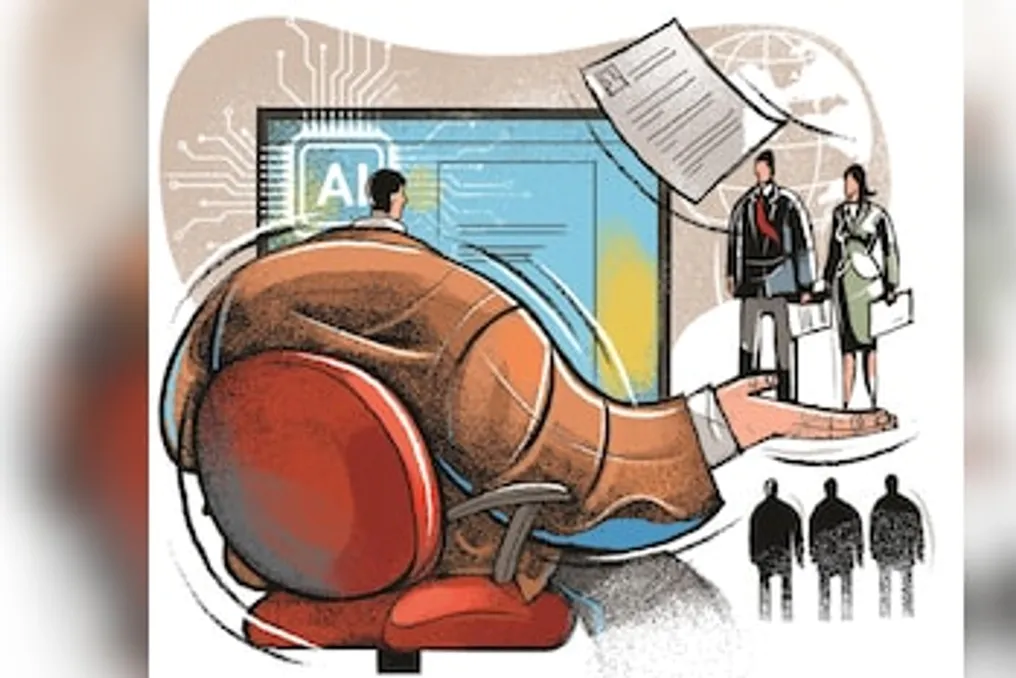
According to the World Bank's 2026 World Development Report, generative artificial intelligence (AI) is beginning to transform the labor market in South Asia. As a result, multinational corporations (MNCs) and firms integrated into global value chains (GVCs) are reducing staffing more actively than local companies. This indicates the early impact of this technology on the region's export-oriented service sector.
The report, published on Tuesday, showed that after the emergence of ChatGPT at the end of 2022, the number of online job postings in South Asia decreased by 1.6 percent, despite the growing demand for AI-related skills. The decrease was more noticeable among MNCs and GVC-related firms compared to local companies. This suggests that enterprises with better access to AI technologies and international operational mobility are adjusting their hiring strategies faster.
These findings are particularly significant for India, as its IT industry, business process management sector, and growing network of global centers of excellence are closely linked to multinational supply chains and heavily reliant on digital service exports.
Automation and Employment Challenges
According to the report, multinational firms can more easily automate tasks or move work across borders, whereas local companies are slower to adopt AI technologies. Consequently, the initial employment consequences are primarily seen among internationally connected enterprises, rather than across the entire economy. The report notes: 'Due to the effects of job displacement and job loss, AI has a strong negative correlation with the wage share of high and medium-skilled workers, mainly through wage reduction as AI usage increases.'
The World Bank also warned that AI could gradually undermine the outsourcing advantages that have supported economic growth in countries like India and the Philippines over the last two decades. While the report emphasizes that data on AI's impact on the labor market remains ambiguous and evolving, it points to early signs that some routine digital tasks are already being replaced.
Inderjeet Gill, Senior Vice President and Chief Economist of the World Bank Group, stated: 'AI could close a promising path to middle-class employment in many developing economies, threatening call center jobs and entry-level positions in software, finance, and business services. It could exacerbate shortages of electricity and water. It could deepen dependence on foreign technology—and force poor countries to choose between competing AI systems controlled by the most powerful nations. It could bring a host of other undesirable consequences: greater income inequality, covert disinformation, and political repression.'
Referencing data from an online freelancing platform, the report demonstrated that the volume of work outsourced to developing countries decreased by 39 percent in 2025, with the sharpest decline observed in professions most susceptible to AI automation. It was noted that sectors such as call centers, customer support, data processing, and back-office services, which contributed to growth in countries like India and the Philippines, may come under pressure as AI becomes capable of performing more office and knowledge-based tasks.
Despite these changes, the World Bank believes that fears of widespread job losses in developing countries are exaggerated. Estimates suggest that less than one in ten jobs in developing countries are subject to AI-driven automation, compared to more than one-third of jobs in high-income countries. Conversely, it is expected that about one in six jobs in developing countries will be enhanced by AI-driven productivity gains, rather than being completely replaced.
The report argued that the greater opportunity for countries like India lies not in creating cutting-edge AI models, but in adapting existing technologies to local languages, institutions, and business needs. It recommended that governments and businesses prioritize the broad implementation of small, specialized AI applications that can boost productivity across various sectors, including agriculture, healthcare, education, and public administration, instead of concentrating resources on developing large language models.
The report also provided examples from India where AI is already providing tangible benefits. As evidence that locally adapted AI applications can generate significant economic returns even without advanced computing infrastructure, it cites an example of AI-based weather forecasting in Telangana, which helped small farmers save up to $560 per farmer by improving agricultural decision-making.
Gill concluded: 'Developing countries should leave the wealthy world to worry whether AI will ever doom humanity. Their own question is more pressing: will they miss the technological revolution again? Or will they use it this time to improve the lives of millions? Today's developing economies missed the first industrial revolution and paid for it for two centuries. They cannot afford to miss this one.'