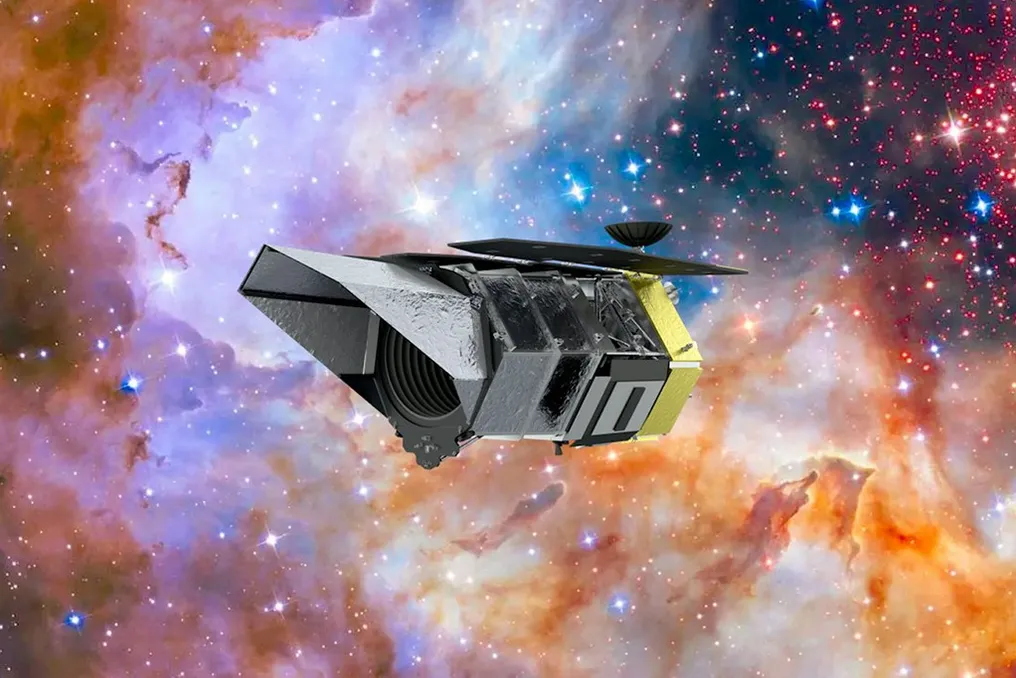
NASA is preparing to launch a new space telescope that will help unravel some of the greatest mysteries of modern astronomy. This instrument, named after Nancy Grace Roman, the agency's first head of astronomy, will study the origin, composition, and evolution of the universe.
Mission Preparation and Characteristics
The launch is scheduled for the end of August. The Nancy Grace Roman Telescope, named after the first female leader of NASA's astronomy who passed away in 2018 at the age of 93, made a significant contribution to understanding stars and played a crucial role in shaping NASA's space astronomy program.
The mission is undergoing its final preparation stage before the launch, which is set for the Kennedy Space Center in Florida at the end of August. The project is eight months ahead of schedule and remains within budget, which is a rare achievement for NASA missions.
Comparison with Other Telescopes
Unlike the James Webb Space Telescope, which is designed for detailed study of individual objects, Roman is designed for large-scale sky mapping. It will cover vast areas of space, allowing astronomers to form a much broader picture of the universe and its transformation.
Interestingly, Roman was originally a spy satellite transferred to NASA by the US government intelligence agency. The telescope is equipped with two main instruments: a wide-field imager and a coronagraph.
The wide-field imager will detect infrared light from the universe. Since the wavelength of infrared light is slightly longer than visible light, this instrument can penetrate cosmic dust and observe deeper into space. Its field of view is about 100 times larger than that of the Hubble Telescope's infrared camera, but with comparable clarity. Furthermore, thanks to the capabilities of the wide-field imager, it will be able to map space approximately 1000 times faster than Hubble, completing observations that Hubble might take centuries to conduct.
The coronagraph, on the other hand, is designed to block the blinding glare of nearby stars. This function allows astronomers to use direct imaging techniques for faint planets and disks of dust and gas around other stars by suppressing the light from the stars themselves.
Cosmology Research
Modern cosmology, which studies the birth and evolution of the universe, is based on a successful model. According to this model, ordinary matter, which makes up stars, planets, and people, constitutes only a small part of everything. The rest of the cosmos consists of two invisible and mysterious components.
The first component is dark matter, which accounts for about 25% of the universe. This form of matter does not reflect or absorb light, but its gravitational pull helps hold galaxies together. The Roman mission may help clarify the nature of dark matter by tracking how it formed galaxies at different stages of cosmic history.
The second invisible component is dark energy, which makes up about 70% of the universe. Its exact nature is unknown, but dark energy causes the accelerated expansion of the universe. For decades, astronomers assumed it was constant or uniform, but recent research suggests that dark energy may change over time. Roman will test these conflicting hypotheses.
If dark energy is constant, it indicates an infinite expansion of the universe. But if it changes, it could point to new physics beyond current theories. Roman may also help solve an old mystery: why we observe the universe at a moment when the densities of matter and dark energy are roughly comparable. In the early universe, matter dominated, and in the distant future, dark energy is expected to dominate completely. The current era appears to be a transitional period between these two states.
Beyond Cosmology
Roman's scientific investigations extend far beyond dark energy. The telescope will conduct the largest survey of exoplanets outside the solar system, discovering thousands of new worlds using the method of gravitational microlensing.
Gravitational microlensing occurs when the gravity of a foreground star temporarily deflects and amplifies the light of a more distant background star, acting as a natural magnifying lens. If the foreground star has a planet, that planet can cause a slight brightening of the signal, revealing its presence.
Many of these exoplanets are difficult to detect using the two most common methods—transit and radial velocity. By using microlensing, Roman will be able to find planets in wide orbits, low-mass planets, and even free-floating worlds not associated with any star.
Roman is also part of a new era of astronomical surveys. Its wide-field capabilities place it alongside other important missions. The European Space Agency's (ESA) Euclid mission maps billions of galaxies to study dark matter and dark energy. And the Vera C. Rubin Observatory, built in Chile, conducts repeated scans of the Southern sky.
These observatories will collectively help astronomers map the universe across various wavelengths, distances, and timescales. Roman will also collaborate with the James Webb Space Telescope, identifying large patterns and unusual objects across the sky that Webb can then study in detail. This combination of breadth and depth is becoming increasingly important in modern astronomy.
However, Roman's greatest impact may be unexpected. Through repeated observations of large sections of the sky, it could potentially discover rare events and phenomena previously unknown to science. For astronomers, this is one of the most exciting aspects of the mission.