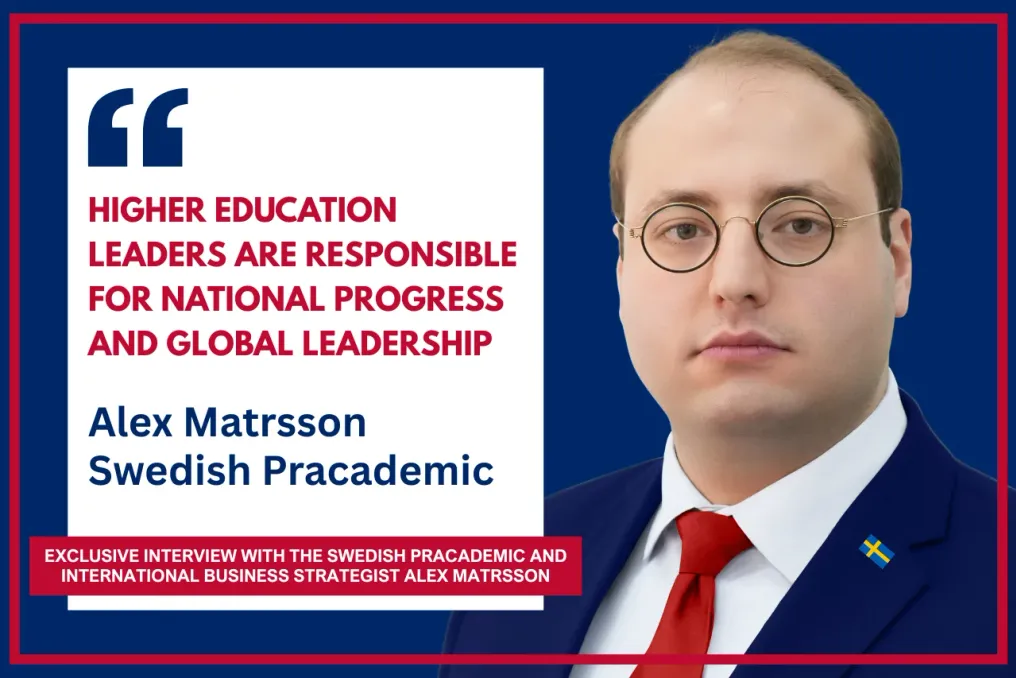
In an exclusive interview, Alex Mattsson, a Swedish professor and international business strategist, asserts that the future of national prosperity will be determined not only by economic policy, industrial potential, or technological breakthroughs. It will depend on the quality of leadership in institutions that develop knowledge, talent, and innovation. Mattsson emphasizes that any nation's true competitive advantage today lies in its ability to shape leaders capable of transforming knowledge into national power.
Similar stories
Popular
Amid the growing orientation of the global economy towards knowledge, universities have long gone beyond their traditional educational mission. They function as strategic national assets, influencing economic stability, technological development, diplomatic influence, and social progress. Consequently, leadership in higher education has become a matter of national strategy, rather than mere administrative management.
The Threat of Leadership Gap for the Future of Higher Education
Mattsson notes that universities occupy a unique position at the intersection of education, research, innovation, government, and industry. They nurture future leaders, generate scientific discoveries, accelerate entrepreneurship, and influence public policy. However, this exceptional responsibility is undermined by a structural contradiction that remains largely unresolved in all higher education systems worldwide.
Academic leadership is often viewed as a natural extension of scholarly virtue, rather than as a distinct professional discipline requiring specialized training. Mattsson warns that the blending of academic and leadership excellence is one of the main strategic weaknesses of higher education. Outstanding researchers often take on high leadership positions without formal training in organizational strategy, institutional management, financial administration, geopolitical awareness, stakeholder management, or transformational leadership. The consequence is not merely institutional inefficiency, but a decline in the nation's ability to compete in an increasingly interconnected world.
Leading Universities in an Era of Global Complexity
According to Mattsson, modern universities operate in an environment marked by geopolitical uncertainty, demographic changes, breakthrough technologies, financial pressure, international competition, and rapidly changing labor market demands. Managing such institutions requires much more than subject matter expertise; it demands systemic thinking, strategic foresight, diplomatic competence, and the ability to unite diverse communities around a compelling long-term vision. Mattsson states that universities cannot solve 21st-century problems using leadership models developed for 20th-century institutions.
Without the deliberate development of leadership qualities, many educational institutions become trapped in bureaucratic cultures that prioritize administrative continuity over strategic transformation. Intellectual superiority remains abundant, but institutional leadership often lacks the mechanisms necessary to translate knowledge into measurable national impact.
Cultivating Leadership as Institutional Culture
Mattsson further argues that leadership should not be perceived as the duty of a small executive group, but as an inherent capacity of the institution, embedded at all levels of the university. The most influential global institutions deliberately cultivate leadership at every level of their structure. Faculty members develop as academic leaders, professional staff become strategic partners, students are encouraged to become future change agents, and interdisciplinary collaboration becomes the norm, not the exception. Such ecosystems generate resilience, innovation, and continuous renewal, as leadership transforms into a shared organizational culture rather than an isolated administrative function. This distributed approach strengthens institutional adaptability while simultaneously preparing future leaders for life in society, government, and industry.
For Mattsson, the implications of these processes extend far beyond university campuses. Leadership in higher education directly influences national innovation systems, economic competitiveness, workforce readiness, social mobility, and international reputation. Universities drive research that stimulates industrial transformation, graduate students who support national productivity, and create partnerships that strengthen diplomatic and commercial ties across borders. Mattsson explains: 'Every leadership decision within a university ultimately becomes a decision about the future competitiveness of the nation itself.' Therefore, nations striving for global influence must recognize that investing in higher education leadership is simultaneously an investment in economic security, technological sovereignty, and sustainable development.
Aligning Universities with National Aspirations
Mattsson also points out that many national higher education strategies remain fragmented because institutional ambitions and national priorities often develop along separate trajectories. Universities frequently develop forward-looking strategic plans, but these documents are insufficiently linked to broader economic, industrial, innovative, and social goals. True strategic alignment requires universities to integrate their educational missions with national development plans while maintaining academic independence. Such synchronization enhances public trust, improves resource allocation, and positions universities as indispensable partners in solving global social challenges, including sustainable development, artificial intelligence, healthcare, energy transition, and global competitiveness. Thus, strategic planning must move beyond declarative statements to become a disciplined system linking institutional excellence with measurable national outcomes.
Mattsson further asserts that the selection of leaders deserves significantly more attention at the national level, as appointing university leaders constitutes one of the most critical public decisions affecting future prosperity. Governments should not interfere with academic autonomy, but they bear a legitimate responsibility to ensure that appointments reflect the strategic importance of higher education within national development. Transparent governance, rigorous competency-based selection processes, and significant cooperation between governing boards and state bodies ensure greater institutional accountability while preserving autonomy. Mattsson insists: 'Choosing a university leader is not an administrative appointment. It is a strategic investment in the nation's future.' Consequently, leadership should be assessed not only by academic achievements but also by demonstrated ability to manage complex organizations in an era of increasing globalization.
In conclusion, Alex Mattsson, a Swedish professor and international business strategist, emphasizes that leadership in higher education is one of the most decisive yet underestimated factors in national progress. Nations aiming to lead the global knowledge economy cannot afford to leave university leadership to chance or tradition. They must deliberately develop leaders capable of combining academic excellence with strategic vision, global engagement, institutional transformation, and national purpose. Mattsson concludes: 'The future belongs to those nations that understand one simple truth: universities do not just educate the future. They are responsible for creating it.' By elevating leadership development to the core of higher education policy, countries strengthen not only their universities but also their capacity for innovation, competition, and prosperity in an increasingly complex and interconnected world.
According to the daily horoscope for Scorpio on July 22, 2026, the upcoming period promises significant success in the field of education. This is a time when you should focus on expanding your own knowledge and skills.
Financial and Business Aspects
In the business sphere, a favorable period with potential for profit is predicted. However, readers are advised to avoid hasty investment decisions. It is also recommended not to start a business in partnership with relatives.