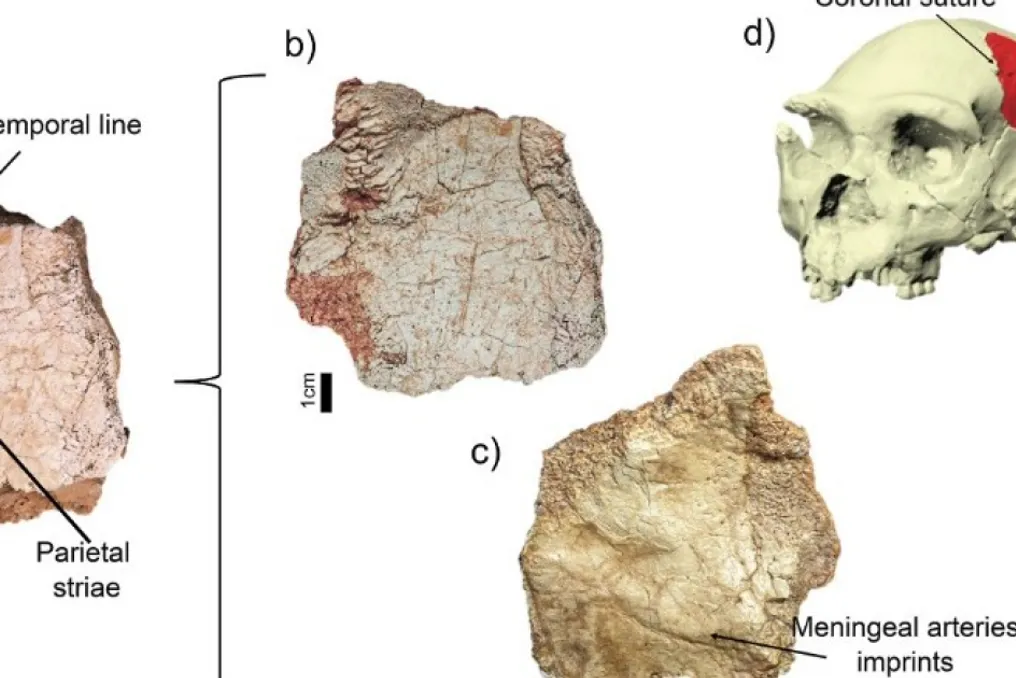
Archaeologists have discovered a fragment of parietal bone belonging to Heidelberg Man in central modern Spain. These new remains are dated to a period estimated between 224 and 160 thousand years ago. Information about this significant find was presented in the journal Journal of Human Evolution.
Heidelberg Man (Homo heidelbergensis) is one of the most difficult types of fossil humans to classify, as its definition heavily depends on the opinions of individual scientists. In a broader sense, this term encompasses archaic hominins that inhabited Earth during the Middle Pleistocene (approximately 774–129 thousand years ago). It often refers only to ancient hunter-gatherers of Europe from whom Neanderthals later evolved. Nevertheless, the diversity of Heidelberg populations observed in this region suggests the existence of several parallel evolutionary branches.
Daniel Garcia-Martinez from the Complutense University in Madrid and his colleagues from countries such as Australia, Bolivia, Germany, Spain, Poland, Portugal, and France reported on these remains. Previously, back in 2009, local residents discovered ancient animal bones in the Spanish province of Ciudad Real, located near Madrid. At this site, named Ruidera, dozens of animal bones or teeth were subsequently found, which were dated to the interval of 400–300 thousand years.
After many years of work, archaeologists began a scientific project to study this monument. In 2023, they were able to confirm the presence of archaic humans at this location. A piece of an ancient hominin skull was found in cemented rock (breccia). Analysis showed that it was a fragment of the left parietal bone measuring approximately 6.8 by 7.5 centimeters. Notably, this bone was quite massive, with a thickness of about 1.2 centimeters, which is roughly twice as thick as that of modern humans.
Since radiocarbon dating was unsuitable for determining the age of the finds from the monument, scientists applied uranium series and optically stimulated luminescence methods. The first method established a minimum age of just over 18 thousand years, while the second indicated a much deeper antiquity. Based on the rocks adjacent to the skull, it was concluded that the last remains were on the surface of the earth and were exposed to sunlight during the period between 224 ± 14 and 160 ± 10 thousand years ago.
The thickness of the cranial bone from the Ruidera site significantly exceeds the measurements of the archaic human from the Grand Dolina cave. Recent measurements of the remains from this site allowed scientists to understand that their predecessors (H. antecessor) underwent an evolutionary reduction in the thickness of the cranial vault towards modern humans.
Furthermore, researchers discovered a burial of a person in the late capital of the Xianbei state, Northern Wei, who likely belonged to the ruling elite of that time. This person's tooth was selected for ancient DNA analysis, which revealed that the remains belonged to a woman genetically related to the Han people, rather than the steppe nomads to whom the Xianbei belonged. This information was published in the journal Archaeological Research in Asia.