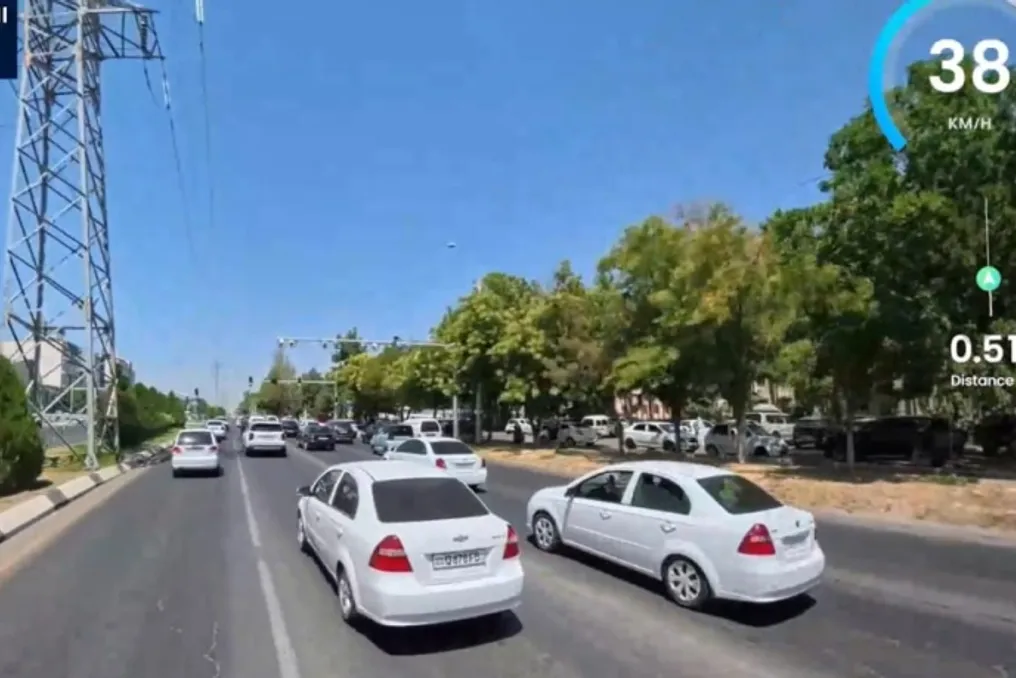
The expansion of the 'Green Wave' system continues in Tashkent, with a new section of the Small Ring Road being added. Thanks to traffic light synchronization, the time required to travel this section has been reduced by almost half.
The expansion of the 'Green Wave' system continues in Tashkent, with a new section of the Small Ring Road being added. Thanks to traffic light synchronization, the time required to travel this section has been reduced by almost half.
According to information from the Center for Traffic Organization, before the 'Green Wave' started operating, drivers needed about five minutes to cover this distance. Now, the average travel time is only 2 minutes and 45 seconds, which represents savings of about 45 percent. By maintaining a speed in the range of 40–60 kilometers per hour, motorists can pass several intersections practically without needing to stop.
Previously, a similar system was launched on Buyuk Ipak Yuli Street, where traffic lights at 13 intersections are synchronized. Currently, the 'Green Wave' operates on two sections totaling 5.7 kilometers, covering 18 regulated intersections. The average travel time on these sections has decreased by approximately one-third.
The Center for Traffic Organization reported that plans include further study and implementation of this system on other streets of Tashkent to increase the speed and comfort of road traffic.
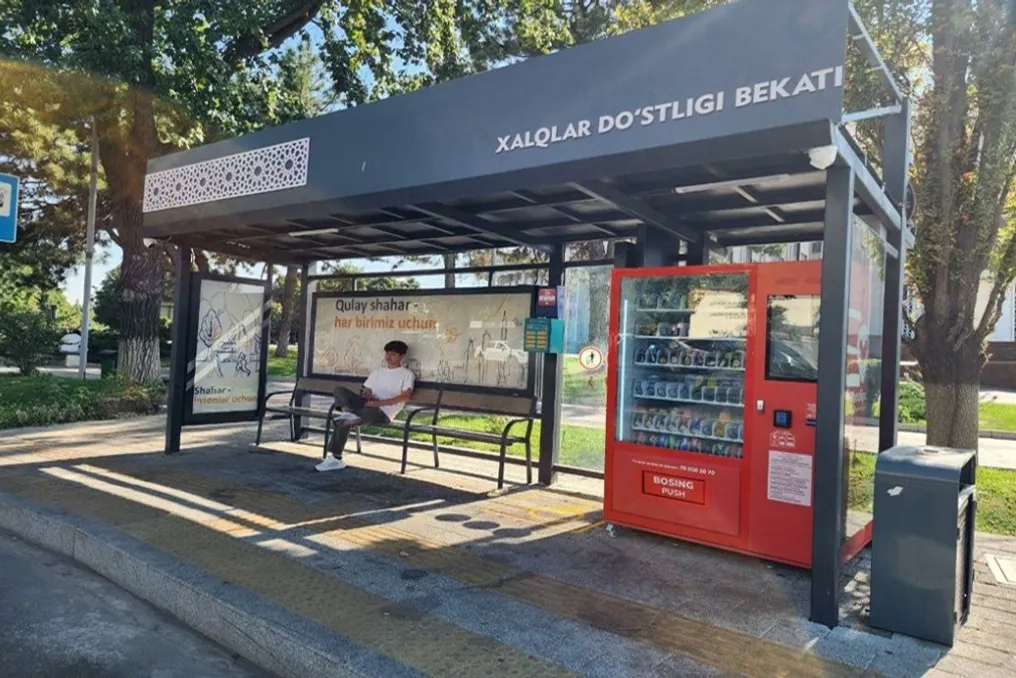
The new bus stops in Tashkent are part of a large-scale project that involves multi-billion investments and a ten-year lease. The right to operate these updated complexes was granted to one operator.
According to information presented in a letter from the Tashkent hokimiyat to the Presidential Administration, the city has 2,871 bus stops. 496 stop complexes were put up for auction: 266 with advertising structures and 230 without them. Formally, three companies participated in the tenders, but the document only names the winner—EWI Snacks LLC, which specializes in snack production.
EWI Snacks LLC received the right to operate all listed objects and committed to paying an annual rent of 1.7 billion soums to the city budget. It is important to note that this scheme does not imply a direct transfer of stops to a private firm or financing of construction from the city budget. Instead, the investor independently creates and equips the complexes, receiving the right to use them for ten years. The main income from the project will likely be generated through the commercial monetization of the complexes themselves, primarily through advertising space and additional services.
A question arises as to how a company whose main activity is related to snack production became a participant in the auction for urban transport infrastructure. The hokimiyat provided context indicating the structure of EWI Snacks LLC. The sole founder of this company is East-West Invest, known as a producer of snacks under the Cheers brand and the official representative of Pepsi in Uzbekistan. Shares in East-West Invest are distributed between the Cypriot company Redlex Trans Ltd, which owns 98.21%, and Shahzod Khalimov, who holds 1.79%.
Furthermore, the hokimiyat's letter notes that entrepreneur Shukhrat Ergashev is the 100% founder of Redlex Trans Ltd. This person is named as the beneficiary of enterprises producing drinks under the PepsiCo brand and is also recognized as one of the country's major advertisers.
The hokimiyat's letter also reveals details regarding the costs of creating the new stop network and the investor's obligations. The cost of the complexes varies depending on the level of equipment. The most basic option—a four-meter pavilion without advertising elements—is estimated at approximately 42.1 million soums. If an LED screen is added, the cost of the same format increases to 114.3 million soums. The most expensive is the six-meter complex, equipped with an advertising screen and a vending machine, which will cost approximately 178.9 million soums.
The investor is responsible not only for installing the pavilions but also for carrying out a number of infrastructure tasks. Each object must be equipped with an electronic display to show vehicle arrivals, video surveillance systems, an emergency call button '112 SOS', bins, benches, ramps, and tactile paving for visually impaired people. The operator is also obliged to ensure the landscaping of the adjacent area.
A separate section of the document addresses the topic of stop air conditioning. The hokimiyat explains that cooling is not planned for most new complexes, citing examples from Tokyo, Seoul, and Singapore, where priority is given to air conditioning the public transport itself and minimizing bus waiting times. According to the administration's estimates, the annual cost of installing and maintaining one air conditioner in Uzbekistan amounts to 18–22 million soums, and its energy consumption exceeds the capacity of solar panels that can be installed on the roof of a standard stop.
Nevertheless, the authorities reserve the right to introduce closed, cooled pavilions on a trial basis in areas with high passenger traffic. Thus, the new model requires the private operator to fulfill a wide range of obligations to the city: from installing necessary equipment and landscaping to full commissioning of the facilities. The effectiveness of the entire project will be determined by how timely and qualitatively these conditions are met during the ten-year lease period.
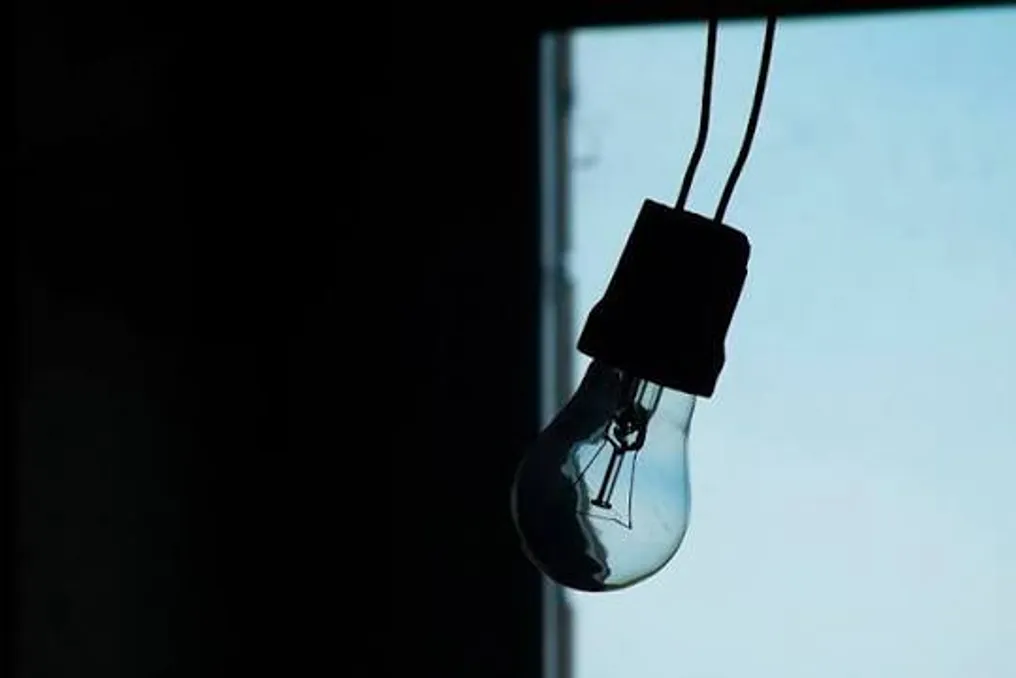
Residents of certain districts of Tashkent may face temporary interruptions in electricity supply today, July 20. The reason for these outages is the commissioning process of a new autotransformer at the 'Ozodlik' substation.
According to information provided by the branch of 'Tashkent City Main Power Grids,' short-term disruptions in electricity supply may occur in parts of the Almazarsky, Chilanzarsky, Uchtepinsky, and Yakkasaraysky districts of the capital.
Company specialists confirmed that all work being carried out complies with established safety standards. After the completion of technical work, electricity supply is planned to be restored to normal operation as soon as possible. The energy company apologized to residents for any inconvenience and thanked consumers for their patience and understanding.