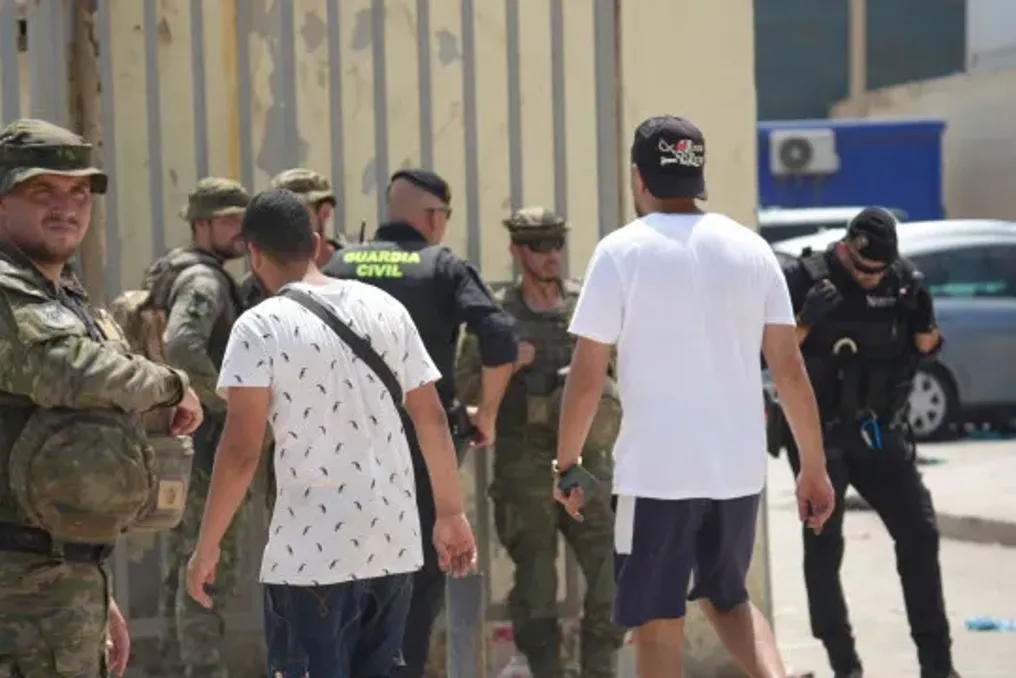
The autonomous city of Ceuta is beginning to return to normal mode thanks to the gradual departure of migrants to Morocco, increased security measures at key points, and a reduction in tension surrounding demonstrations that took place in Reis Square in the city center, according to a report from the news agency EFE.
Residents of Ceuta are trying to restore their usual way of life, but some people are still hesitant to leave their homes, and restaurants and beaches look less crowded than usual for this time of year.
The arrival of about 80,000 migrants from Morocco, which began on Thursday, coincided with the first days of the city fair, which was forced to be canceled.
The Ceuta government has increased the number of fatalities near the Tarajal border breakwater to 88 people.
The President of Ceuta, Juan Jesús Vivás, stated that on that day, between 3,000 and 5,000 migrants remained in the Spanish autonomous city four days after the mass influx from Morocco.
In statements made to Telecinco and distributed by the Europa Press agency, Vivás emphasized that Spain's 'territorial integrity' was 'violated' in Ceuta 'due to the flooding of 80,000 people,' which constitutes almost the entire population of the city.
The president of the autonomous city noted that the situation differs from that observed on Thursday and Friday, but specified that 'measures must be taken in various areas' to ensure that such a situation 'does not happen again.'
As for the border of the Spanish enclave of Melilla, which also borders Morocco, it spent a second night in a row without incident since the start of the migration crisis last Thursday.
The Beni Ensar border crossing continues to gradually reopen. Sources from the Government Delegation in Melilla informed EFE that no incidents have been registered along the border perimeter.
According to police sources, the situation at this border crossing is 'almost normal,' and traffic movement is gradually resuming in groups of 20 vehicles.
This measure aims to prevent a new border blockade and a 'humanitarian crisis' similar to the one experienced by about 2,000 foreigners during the 36-hour closure between Thursday evening and Saturday morning, when about 700 cars accumulated near the border crossing.