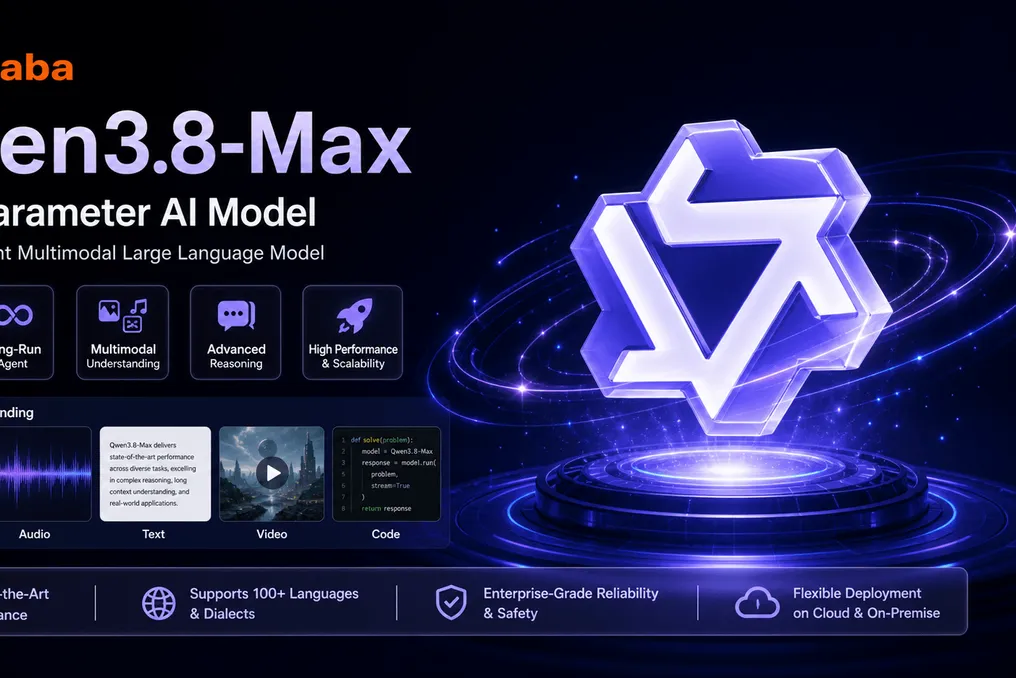
Alibaba introduced the official version of the Qwen3.8-Max model on August 3rd, following the wave of Kimi K3. This model boasts 2.4 trillion parameters and supports a 1 million token context window. It demonstrates significantly improved capabilities in programming and office tasks, securing a place in the global top tier, with the model weights expected to be open-sourced within a week.
As a multimodal system, Qwen3.8-Max is capable of processing images, video files, and PDF documents. Access to these features is provided through token plans, as well as via the Qianwen Office, Qoder, and Qianwen applications.
A demonstration was conducted featuring a long-term agent that completed an autonomous task from start to finish: it researched the visual language of world-class annual reports, extracted reusable skills, and generated three fictional annual report cases in HTML format. The task required analyzing at least ten reports covering American technology and consumer brands, European energy and industrial companies, Japanese or Scandinavian design firms, and Chinese firms in the internet, manufacturing, and consumption sectors. These reports needed to cover both regulatory disclosures and brand narrative aspects.
Each report required opening the original PDF file and studying the cover, financial summary, management discussion, charts page, and tables. Research cards documented sources, typography, grid, color scheme, and rules, while also including a prohibition against copying real text, numbers, graphs, logos, or images.
In performing the task, Qwen3.8-Max acted as the primary agent, coordinating the work of six parallel sub-agents that studied the companies' annual reports. The sub-agents' results were reviewed sequentially, which prevented overloading the main agent's context window and ensured task completion over a long horizon. During two waves of research, twelve companies were examined, including Tencent, Xiaomi, Muji, Coca-Cola, Nike, Alibaba, IKEA, Shell, Li-Ning, Unilever, Alphabet, and Orsted, representing Chinese, American, European, and Japanese markets.
The model summarized the gathered data into a reusable skill that encompasses a complete workflow, research cards, typography syntax, chart specifications, and design tokens. It was required that images serve the narrative, prioritizing CSS and embedded SVGs, as well as custom data diagrams. A condition was also set to use only licensed open materials and permission for the absence of images if legal material was unavailable.
The release of this model underscores Alibaba's commitment to the paradigm of long-term agents, where models can execute multi-stage autonomous workflows. The 1 million context capacity allows for processing extensive documentation, and the 2.4 trillion parameters ensure the depth of reasoning for complex task decomposition. The one-week timeline for releasing open weights supports competitive pressure and strengthens the Chinese open-source ecosystem, where Qwen models are enterprise infrastructure. Qwen3.8-Max emerges amid the general growth of Chinese models, such as Kimi K3 with 2.8 trillion, DeepSeek-V4-Flash with 304 billion, and MiniMax H3, which enables multimodal content generation. The combination of scale, context, agent orchestration, and rapid open-sourcing places Alibaba at the center of the competition in the field of long-term agents.