The Chinese agent InAgent achieved a task success rate of 90.2% on the OSWorld platform, becoming the first computer-operating agent to exceed the 90% threshold. Furthermore, it demonstrated 100% success in executing system-level tasks. This marks a transition to a new arena of competition in artificial intelligence—Harness engineering.
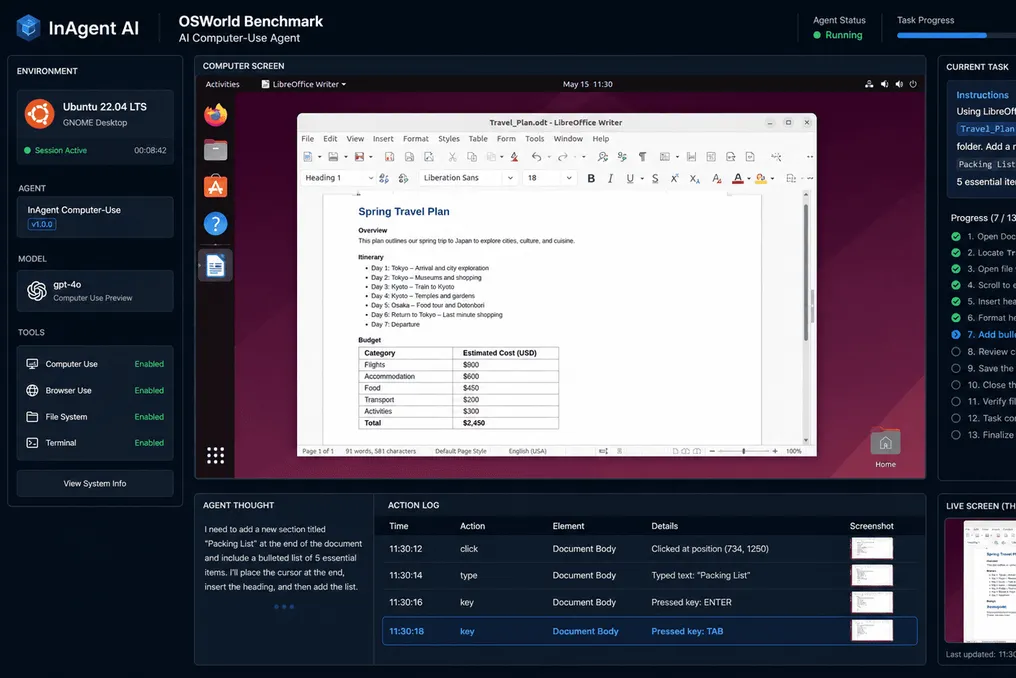
On July 27, the Chinese agent InAgent topped the global OSWorld ranking with a task success rate of 90.2%, winning titles in both general and agent categories. It surpassed the best public results achieved by Meta, Anthropic, and OpenAI. OSWorld, presented at the NeurIPS 2024 conference by the University of Hong Kong, Carnegie Mellon, and the University of Waterloo, is a recognized industry standard because it defines the threshold at which agents move from experimental use to stable industrial deployment.
The OSWorld platform tests applications in real Ubuntu virtual machines using 361 tasks covering office operations, programming, user interface development, and system administration. The evaluation is performed automatically, without human intervention. Progress dynamics showed growth from 12.2% in 2024 to 22.0% and 72.6% in 2025, when the human level was first exceeded, followed by 83.6% in May 2026, and finally 90.2% for InAgent two months later.
Result details include application collaboration with a success rate of 84.7% across 93 tasks, nearly ten points higher than second place; GIMP interface processing, where 24 out of 26 tasks were successfully completed with a 92.3% rate; and system-level operations executed with a perfect 100% result across 24 tasks, including process management, access rights, and command line.
Experts believe that the key to success lies not in the size of the model itself, but in Harness engineering. Harness acts as an AI operating system, determining how tasks are decomposed, how tools are called, and how recovery from errors occurs. There is a shift in industry understanding from Prompt Engineering to Context Engineering, and then to Harness Engineering. CITIC Securities notes that as agents move towards complex and multi-agent tasks, the costs associated with state maintenance, error propagation, and tokens increase, meaning the strength of a model in a single step no longer guarantees stable result delivery.
Harness represents an intermediate layer that transforms intelligence into stable operation, expanding the potential market from approximately $200 billion to $1.5 trillion, allowing AI to take over the management of legacy systems without needing APIs. Research from Stanford and Tsinghua demonstrates that different Harness implementations can lead to performance differences ranging from 6% to 17% when using the same model, and the percentage of successful coding tasks can increase from about 5% to over 30%.
The developer of InAgent, Intelligence Indeed, founded in 2018, is a pioneer in Harness. CEO Sun Linjun noted that pure API integration entails exorbitant maintenance costs: industrial systems like Siemens require up to 200,000 yuan per interface, and decade-old systems often lack interfaces, while e-commerce APIs are constantly changing. The agent takes no side; it uses interfaces where they exist and switches to a mode simulating human actions in systems without interfaces, observing the screen and controlling the mouse.
One manufacturing client previously spent half a year connecting a new system; now, by instructing the agent to compile production data into a report, they receive the result in just ten minutes. The company bet on the Graphical User Interface (GUI) as the core capability, based on the assumption that Artificial General Intelligence (AGI) requires a multimodal breakthrough: only by perceiving and operating in the world like a human can AI understand it. Harness transforms AI from a supported tool into an independent colleague, and the OSWorld results show that Chinese companies are leading, as AI competition shifts from simply piling up models to ensuring the stability of engineering solutions.