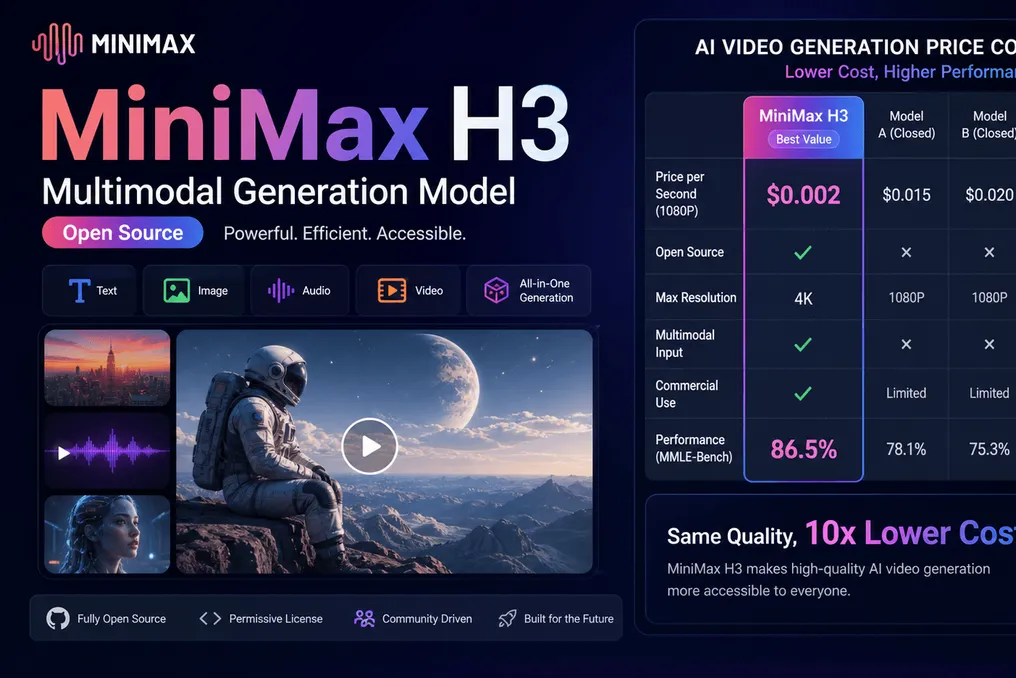
MiniMax has released the weights of the open-source H3-Base model on the HuggingFace platform. This model is a dense, single-stream Omni-Transformer with 33 billion parameters, equipped with a VAE featuring 16x spatial and 4x temporal compression. Furthermore, its usage cost via API is one-third of the price of Seedance 2.0.
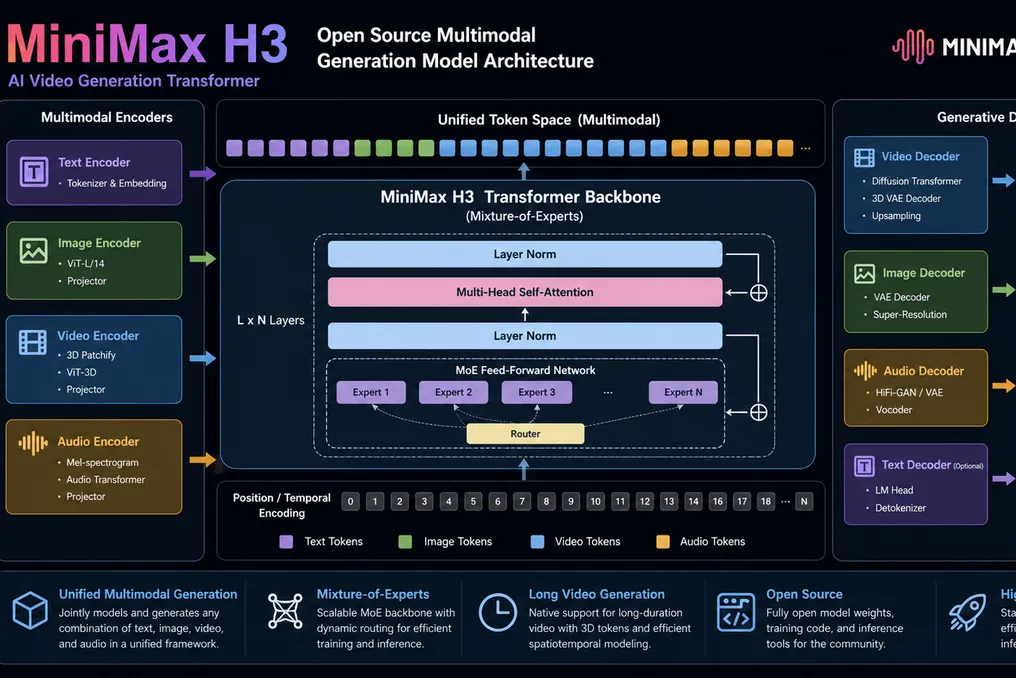
The H3 model is a universal system for generating all modalities, unlike models designed only for text-to-video or image-to-video conversion. It is capable of understanding contexts from text, images, video, and audio, and then generating video with native stereo sound. Architecturally, H3 does not consist of a sequential connection of video and audio models.
The main network, H3-Omni-Transformer, is implemented as a dense, single-stream Transformer with 33 billion parameters, with about 13 billion parameters located in the AdaLN branch, whose modulation results can be pre-calculated and saved for lighter inference. Text encoding is handled by H3-Encoder, visual data by H3-Encoder and H3-VisualVAE, and audio by H3-AudioVAE; all these elements are integrated into a single sequence that is jointly predicted for video and audio latents.
MiniMax improved H3-VisualVAE by implementing 16x spatial compression and 4x temporal compression. After additional patching, the effective spatial downsampling of video tokens entering the Transformer reaches a 32x level, which reduces computational costs during high-resolution video generation. The complete MiniMax H3 suite includes three components: H3-Context-IR, H3-Base, and H3-Regenerate-2K. H3-Context-IR interprets user-provided text, images, video, and audio, structuring complex multimodal instructions into intermediate representations suitable for generative models. H3-Base is responsible for the actual generation of video and audio with primary output at 768P resolution. The H3-Regenerate-2K component uses context regeneration to obtain a 2K version from the 768P result while preserving the original context. Currently, the H3-Base component has open weights.
The pricing policy makes H3 a significant market disruptor: 2K resolution generation costs 0.8 yuan per second, and 768P resolution is cheaper, with free audio input and up to five free images. In terms of performance, H3 demonstrates competitiveness against ByteDance's Seedance 2.0 at one-third the cost, and local deployment on two RTX 5090 cards or one RTX 6000 reduces costs to zero. With its flagship capabilities, favorable pricing, and open weights, the initiative for video creation becomes accessible to every developer.
The release of this model intensifies competition in the AI video generation market. Seedance 2.0 previously dominated due to unified joint audio and video generation, and MiniMax H3 directly challenges this position by offering comparable functionality at significantly lower costs. For content creators and developers, H3 provides flexibility unavailable on closed platforms, including the option for local deployment for data-sensitive workflows, custom fine-tuning, and integration with existing production pipelines. The open-weights strategy aligns with the global trend where Chinese AI companies use open source and aggressive pricing to counter closed ecosystems. Thus, H3 is reshaping the economics of AI video generation, challenging the assumption that advanced video models must be expensive cloud services, and potentially accelerating adoption in advertising, e-commerce, film production, and content creation, where usage was previously limited by cost sensitivity.