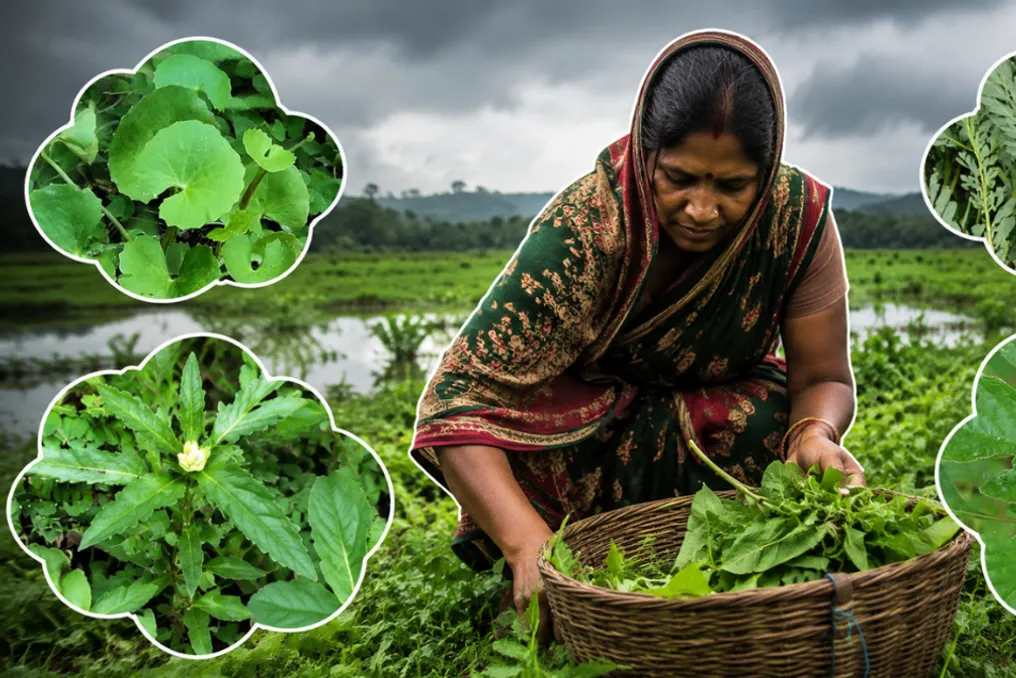
Long before kale or imported salad greens became popular, the landscapes of India offered their own seasonal superfoods—free, nutritious, and perfectly adapted to the local climate. These greens serve as a reminder that sustainable eating involves following the seasons, respecting local biodiversity, and trusting nature regarding diet.
Similar stories
Popular
These seasonal plants, known as shaak, saag, kiyerai, soppu, or bajji depending on the region, only appear after the first prolonged rains.
Why do these greens grow only during the monsoons?
Unlike cultivated spinach or cabbage, many of these plants are naturally adapted to India's rainy season. Their seeds remain dormant underground throughout the scorching summer. As soon as the rains soften the soil and increase humidity, they sprout quickly, utilizing marshy soils, forest moisture, and nutrient-rich floodplains.
Some grow in rice paddies between rice fields. Others thrive near streams, ponds, forest clearings, or rocky hillsides. Most complete their entire life cycle in just six to ten weeks before disappearing until the next year.
Odisha—a treasure trove of wild 'saag'
Few places celebrate seasonal green vegetables as vibrantly as Odisha. In the districts of Mayurbhanj, Koraput, Kandhamal, Sundargarh, and Keonjhar, tribal communities gather dozens of species of edible saag from forests, wetlands, and rice fields.
Among the most well-known are Kosala Saag, Kalama Saag, Ban Palanga, Sunsuniya (water clover), Futkal, Goda Kana, and Hada Saag. Women often go out early in the morning with bamboo baskets, carefully selecting only young shoots so the plants can naturally recover. These greens are cooked with garlic, mustard, lentils, or dried fish and have long served as an important seasonal source of iron and calcium when cultivated vegetables were scarce.
West Bengal—wetlands transform into vegetable gardens
When rivers overflow during the monsoons, the ponds, canals, and swamps of Bengal become natural vegetable gardens. Two of the most common are Kolmi Shaak (Ipomoea aquatica), which grows along shallow water bodies and flooded rice fields, and Helencha Shaak. Other seasonal favorites include TankuniSunsuni Shaak (water clover) and Hinche.
For generations, families have gathered these greens during morning walks, lightly frying them with garlic, mustard oil, or poppy seeds. Many Bengali households also consider them refreshing products during the humid rainy season.
Maharashtra—the return of Takla Bajji
In the Western Ghats, Vidarbha, and rural Maharashtra, residents eagerly await Takla Bajji (Senna tora, formerly Cassia tora). It naturally sprouts in pastures, road shoulders, open scrub forests, and uncultivated agricultural land shortly after the first heavy rains.
Its slightly bitter leaves are boiled to reduce bitterness and then cooked with fried peanuts, coconut, garlic, or besan. Another seasonal favorite is Tarota, another wild leafy vegetable growing in similar habitats. These greens were once considered 'poor man's food,' but nutritionists are increasingly recognizing their content of fiber, minerals, and antioxidants.
Karnataka—monsoon brings the season of soppu
In Karnataka, the monsoon heralds the arrival of the soppu season. Local markets suddenly fill up with leafy vegetables such as Agase Soppu, Dantu Soppu, Harive Soppu, Kiraksali, and various wild greens collected from rain-irrigated fields.
Many gather them at the edges of millet farms, home gardens, and uncultivated village lands after the rains. Traditional dishes like soppu saaru, palya, and dal-based curries combine several types of greens, creating meals naturally rich in vitamins, minerals, and fiber.
Kerala—backyard greens
Heavy rainfall in Kerala promotes the growth of edible greens almost everywhere—from coconut groves and home gardens to the banks of canals and rice fields. Families prepare seasonal varieties of Chiera, Mutili, Koditova, Tazutama, and other local wild greens.
Many are also used in Ayurvedic dietary traditions, where it is believed that monsoon season produce supports digestion and immunity in damp weather. Even today, the older generation can identify edible plants that young city dwellers often pass by without noticing.
Northeast India—forests as food baskets
In Assam, Meghalaya, Nagaland, Mizoram, and Manipur, gathering wild produce during the monsoons remains an important part of daily life. Communities collect Dhekia (edible fern-like), Maniminikhutura, bamboo shoots, and numerous local leafy vegetables from forests and jhum fields. Many of these greens are eaten raw, fermented, or cooked with smoked meat, fish, or sesame seeds.
For indigenous communities, knowledge of which wild plants are edible and when to harvest them is knowledge passed down through generations.
Small leaves, big health benefits
Scientific studies have shown that many wild leafy vegetables are exceptionally rich in iron, calcium, potassium, folic acid, vitamins A and C, antioxidants, and dietary fiber. Since they grow locally with minimal or no external resources, they also have a much smaller ecological footprint than commercially produced vegetables.
As wetlands shrink, forests fragment, and the younger generation moves away from traditional seasonal eating, this knowledge disappears as quickly as the greens themselves. Every time communities gather wild greens, they also help preserve traditional ecological knowledge. People learn where each species grows, which leaves should be picked, which roots should be left untouched, and how to ensure the plants return next year.
Heavy rains and flooding have led to widespread destruction in the state of Assam. Currently, ten districts, including Jorhat, Tinsukia, and Dibrugarh, are affected by the flood.
Scale of the Disaster
As of now, over seven hundred thousand people have been forced to leave their homes. The flooding has submerged more than twenty-five thousand hectares of agricultural land, resulting in significant crop damage.
Before weather forecasts, people relied on the sounds of frogs. Their singing intensified with the first rains and became part of India's seasonal memories. Even in the Rigveda, the chorus of frogs after the rain is compared to the chanting of priests.
Biodiversity and Behavior
To most people, a pond with frogs seems like one loud chorus, but in reality, each variety follows its own rhythm, pitch, and timing. Males emit calls to attract mates, and scientists can often identify the species just by sound.
For most of the year, the Indian brown frog has an olive or brown coloration. When the monsoon arrives, breeding males can turn bright yellow and inflate bright blue vocal sacs, demonstrating one of the most striking seasonal metamorphoses in India.
Unique Species and Habitat
The purple frog spends most of its adult life hidden underground in the Western Ghats. It only emerges briefly during the monsoon for breeding, making every appearance exceptional. Scientists officially described an adult specimen of this species only in 2003.
Even a common puddle by the roadside after the rain can become a breeding ground for frogs. Rice fields, forest ponds, and temporary ditches fill up with eggs and tadpoles, providing the new generation enough time to grow.
Role in the Food Chain and Ecology
Frogs feed on insects and other invertebrates around farms and rice fields, including many agricultural pests. Thus, they contribute to natural pest control.
Despite their small size, the importance of the frog in the food web is immense. Frogs and tadpoles serve as food for fish, snakes, birds, and other predators, while tadpoles graze and process nutrients in the water, helping monsoon wetlands support much more life.
The porous skin of the frog allows it to absorb water and exchange gases, making it very sensitive. When frogs begin to disappear, they can serve as an early warning sign that a wetland or forest is under threat.
With the arrival of the Sawan season and the gathering of rain clouds, an ancient tradition comes alive. This refers to Kajari—folk music that celebrates the monsoon, love, longing, and life in North India.
Origin and Significance of Kajari
Kajari is a centuries-old folklore tradition originating in the eastern state of Uttar Pradesh and western Bihar. This music is performed during the monsoons and reflects a deep connection between people, seasons, and agricultural activities.
The name itself derives from the word kajra (pencil), which symbolizes the dark, rain-filled monsoon clouds. Some also associate this tradition with the goddess Kajali Devi, who is revered in Vindhyachal near Mirzapur.
Performance Setting and Song Themes
Kajari was never created for concert halls. Women sang these songs while sowing crops, working in the fields, or gathering in courtyards as the rain nourished the surrounding land.
Although the monsoon brings fresh hope, Kajari often touches upon the theme of viraha—the pain of separation. Many compositions tell stories of women waiting for the return of husbands who have gone to distant cities to earn a living.
Symbolism and Heritage
Within Kajari, birds such as the pipit, peacock, and crow are not just part of the landscape; they act as messengers, conveying sincere words of lovers over long distances.
For generations, Kajari has resonated in villages every Sawan season. These orally transmitted songs preserve local dialects, traditions, and stories of daily life. Even today, Kajari reminds us that rain is more than just weather; it brings memories, hope, harvest, and stories that continue to unite communities across generations.