Researchers have discovered a new species of parasitic wasp in the Rajarhat wetlands of Kolkata, West Bengal, India. This tiny insect, named Tetrastichus narayandebnathi, is a specialized predator that develops inside the pupae of turtle beetles.
Researchers have discovered a new species of parasitic wasp in the Rajarhat wetlands of Kolkata, West Bengal, India. This tiny insect, named Tetrastichus narayandebnathi, is a specialized predator that develops inside the pupae of turtle beetles.
This discovery is the third in history where a wasp of the genus Tetrastichus has been found associated with this specific group of beetles worldwide, and the second such report from India. The discovery was made by researchers from Kalyani University, iForNature - Nature Club, West Bengal, and Cairo University in Egypt.
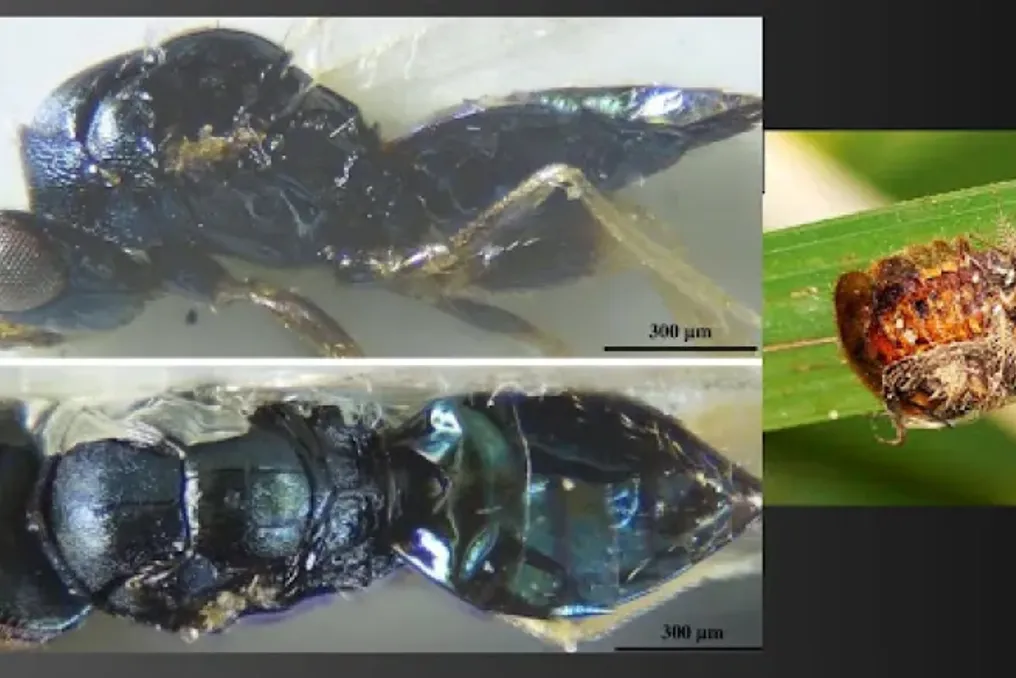
The team stumbled upon the wasp accidentally while surveying local vegetation in the Rajarhat wetlands. They noticed a turtle beetle pupa on a blade of grass that looked unusually dark—yellow-orange compared to healthy pupae in the area. Suspecting parasitic infection, the scientists collected a sample at the iForNature—Nature Club research laboratory in Kolkata.
After being kept in controlled conditions, eight tiny wasps emerged from one beetle pupa: five females and three males. This confirmed that it is a gregarious primary parasite, meaning several wasps develop inside and eventually kill one host.
The new wasp measures only 1.4 to 1.7 millimeters long, is predominantly black, with a distinct metallic blue-green sheen. Although it superficially resembles its closest known relative, T. tunicus, researchers identified several key differences through microscopic analysis. The new species is slightly larger, has darker legs, and possesses a longer hypopygium—a structure on the underside of the abdomen.
To confirm its status as a new species, the team used the Wing Interference Pattern (WIP) visualization method, which captures unique iridescent light patterns reflected from the wasp's transparent wings, creating a digital fingerprint of the species.
The researchers named it Tetrastichus narayandebnathi in honor of the late Shri Narayana Debnath, a legendary Bengali caricaturist and illustrator who received the Padma Shri—India's fourth highest civilian award. Debnath is beloved in West Bengal for creating iconic comic characters, and the scientists wished to link this biological finding to the region's rich artistic heritage.
The discovery of this wasp provides vital information for future agriculture and pest control. Since Tetrastichus wasps are highly specialized on their attacked hosts, they are often used as agents of biological control to manage populations of crop-damaging beetles. Scientists believe that by studying the diversity of these parasitoids, they can develop more natural methods of plant protection without using chemical pesticides.
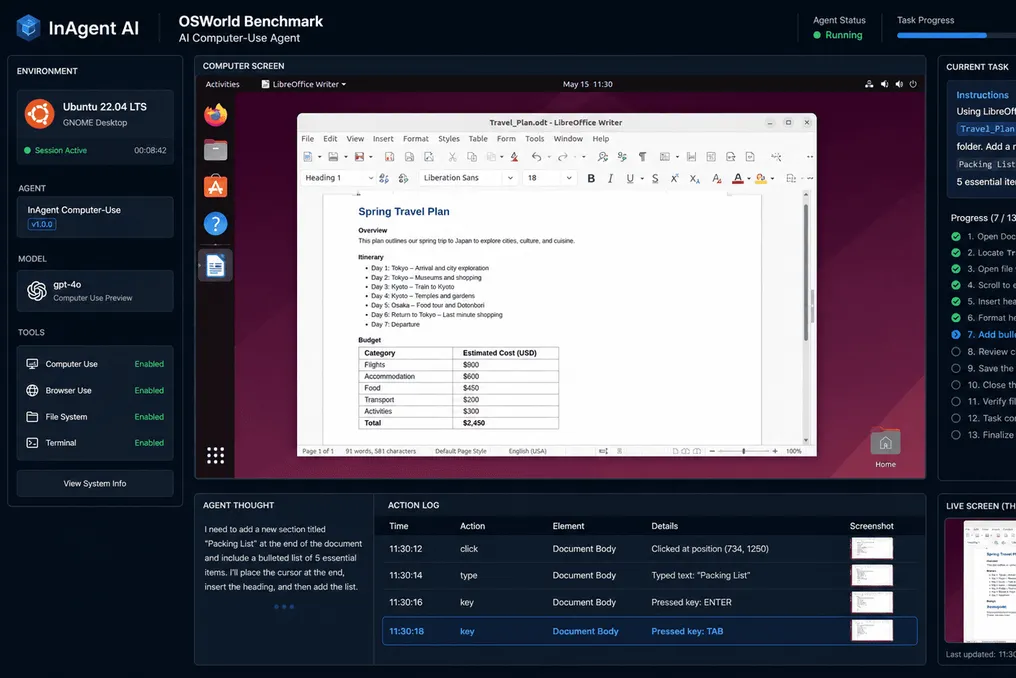
The Chinese agent InAgent achieved a task success rate of 90.2% on the OSWorld platform, becoming the first computer-operating agent to exceed the 90% threshold. Furthermore, it demonstrated 100% success in executing system-level tasks. This marks a transition to a new arena of competition in artificial intelligence—Harness engineering.
On July 27, the Chinese agent InAgent topped the global OSWorld ranking with a task success rate of 90.2%, winning titles in both general and agent categories. It surpassed the best public results achieved by Meta, Anthropic, and OpenAI. OSWorld, presented at the NeurIPS 2024 conference by the University of Hong Kong, Carnegie Mellon, and the University of Waterloo, is a recognized industry standard because it defines the threshold at which agents move from experimental use to stable industrial deployment.
The OSWorld platform tests applications in real Ubuntu virtual machines using 361 tasks covering office operations, programming, user interface development, and system administration. The evaluation is performed automatically, without human intervention. Progress dynamics showed growth from 12.2% in 2024 to 22.0% and 72.6% in 2025, when the human level was first exceeded, followed by 83.6% in May 2026, and finally 90.2% for InAgent two months later.
Result details include application collaboration with a success rate of 84.7% across 93 tasks, nearly ten points higher than second place; GIMP interface processing, where 24 out of 26 tasks were successfully completed with a 92.3% rate; and system-level operations executed with a perfect 100% result across 24 tasks, including process management, access rights, and command line.
Experts believe that the key to success lies not in the size of the model itself, but in Harness engineering. Harness acts as an AI operating system, determining how tasks are decomposed, how tools are called, and how recovery from errors occurs. There is a shift in industry understanding from Prompt Engineering to Context Engineering, and then to Harness Engineering. CITIC Securities notes that as agents move towards complex and multi-agent tasks, the costs associated with state maintenance, error propagation, and tokens increase, meaning the strength of a model in a single step no longer guarantees stable result delivery.
Harness represents an intermediate layer that transforms intelligence into stable operation, expanding the potential market from approximately $200 billion to $1.5 trillion, allowing AI to take over the management of legacy systems without needing APIs. Research from Stanford and Tsinghua demonstrates that different Harness implementations can lead to performance differences ranging from 6% to 17% when using the same model, and the percentage of successful coding tasks can increase from about 5% to over 30%.
The developer of InAgent, Intelligence Indeed, founded in 2018, is a pioneer in Harness. CEO Sun Linjun noted that pure API integration entails exorbitant maintenance costs: industrial systems like Siemens require up to 200,000 yuan per interface, and decade-old systems often lack interfaces, while e-commerce APIs are constantly changing. The agent takes no side; it uses interfaces where they exist and switches to a mode simulating human actions in systems without interfaces, observing the screen and controlling the mouse.
One manufacturing client previously spent half a year connecting a new system; now, by instructing the agent to compile production data into a report, they receive the result in just ten minutes. The company bet on the Graphical User Interface (GUI) as the core capability, based on the assumption that Artificial General Intelligence (AGI) requires a multimodal breakthrough: only by perceiving and operating in the world like a human can AI understand it. Harness transforms AI from a supported tool into an independent colleague, and the OSWorld results show that Chinese companies are leading, as AI competition shifts from simply piling up models to ensuring the stability of engineering solutions.
MiniMax has released the weights of the open-source H3-Base model on the HuggingFace platform. This model is a dense, single-stream Omni-Transformer with 33 billion parameters, equipped with a VAE featuring 16x spatial and 4x temporal compression. Furthermore, its usage cost via API is one-third of the price of Seedance 2.0.
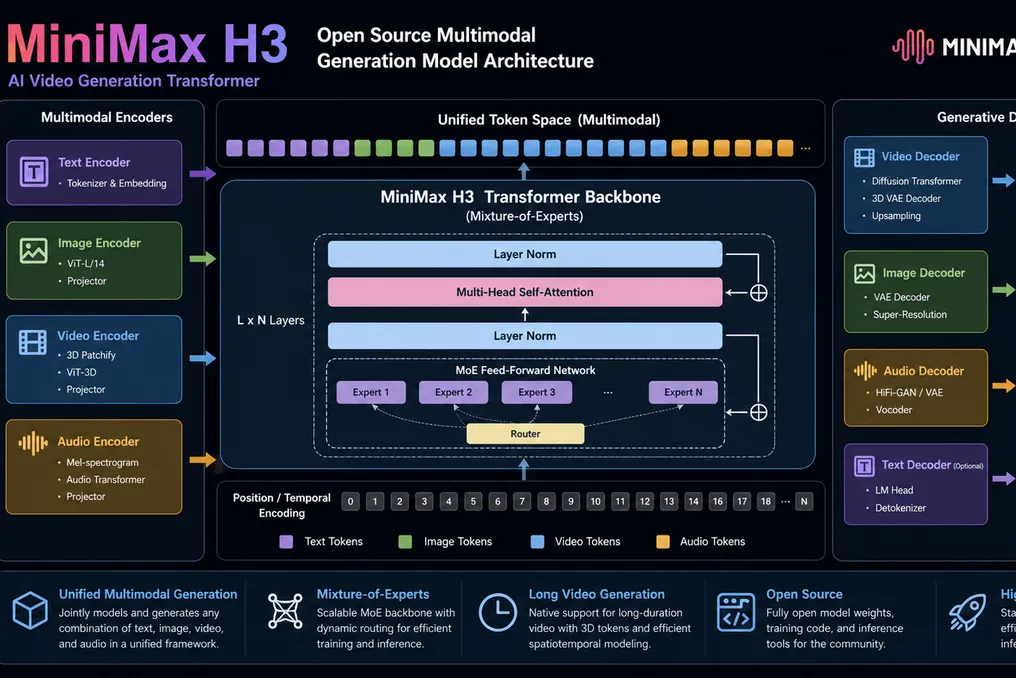
The H3 model is a universal system for generating all modalities, unlike models designed only for text-to-video or image-to-video conversion. It is capable of understanding contexts from text, images, video, and audio, and then generating video with native stereo sound. Architecturally, H3 does not consist of a sequential connection of video and audio models.
The main network, H3-Omni-Transformer, is implemented as a dense, single-stream Transformer with 33 billion parameters, with about 13 billion parameters located in the AdaLN branch, whose modulation results can be pre-calculated and saved for lighter inference. Text encoding is handled by H3-Encoder, visual data by H3-Encoder and H3-VisualVAE, and audio by H3-AudioVAE; all these elements are integrated into a single sequence that is jointly predicted for video and audio latents.
MiniMax improved H3-VisualVAE by implementing 16x spatial compression and 4x temporal compression. After additional patching, the effective spatial downsampling of video tokens entering the Transformer reaches a 32x level, which reduces computational costs during high-resolution video generation. The complete MiniMax H3 suite includes three components: H3-Context-IR, H3-Base, and H3-Regenerate-2K. H3-Context-IR interprets user-provided text, images, video, and audio, structuring complex multimodal instructions into intermediate representations suitable for generative models. H3-Base is responsible for the actual generation of video and audio with primary output at 768P resolution. The H3-Regenerate-2K component uses context regeneration to obtain a 2K version from the 768P result while preserving the original context. Currently, the H3-Base component has open weights.
The pricing policy makes H3 a significant market disruptor: 2K resolution generation costs 0.8 yuan per second, and 768P resolution is cheaper, with free audio input and up to five free images. In terms of performance, H3 demonstrates competitiveness against ByteDance's Seedance 2.0 at one-third the cost, and local deployment on two RTX 5090 cards or one RTX 6000 reduces costs to zero. With its flagship capabilities, favorable pricing, and open weights, the initiative for video creation becomes accessible to every developer.
The release of this model intensifies competition in the AI video generation market. Seedance 2.0 previously dominated due to unified joint audio and video generation, and MiniMax H3 directly challenges this position by offering comparable functionality at significantly lower costs. For content creators and developers, H3 provides flexibility unavailable on closed platforms, including the option for local deployment for data-sensitive workflows, custom fine-tuning, and integration with existing production pipelines. The open-weights strategy aligns with the global trend where Chinese AI companies use open source and aggressive pricing to counter closed ecosystems. Thus, H3 is reshaping the economics of AI video generation, challenging the assumption that advanced video models must be expensive cloud services, and potentially accelerating adoption in advertising, e-commerce, film production, and content creation, where usage was previously limited by cost sensitivity.
In the city of Kogon, Bukhara region, OOO 'Optima Plast' operates, specializing in the production of plastic tableware. The products manufactured at the enterprise are supplied both to the domestic market and exported to neighboring countries.
Thanks to production facilities equipped with modern technologies, it is possible to manufacture high-quality and competitive products. The total investment in the company amounts to 1.5 million US dollars. A land plot of 0.9 hectares was allocated for the project's implementation.
The annual production potential of the enterprise is estimated at 57 billion soums of products, while annual tax revenues to the state budget amount to almost 1.5 billion soums. Currently, 25 local residents are employed full-time at the plant.
The company's activities contribute to increasing employment in the region, strengthening industrial potential, and supporting economic development.