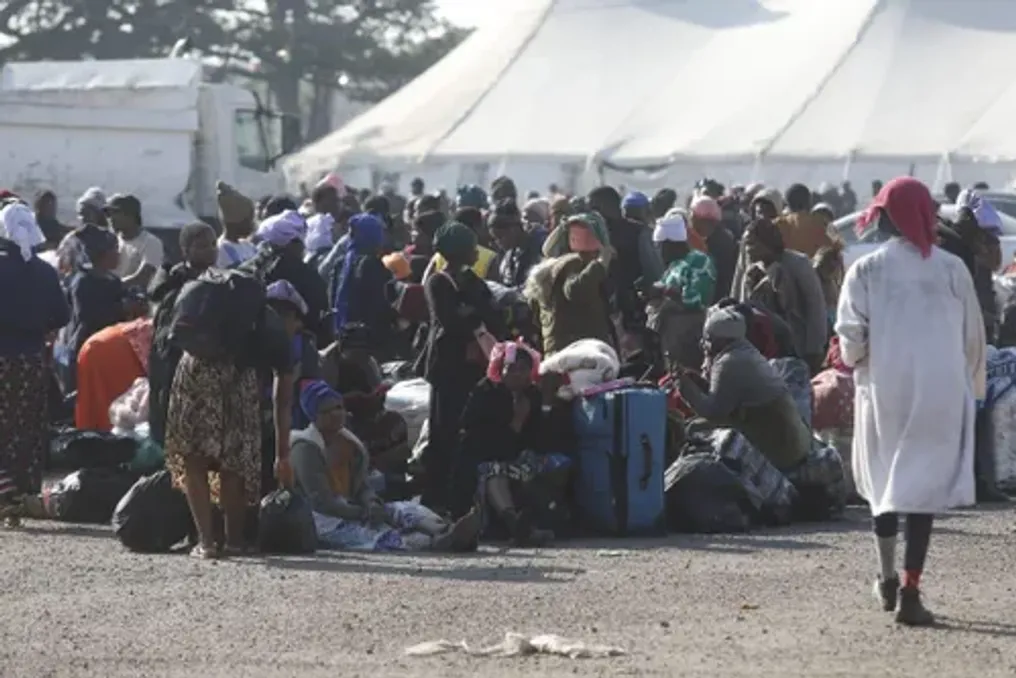
Several hundred Malawian citizens resided in a temporary repatriation center on Derban Drive Inn, which was closed by the eThekwini municipality and relocated to a new center in Musina, Limpopo province. The article examines whether this move signifies a shift towards managing undocumented migrants and asylum seekers in South Africa through a camp system.
South Africa began processing applications from undocumented migrants at the temporary repatriation center in Musina, Limpopo province, in a border town with Zimbabwe, in July 2026. This followed several weeks of increased xenophobic rhetoric and violence against migrants.
This facility has raised questions about the country potentially moving towards a more camp-based method of managing migrants and refugees, which would be a significant departure from South Africa's post-apartheid refugee policy.
Previously, South Africa generally allowed refugees and asylum seekers to live, work, and study in urban centers instead of confining them to designated refugee camps.
By 2025, the country hosted over 160,000 refugees and asylum seekers from places such as Zimbabwe, Malawi, the Democratic Republic of Congo, and Burundi.
Legal Basis and Definition of a Refugee
Legally, all refugees are migrants, but not all migrants have refugee status. A refugee is a person who has crossed an international border seeking protection due to a well-founded fear of persecution based on race, religion, nationality, political opinion, or membership in a particular social group.
International law provides protection for people in such circumstances, notably through the 1951 Refugee Convention and its 1967 Protocol. In Africa, the 1969 Organization of African Unity Convention expanded the definition of a refugee to include those fleeing external aggression, occupation, or events seriously disturbing public order.
However, these conventions are historical documents drafted primarily during the colonial or early post-colonial period, leading to several gaps. Critics note that they do not adequately account for modern forms of displacement, such as those caused by climate change.
In reality, the definition of who is a migrant or a refugee is often blurred. Like all international legal documents, refugee conventions should be viewed as 'living instruments,' allowing for reinterpretation as circumstances change.
How Does South Africa's Refugee System Function?
In 2025, there were over 167,000 refugees and asylum seekers in South Africa, most of whom lived in urban communities. An asylum seeker is a person whose application for refugee status has not yet been legally processed or decided.
Asylum seekers are required to renew temporary permits under Section 22, usually every six months, at refugee reception offices. This places a significant burden on them.
Many asylum seeker applications are rejected at the initial stage, and the appeal process is lengthy. A 2019 audit showed that resolving the accumulated backlog of appeals would have taken 68 years. In 2026, funding for the South African Refugee Appeals Authority was cut, reducing its panel of judges from 36 to just nine.
Now, asylum seekers wait five to ten years or longer for a decision. During this time, they face restrictions on work, study, movement, and access to humanitarian aid.
The legal framework concerning refugees and asylum seekers is also evolving. In May 2026, the Constitutional Court ruled that asylum seekers whose applications, including appeals, were rejected do not necessarily have the right to reapply as refugees. The Department of Home Affairs noted this as a victory.
Two months later, the same court ruled that procedural irregularities, such as failing to obtain a Section 22 permit within five days of entering the country, are not sufficient grounds for disqualifying a person from receiving refugee status. On this occasion, the human rights organization Scalabrini celebrated this.
It is this complex process for asylum seekers, the changing and convoluted legal system, and the need for humanitarian assistance for some asylum seekers that raise the question: might a camp become the better way forward while they wait?
In other words, can camps offer a solution for protection? Or will they diminish the rights of refugees and asylum seekers in a country once considered exemplary?
What Do Testimonies Say About Refugee Camps and Protection?
Refugee camps are humanitarian and political spaces created to provide refugees with settlement, protection, and assistance, especially after mass movements into host countries. Host governments decide whether to create camps and how they function, but they often collaborate closely with humanitarian agencies. The UN Refugee Agency (UNHCR) plays a central role here, given its global mandate for protecting refugees and their rights.
In practice, governments often cooperate with UNHCR to manage camps and coordinate NGOs providing services such as housing, food, water, and medical care.
Although camps are intended as temporary spaces of protection, many exist for years or even decades. They remain designed as temporary structures even when they transform into long-term infrastructure.
And despite the emphasis on protection, camps are not safe havens. Scholars describe them as spaces of order and control, a form of 'human warehousing' and a 'place of non-existence.' Political actors manage them, controlling the daily lives of refugees. UNHCR relies on host states for access and on donor states for funding to provide protection.
The legal basis for creating camps is also debated. The 1951 Refugee Convention does not require refugees to be housed in camps. Establishing camps is a political choice, not a legal obligation. Nevertheless, camps have become the standard humanitarian response and often severely restrict refugees' freedom of movement.
What Are the Problems with Refugee Camps?
Various difficulties arise for people living in camps after their establishment. Harsh living conditions and human rights violations are well-documented. These include gender and sexual violence, daily denial of rights, limited legal support, economic marginalization, restricted political participation, and general structural 'containment.'
Consequently, living conditions are generally severe. Camps are mainly intentionally located in remote areas, physically, socially, and economically isolating residents from surrounding host communities. As a result, livelihoods suffer. Decisions regarding housing and daily life are made by aid agencies and state structures.
Does the Musina temporary center signal a change in South Africa's refugee camp policy?
The Musina center is not a UNHCR-managed refugee center. There is also no indication that it will become one. The revised white paper on citizenship, immigration, and refugee protection, approved by the cabinet in 2026, contains no plans for establishing refugee camps.
Nevertheless, several issues require attention. Firstly, UNHCR faces a massive reduction in funding, consistent with the overall decline in humanitarian aid. The organization aims to reduce, not build new camps. As of June 30, 2026, only 18% of its annual budget is funded for a multi-country operation covering South Africa, Botswana, and Namibia.
Secondly, establishing camps in poor conditions can always cause tension with host communities, which also require humanitarian aid. In a situation where xenophobic violence is partially fueled by tensions between refugees and host communities, this is far from ideal.
Thirdly, the current trend is away from the camp approach, as seen, for example, in Kenya. Allowing the free market and self-settlement to solve refugee problems can be extremely problematic. But it is in this space that South Africa is likely to find a sustainable path forward—a path that remains true to its obligations of protection while allowing refugees to contribute to and benefit from the communities in which they live.