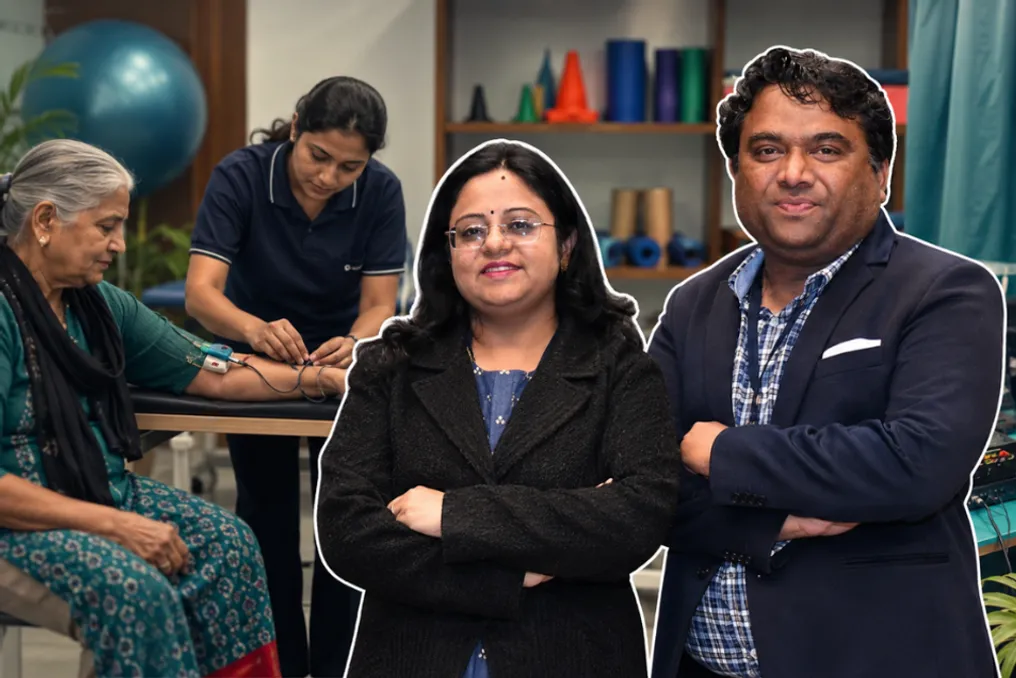
Patients often discontinue physiotherapy halfway through, which prompted two doctors from Bhopal to create artificial intelligence-based devices that allow treatment at home.
During a video call, a physiotherapist observes a family member helping the patient perform an exercise. A small device connected to a tablet emits a quiet hum. Located hundreds of kilometers away from the patient, the therapist adjusts treatment parameters in real time.
What appears to be a simple virtual consultation is actually something much larger: a rehabilitation session conducted at home without the need for a live physiotherapist visit to a clinic, thanks to connected devices and remote monitoring that ensures clinic-level quality of physiotherapy.
For millions of Indians recovering from paralysis, neurological disorders, injuries, and surgeries, physiotherapy is not a one-time treatment. It often requires months, or even years, of continuous care.
However, for many families, especially in small towns and rural areas, regular visits to a physiotherapy clinic are simply impossible. This gap inspired the medical technology startup Remote Physios, founded by physiotherapists Dr. Anant Singh Gaur and Dr. Anubha Singhai, to create an AI and Internet of Things-based rehabilitation platform that brings professional physiotherapy beyond the walls of the clinic.
A Child Who Raised a More Serious Question
For Anant Singh Gaur and Dr. Anubha Singhai, Remote Physios did not originate in a boardroom. It emerged after nearly two decades of working closely with patients and observing the same challenge repeatedly.
This couple, who met during their physiotherapy studies and have been together since university, completed postgraduate physiotherapy training in 2008 and built successful clinical careers. Anant specialized in neurology, while Anubha focused on clinical practice and patient care.
Over many years, they treated hundreds of patients recovering from paralysis, neurological diseases, injuries, and chronic pain. Nevertheless, despite all their efforts, one thing worried them. 'We always noticed this gap,' says Anubha. 'Patients couldn't complete the necessary number of sessions for better recovery.'
The problem was not a lack of motivation. For many families, daily trips to clinics were expensive, time-consuming, and often impossible. As the acute pain subsided, physiotherapy slowly fell out of priority, leaving recovery incomplete.
The couple tried various approaches—opening clinics, experimenting with home care models, and conducting teleconsultations. But every solution faced the same hurdle: how could patients continue to receive quality physiotherapy without traveling every day?
This question haunted them for years before ultimately becoming the foundation of Remote Physios. One story that stuck with Anant involved a four-and-a-half-year-old boy from Nasrullaganj, about 100 kilometers from Bhopal. The child developed Guillain-Barré Syndrome (GBS)—a rare autoimmune disease that paralyzed both his arms and legs. His family were farmers, and daily trips to Bhopal for rehabilitation were almost impossible.
'We started training family members and helping this patient via video link,' recalls Anant. For a year, the family underwent guided remote physiotherapy sessions. Today, the child goes to school and leads a much more independent life. This case reinforced what Anant and Anubha had observed repeatedly over 17 years as physiotherapists: patients rarely stop treatment because it is unnecessary. They stop because continuing becomes too difficult.
Why Physiotherapy Often Stops Halfway
The physiotherapy system in India is largely centered around clinics and home visits. While this works well in the initial stages of recovery, long-term rehabilitation remains a challenge. Patients recovering from paralysis, spinal cord injuries, neurological diseases, arthritis, or post-operative complications often require controlled exercises for several months. However, travel costs, time constraints, caregiving duties, and geographical barriers often interrupt treatment.
'As long as symptoms like pain are present, patients prioritize treatment,' says Anubha. 'But once symptoms lessen, many cannot continue the sessions needed for full recovery.'
The problem is particularly acute in second and third-tier cities and in rural India, where access to qualified physiotherapists remains limited. Over the years, the founders experimented with various models, including clinics, home care services, and teleconsultations. But one problem remained unsolved: how to deliver actual physiotherapy equipment remotely?
This question eventually led to the birth of Remote Physios. The idea was officially conceptualized in 2023. By then, the founders had already helped nearly 1000 patients through telephysiotherapy consultations. Although video calls helped, they constantly encountered a limitation. 'When devices were required, we were at a dead end,' says Anant. 'If someone needed muscle stimulation or pain modulation, we still had to bring them into a clinic.'
The solution was recreating a physiotherapy clinic at home, allowing patients to continue rehabilitation without the need for a physical presence of a physiotherapist at every session. Remote Physios developed a set of IoT-enabled devices that physiotherapists can control remotely while tracking patients through video consultations. Their ecosystem includes: AxonEase for neural stimulation and pain management, MyoElevate for muscle stimulation and strengthening, TissueWave for therapeutic ultrasound, Pelvistrength for pelvic floor and core rehabilitation, and PhysioEMG for muscle activity assessment and biofeedback.
'These are the same devices used in physiotherapy clinics,' explains Anant. 'The difference is that the physiotherapist, sitting hundreds of kilometers away, can control them.'
The startup also uses AI-powered clinical decision support tools that help physiotherapists develop more personalized treatment plans, reducing the likelihood of human error. On the patient side, exercises are transformed into interactive augmented reality games. Instead of performing monotonous movements repeatedly, patients participate in activities that resemble play more. 'We are preparing over 150 rehabilitation games to make exercises interesting and measurable,' says Anant.
Building Technology as Healthcare Professionals
Creating complex medical technology was not an easy task for two clinicians. 'We are real medics,' laughs Anant. 'Technology was one of our biggest challenges.'
Initially, the team experimented with commercially available physiotherapy devices equipped with simple control mechanisms. Early prototypes were outsourced while the founders focused on validating the model. A turning point was winning the Himalayan Startup Trek at the end of 2024, followed by the NIDHI PRAYAS grant in 2025. This support allowed them to create advanced prototypes, expand the team, and develop in-house engineering capabilities.
Today, Remote Physios employs a team of about 20 people, including physiotherapists, IoT engineers, AI specialists, and software developers. Patient feedback played a crucial role in shaping the platform. 'The software had to be rebuilt four or five times,' says Anant. 'Every time we saw users facing difficulties or too many clicks, we redesigned it.'
Safety features, such as emergency stop buttons, were added based on care feedback, and interfaces were simplified so that elderly patients and non-technical users could comfortably use the system.
When Healing Finds Its Way Home
For Anant and Anubha, some of the most significant lessons came not from laboratories or prototypes, but from living rooms, village homes, and conversations with patients trying to balance recovery with daily life. One such patient was a corporate worker suffering from elbow tendinitis. Every time he called, he promised to visit the clinic the following week. Work deadlines, long commutes, and daily responsibilities always got in the way.
The pain persisted for months. 'It sounds like a small problem,' says Anant, 'but if left untreated for a long time, it can become chronic and much harder to manage.'
Instead of asking him to change his life for treatment, the team sent him a therapeutic ultrasound device home and scheduled short sessions before the start of his workday. For the patient, the difference was not just in the treatment itself, but in the fact that recovery finally became practical.
Anubha recalls another elderly woman whose children lived in the United States. Like many seniors, she required continuous physiotherapy, but she struggled to maintain regular sessions. 'Slowly she could see her own progress,' says Anubha. 'This continuity was huge.'
Such stories reinforced a simple truth for the founders: recovery often fails not because the treatment is ineffective. It fails because life interferes. Work schedules, distance, finances, caregiving duties, and daily commitments make it difficult for people to attend sessions regularly. They realized the problem wasn't just providing physiotherapy—it was helping people stay connected to it.
Building Through Doubt, Debt, and Determination
The journey from idea to realization was far from easy. In the early days, the founders financed most of the development themselves, testing concepts with patients and refining prototypes long before external support arrived.
At one point, the pressure became significant. 'In November 2025, we had personal loans of almost 45 lakh rupees,' recalls Anant. 'There were moments when everything seemed uncertain, but we believed the problem was worth solving.'
The couple relentlessly pitched their ideas, presenting them in over a hundred forums, incubators, and startup programs. Their persistence gradually began to pay off. Remote Physios won the Himalayan Startup Trek, received the NIDHI PRAYAS grant, and gained support from organizations such as IIT Mandi Catalyst, T-Hub, IIT Indore, MeitY Genesis, and Aditya Birla Foundation.
Today, the startup works with over 250 patients, has filed numerous patents and trademarks, and has created a growing ecosystem of physiotherapists, engineers, and tech experts. However, for the founders, these milestones are less important than what they represent. 'Funding and recognition are important,' says Anant. 'But the most important thing is that they allow us to keep building and reaching more people who need rehabilitation support.'
Ultimately, the goal was never just to create another medical startup. It was to ensure that a patient's recovery journey would not end prematurely because the help was too far away.
Why Rehabilitation Cannot Be a Secondary Concern
For Anant and Anubha, Remote Physios is not just a technology company. It is an attempt to solve one of healthcare's most overlooked problems: continuity of care. 'We want to enter the public health sphere,' says Anant. 'That is why we deliberately kept the cost of the devices affordable.'
Each device costs about 15,000 rupees, which is significantly lower than the cost of many specialized rehabilitation technologies. In comparison, one home physiotherapy session in India can cost between 700 and 2000 rupees, depending on the city and the condition being treated. Since rehabilitation often requires dozens of sessions over several months, the cumulative cost can reach tens of thousands of rupees, making a single investment in a device potentially a more accessible option for long-term continuity of care.