At the Politburo meeting in April, investment of over 7 trillion yuan was launched for six networks. The first commercial orders in the commercial space sector are expected to be for ground equipment, including remote sensing systems, satellite communication, and BeiDou synchronization equipment.
At the Politburo meeting on April 28, a decision was made to strengthen water networks, create new energy systems, computing networks, next-generation communication networks, underground urban pipeline networks, and logistics networks. According to the NDRC, the total investment in these six networks, as well as in low-altitude and other key areas, will exceed 7 trillion yuan this year.
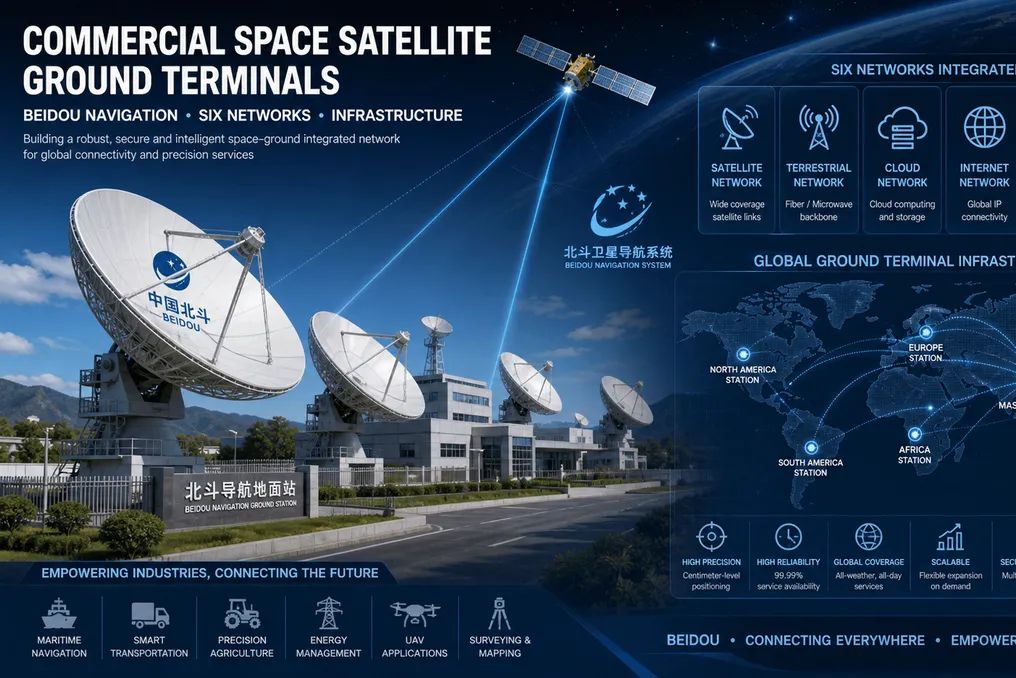
In the field of commercial space, initial orders will concern ground components: satellite communication terminals, BeiDou chip modules, synchronization equipment, remote sensing products, and emergency communication systems. These elements are closer to the procurement and adoption stage than new satellite constellations, satellite manufacturing, or rocket launches.
The six networks are designed to solve four problems: invisibility of remote areas for ground observation, coverage gaps, position and time misalignment, and lack of backup routes in case of ground network failure. Remote sensing allows for the detection of changes, satellite communication complements ground networks, and BeiDou provides positioning and timing.
On July 31, the China Satellite Navigation Authority announced the completion of a full-scale orbital update of BeiDou, which corresponds to the construction of the six networks. The focus of the BeiDou industry has shifted to ground applications, and the NDRC aims to achieve an industry scale exceeding 1 trillion yuan within five years. In 2025, BeiDou terminal sales exceeded 410 million units, with nearly 2.6 billion chips and modules shipped.
Although satellites entering orbit create network nodes, ground vehicles, ships, drones, sensors, and personnel require connection equipment. The Ministry of Industry and Information Technology (MIIT), as part of positioning next-generation networks, now takes into account machines, objects, and vehicles in the air, space, on land, and at sea. Communication modules, phased array antenna terminals, equipment for transport and ships, portable terminals, BeiDou chips, synchronization equipment, gateway stations, and protocol software are closer to real projects.
While one satellite covers a vast area, every vehicle, ship, and station may require its own terminal. When evaluating a satellite internet company, it is necessary to analyze not only constellation plans but also terminal development, operator accessibility, industry testing, production stability, and price acceptability.
Water and energy networks will be the first to acquire 'eyes in the sky'. The Ministry of Water Resources released the Main Plan for the Application of Satellite Water Remote Sensing for 2026–2035, which aims to obtain quarterly sub-meter resolution images of key areas and monitor in real-time for major water emergencies by 2030. The new energy system plans to invest over 5 trillion yuan under Plan-5, where corridors passing through mountains, deserts, and seas will require remote sensing, BeiDou, and satellite communication.
Companies that can integrate data into existing water and energy platforms, transforming satellite capabilities into warnings and instructions for task execution, will be successful. In logistics, BeiDou and satellite communication will be used to track cargo, cold chain anomalies, and equipment failures. In the long term, within the six networks, only those companies that understand industry processes, not just the satellites themselves, will remain.